Film Friday: Fast Company
May 29, 2026
Peter HughesDavid Cronenberg's campy but earnest drag racing flick is one of the best racing movies you've never seen.
David Cronenberg infamously made a car movie, Crash (1996), based on the 1973 J. G. Ballard novel of the same name, about people who get off on car accidents. Like, sexually. I say infamously because Crash got booed at Cannes, the Daily Mail tried to get it banned in the U.K., and Ted Turner refused to distribute it to theaters in the U.S. Too spicy!
Turns out Cronenberg is actually a car guy. A real one. He was a vintage racer in the ’80s and ’90s. Owned 1959 Type 51 and 1961 T55 Cooper-Climax Formula 1 cars, a 1963 Cooper Monaco sports racer, a Ferrari Dino 206 GT, and, if the forums are to be believed, at least one other front-engined ’50s Ferrari of indeterminate specification.
He even wrote a screenplay, Red Cars, about the 1961 F1 championship battle between Phil Hill and Wolfgang von Trips, which might be the best car movie never made. (It opens with a dream sequence in which Enzo Ferrari falls, hits his head, and “starts shrinking up, smaller and smaller, until he’s only two feet long,” at which point Hill—whose dream this is—scoops him up like an infant and goes running for help. Exactly what has been missing from every glossy Hollywood racing movie of the last twenty years: Cronenbergian body horror!)
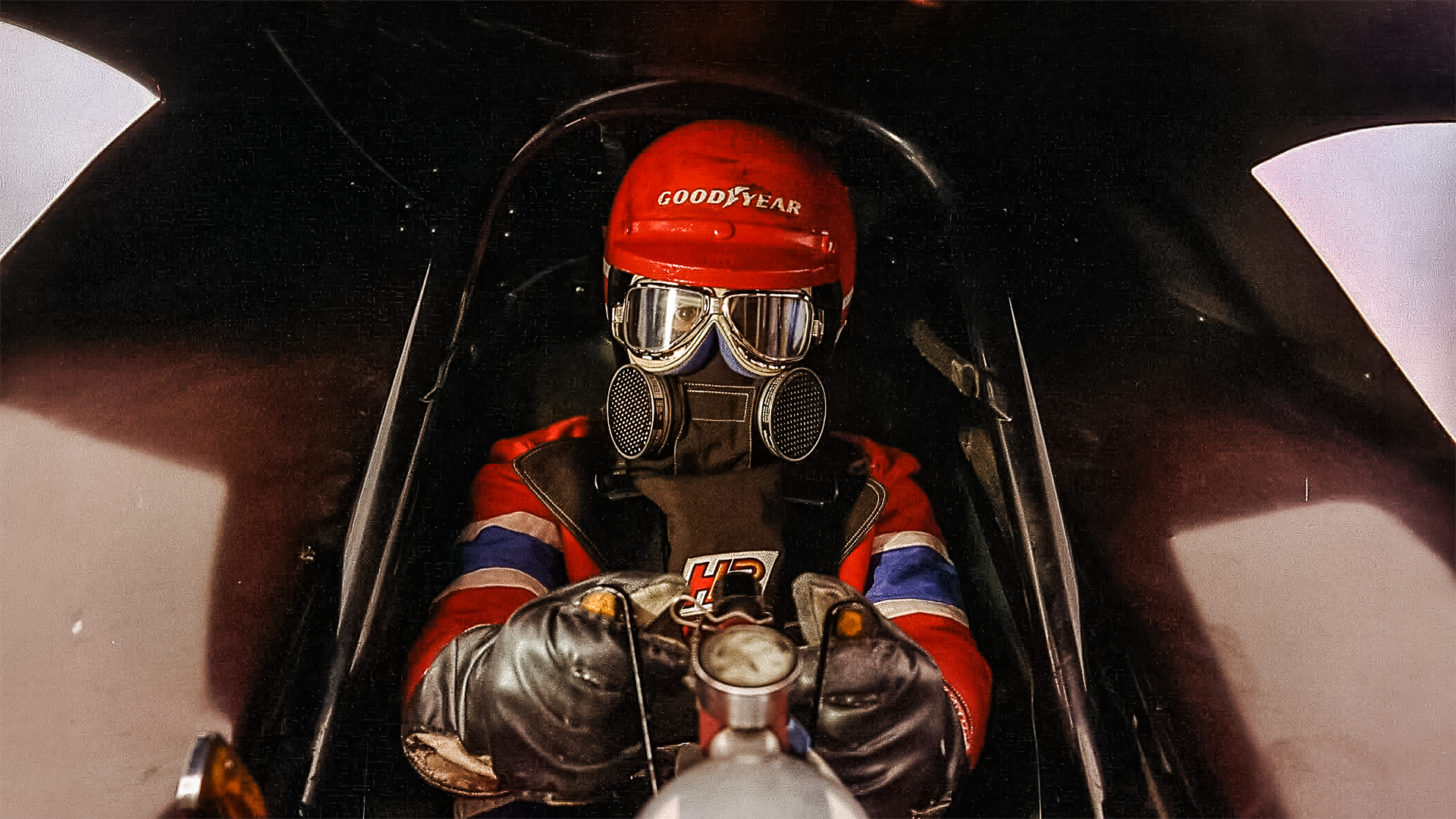
But there was yet another racing movie that Cronenberg did make, and that’s the one we’re here to talk about. Fast Company (1979) is something of an outlier in the director’s oeuvre. He didn’t write it, for one thing. There’s nothing particularly weird, creepy, grotesque, or otherwise discomfiting about it, either. Instead, this is a pretty straightforward and somewhat cheesy action movie/melodrama. It’s a gig that Cronenberg has admitted he took because he needed the money. Who amongst us, right?
That said, Fast Company is better than a low-budget exploitation flick about drag racing really has any right to be. That’s right, drag racing. Forget Monaco in ’61; this is Edmonton in ’79, and we’re all the luckier for it.
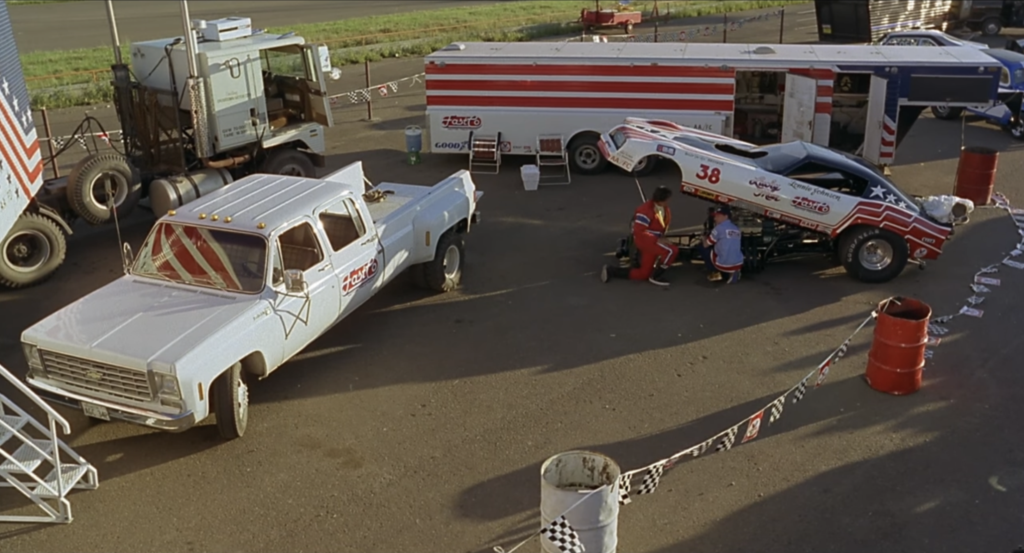
Veteran character actors William Smith and John Saxon feature as the venerable star of the quarter-mile circuit, Lonnie “Lucky Man” Jackson, and his sleazy sponsor rep, Phil Adamson. If the latter’s villainy isn’t clear enough from the way his shirt collars perpetually and immaculately sit atop those of his sport jackets, it’s confirmed early on when he explains to the team’s crew chief that “winning is too expensive.” His job is to keep them just competitive enough to stay in the game and “sell those little red, white and blue cans of FastCo,” the movie’s fictional STP stand-in.
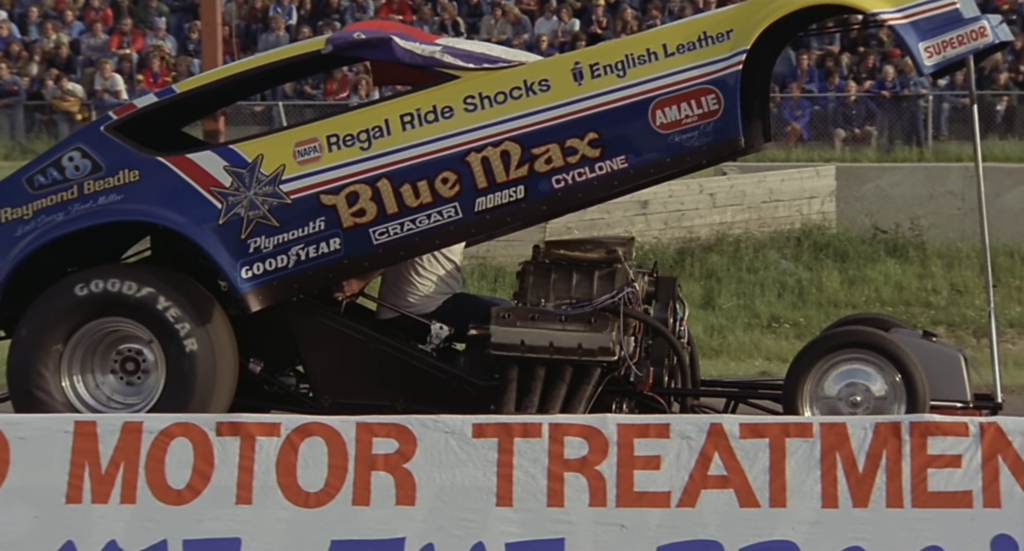
When a top-fuel dragster crash—caused by the recklessly ambitious addition of a “quadravane” blower—forces the team to downsize from a two-class effort to its remaining funny car, the repellent Adamson pits Lonnie against his younger protégé, Billy (Nicholas Campbell). The conflict that results sparks a methanol fire of greed, jealousy, wounded pride and occasionally laughable overacting that propels Fast Company across the Pacific Northwest and Canadian prairie to a dramatic and satisfying conclusion.
Along the way, we get some gratuitous sex, a procession of malaise-tastic rental cars as Adamson flies his Chekhov’s Cessna from meet to meet, a rivalry with a shoestring also-ran and his goon-squad support team, and a bit of unexpectedly genuine tenderness courtesy love interests Candy (“Miss FastCo,” played by Judy Foster) and Sammy (1970 Playboy Playmate of the Year and “queen of the B movies” Claudia Jennings in her final role before dying in a car crash at only 29), both of whom lighten the sometimes leaden performances of the male leads with actual on-screen chemistry.
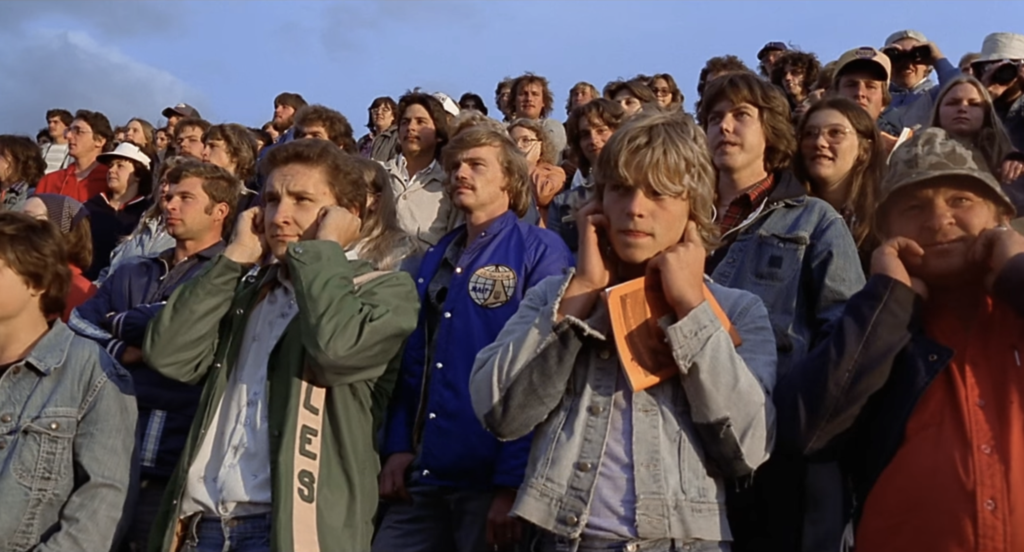
More importantly, Fast Company gives us a rich time capsule of small-time drag racing in the ’70s, with its windswept plains, sparsely populated grandstands, shady cash dealings, and safety standards that could best be described as “casual.”
Most startling are the cars themselves. I’m always surprised by how many avowed car people of my acquaintance, racing fans even, have never been to the drags. Granted, it’s a weird one—a peculiar evolutionary cul-de-sac of automotive competition, a sport that has as much relevance to the cars that you and I drive (or things we might experience ever in our lives) as BASE jumping or big wave surfing. Professional drag racing is one of those things that lies so ridiculously outside of the scope of normal human activity that just attending a meet almost qualifies as an extreme sport in itself.
To say it is loud is like saying the sun is bright—if you were standing fifty feet from the sun. It is violently, disorientingly, destabilizingly loud, an effect that is every bit as physical as it is aural. A hearing person could bring a deaf friend and the two of them would have essentially the same experience. Seriously, if you take nothing else away from this review, go to an NHRA meet. Even if you don’t think it’s your scene, it’s something that everybody needs to experience at least once. You can thank me later.
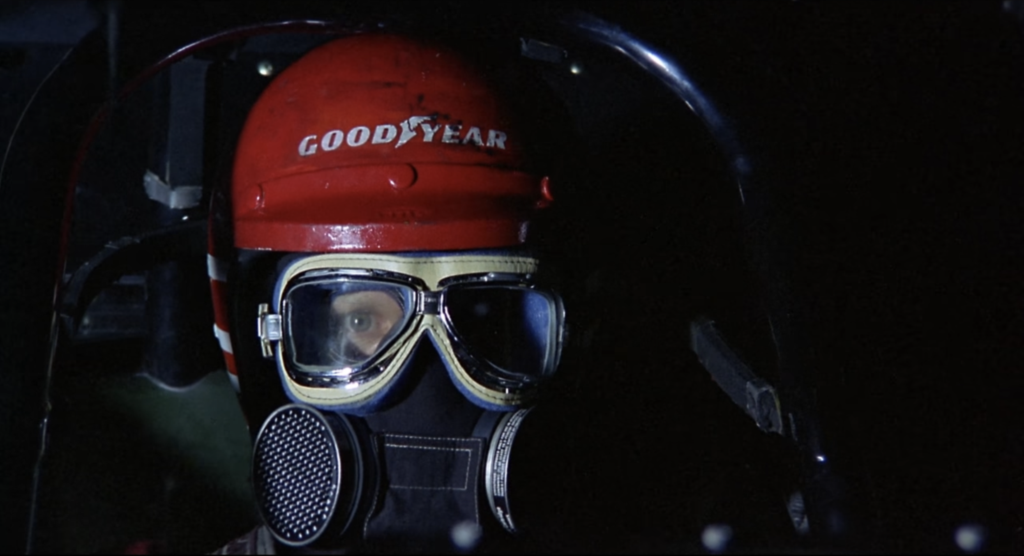
Cronenberg gets all of this. In a 2014 interview with The Guardian, he contrasts the anodyne quickness of a Tesla with the visceral nature of its antecedents: “…If you see a Lamborghini or a Ferrari driven at speed, it’s pretty impressive, it’s like an animal, there’s a beauty to it. I could go on and on about the beauty of the now-outmoded internal combustion car, but there was a prehistoric magnificence to them.”
Fast Company’s racing sequences capture that animalistic drama in a way that bigger-budget racing movies rarely do. The cars at the line twitch and jerk and strain like caged bulls, telegraphing real and palpable danger. A couple comically fake-looking staged accidents notwithstanding, this is one of the most successful cinematic portrayals of racing outside of standard-bearers like Grand Prix and Le Mans.
Of course, drag races are notable for only lasting a few seconds. This is a 90-minute movie. Readers are invited to do the math and draw their own conclusions.
Alloy Official Rating: 3 quadravane blowers ✣✣✣
One response to “Film Friday: Fast Company”
-
Ha! Three quadravane blowers!
Had no idea this movie exists. Love the review–and you describe the physical experience of attending a drag race beautifully. Cronenberg to direct the Ford v.s Ferrari sequel!

Recent Posts
All Posts
July 27, 2026
July 17, 2026
July 16, 2026
Leave a Reply
You must be logged in to post a comment.