EQ Quotient

July 27, 2026
Alex KiersteinThe Mercedes-Benz CLA 250+ is result of a new EV strategy—sharing a platform and styling with internal combustion models—and it works.
I’m really fascinated by how automotive strategies seem to swing wildly from weirdly misbegotten to perfectly suited for the market depending on the timeframe. Take the Mercedes-Benz CLA 250+, which represents a retreat from the idea of EVs lines being distinct from internal combustion ones–the Mercedes-Benz EQ experiment, where some lines of vehicles like the got a similarly named and positioned EV versions with an EQ prefix; thus the S-Class’s sister, the EQS.
One problem with this is the engineering and tooling costs of two unrelated but overlapping vehicles. If you honestly think the EV will supplant the other, then I suppose it’s not a big deal to temporarily run with the overlap until we all transition to that happy EV-only place, where the chargers always work and there are no more resource wars. I’m being a bit facetious, but I’m also being self-effacing, as at one point I thought we were on the way to a mostly EV market.
That hasn’t come to pass, of course, and the outlook right now seems to be a heavy helping of conventional hybrids. And this is rational; PHEVs were always problematic because of consumers didn’t really use them as intended, often failing to keep them charged. Focusing on platforms that can accommodate both modern hybrid and BEV drivetrains now seems sensible.
It didn’t always seem that way. In my recollection, the general consensus was that these were “master-of-none” vehicles, with compromises across the board. And maybe that was true; certainly the Mazda MX-30 shows how badly that can go.
But the world is a differnt place than it was a few years ago. Consumers are more familiar with EVs and a segment of the market prefers them. The government is hostile toward electric cars and infrastructure generally. Fuel prices remain volitile, there’s a new Middle Eastern war, and all of it feels like it could change drastically at any moment. Automakers have little choice but to hedge.
Of course, whether it works depends on how well the product is engineered and marketed. The MX-30 is an easy punching bag because it was so far off the mark in terms of basic specification, and was sold only in a few states. It almost seemed engineered to fail, which is too bad because it was actually a neat vehicle physically, and was only a little drivetrain calibration and a larger battery away from being less of a rolling joke.
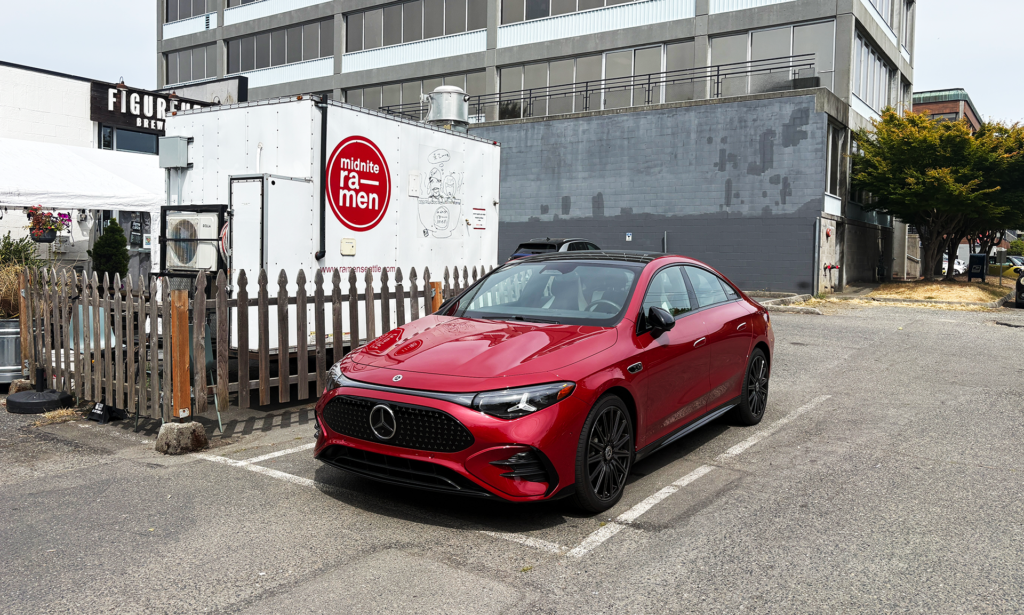
The CLA 250+ is a more serious affair, seeming like a mature EV that’s very well-suited to its role (and, somewhat incredibly, priced well). Unlike the EQ episode, its styling closely matches its internal combustion siblings, but also is a blend of EQ-ish soft roundedness and more proportionate and traditional Mercedes forms.
In other words, it looks damn good, and it also executes on some of the better EQ ideas without some of the blobular baggage. The front fascia is nearly identical, down to the front-spanning light element. The closed-off multi-star grille looks good, and the open form on the hybrid is very similar. Both versions of the CLA look reasonably futuristic but not in a way that’s going to challenge or polarize any onlookers.
I rarely say this about the sticker on any up-optioned Mercedes, but the CLA 250+ struck me as a reasonable proposition at the $64,780 sticker price—and an even better proposition without the $15,480 in options shoehorned on. (Ok, ok, I’ll admit the red paint is pretty slick and I’d even consider wrapping its $1,750 cost into a lease, but the rest isn’t necessary for the CLA 250+ to prove out.) Even with 19s wrapped in summer tires, the ride proposition is phenomenal. Notably so.
All of the Ioniq 5s I’ve owned or leased have been close to the sticker on the base CLA 250+, and all of them have been on the smallest available wheels, but all of them rode poorly. A lot of EVs don’t seem to carry their heft well. It leads to some awkward ride compromises. The CLA transcends all that, and while I don’t have any specific evidence for it, my hunch is that the shared underpinnings give it a leg up.
It’s also appropriately zippy considering modest powertrain specs. This is the single-motor, rear-drive model, so it has 268 hp and 247 lb-ft of torque running through a 2-speed transmission. The dual-motor model has 349 hp, by contrast. Both have a sizable 85 kWh battery, giving the 250+ a 374 mile estimated range (and real world mixed driving indicates that’s probably not far off, at least in warm weather). It reminds me a lot of the rear-drive Alfa Romeo Giulia Tis with the 2.0-liter turbo four—a competent, mildly sporty sedan with really pleasant dynamics.
The real question is what the hybrid version drives like. I haven’t been in one yet; the initial reviews from the usual sources late last year are mixed, in as much as the drivetrain calibration and handoff from the smaller e-motor to the gas engine are crude. I’d bet a lot of the CLA 250+’s core competency carries over. And it sort of seems like a reversal of the trends I was mentioning above; the ICE-converted-to-EV vehicles that struggled as EVs. In this case, it seems like the hybrid is the inferior driving experience. That doesn’t dissuade me from the notion that the MMA flexible platform is the way forward, or the notion that the CLA 250+ is a strong EV regardless of how the hybrid strikes you.
Recent Posts
All Posts
July 17, 2026
July 16, 2026
July 13, 2026
Leave a Reply
You must be logged in to post a comment.