(UPDATE): GO!

July 16, 2026
Alex KiersteinThe MG Go! Concept indirectly inspires a look at the brand's history, and the complex nature of the titans of capitalism.
I was going to talk about cute EV hatchback concept from MG, which is now a subsidiary brand of the Chinese company SAIC, joining a raft of other British brands whose existence was secured by foreign ownership while continuing to emphasize the brands’ Britishness: Roewe (SAIC’s Rover analogue), Lotus (Geeley), Jaguar Land Rover (Tata), and Mini (BMW). But somehow, an early version of this post turned into a rollercoaster ride through the history of British fascism, the nuanced legacies of the titans of automotive capitalism, and a little hubris.
But first, the car:
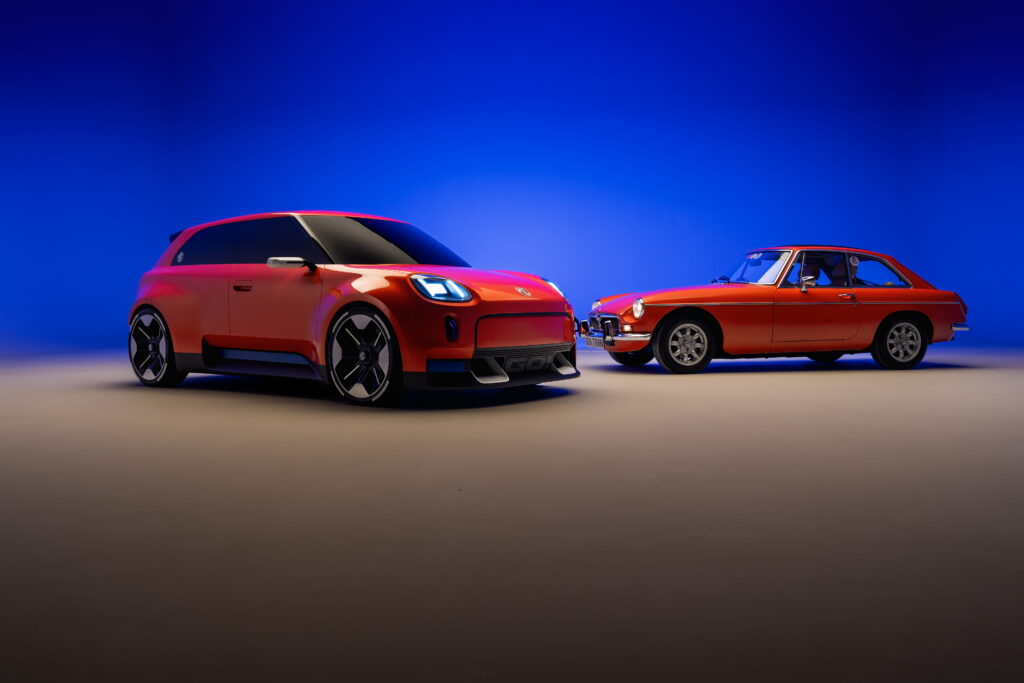
MG gives SAIC the benefits of an established European brand, although by looking at the MG lineup the connection is mainly name recognition rather than heritage-inspired engineering or aesthetics. But the Go! Concept is delightful, and close, in spirit, to the MG brand historically, especially the MG-branded Rovers of the 1990s and 2000s. There is also a lot of modern Mini Cooper to its look, proportionally and in detail, but I think that’s ok. It’s a handsome, coherent design that looks considerably more British/European than any of the other current MG models, which are reasonably attractive but entirely generic.
MG goes out of its way to reference the pre-SAIC iconography of MG in promoting the MG Go!, in what reads a lot like AI-generated puffery: “The design language is deliberately simple, built around a small number of key elements that reflect qualities always admired in MG’s classic designs, especially the MGB GT – a car that embodied everyday elegance, joy and presence without excess.”
I’m glad that MG is transforming from simply being an existing badge applied to vehicles seemingly divorced from the company’s entire history. I think a modern MGB, replacing the weird Cyberster roadster, would be a natural step. Give it the contemporary cute vibe of the Go!. Or made it mid-engine and riff on the MG F, which is cool in its own right. Really, MG should produce the Go! as a new Metro or something—give it the name EV4, to riff on the bonkers Group B GR4—and fight the French’s new wave of retro EVs.
Ok, now back to the previous version of this post:
I can’t enjoy a cute car without somehow ending up reading about assholes. You see, there are many assholes in the annals of automotive history. Henry Ford was a rampant antisemite and a deeply unpleasant man. Felix Wankel, well, that guy was a straight-up unrepentant Nazi—and I think you should stop calling rotary engines “Wankels” because of it. Put Elon Musk’s hideous politics (which caused hundreds of thousands of deaths via the DOGE fiasco) in the same horrible company.
And initially, I thought William Morris, 1st Viscount Nuffield, belonged among the worst of the assholes because of what he got up to in the 1930s. Fortunately for him and the philanthropic and educational entities that bear his name and continue to do good work, he wised up and stopped actively supporting the rabidly antisemitic fascists. When I first wrote this up, I’ll admit that I had the guy pegged for a reactionary interwar British aristocrat, admiring of the Italian and German strongmen and their paramilitary throngs. I dismissed him, almost reflexively, as a fascist himself, and was ready to tear him down. This is an example of a very bad tendency, identifying a take or an angle and running with it before you understand it fully. I am now engaging in some self-flaggelation describing the exact way that I blew it.
I should know better. Things are sometimes not that simple. Nuffield may have been—likely was—privately antisemitic. In this, he joins a vast number of British politicians, authors, and the like—see Roald Dahl, beloved and reviled. Not excusing it in any way, but it’s the 1930s, it’s England, there’s class and deep-rooted prejudice involved, so it’s not surprising. And yes, Nuffield gave Sir Oswald Mosley some money in the early 1930s. Mosley, of course, would later go on to become an avowed fascist, founder of the British Union of Fascists. Mosley, I think its fair to say, was always an asshole, and Nuffield did not exercise good judgement supporting him at any stage.
Does that make Nuffield a fascist? A terrible guy? I thought so. I also have the misfortune of knowing how the story plays out for Mosley and his fascist friends; Nuffield did not. When Mosley’s fascism became overt, when he started posturing as a dictator and the New Party that Nuffield financially supported gave way to the BUF, Nuffield publicly distanced himself from fascism and antisemitism. Whatever he may have believed privately, it seems that his public political life revolved around the auto industry. He stayed in his lane, so to speak.
This is probably a good model for any industry leader with amoral personal politics: keep it to yourself. The best thing to do, really, would be to evolve into a human whose public good and private thoughts are equivalent. The second best thing to do is to focus on other things. Nuffield was hostile to labor unionizing in his factories, but it doesn’t seem like he went out of his way to quash labor unions in general with broader union-busting tactics. And he was a monumental philanthropist. With no kids, so he gave away the majority of his wealth, benefiting the Nuffield Foundation and Nuffield College, Oxford, among other things—and thereby doing quantifiable good in many people’s lives.
The good done from those enterprises doesn’t have any bearing on his personal views, whatever those were. Maybe he was antisemitic, but he also donated to Jewish charities. Giving thousands of pounds to Mosley in the 1930s is bad, but it pales in comparison to the millions given to other objectively positive enterprises.
Why delve into all of this? Well, I have to. I think we should all be thinking about this all the time. We should think about GM’s president in the 1930s and the Nazi medal he was awarded after meeting with (and saluting) Hitler, well after everyone knew who exactly Hitler was. We should think about how the zaibatsu predecessors to modern Japanese automakers supported the war machine of Imperial Japan and its attendant atrocities. We should think about DOGE’s role in the gutting of lifesaving foreign aid when laughing at a Cybertruck parked obliviously close to a dumpster.
And we should also recognize that you can’t pigeonhole every capitalist with possibly odious personal beliefs into the same category as Musk or Ford, because what they do with the obscene wealth they possess matters to a degree. Importantly, it doesn’t necessarily excuse the way in which the wealth was acquired, or that these few can concentrate this obscene wealth at all. Capitalism is complicated, and the acquisition of significant wealth isn’t a neutral act.
My views on Nuffield evolved from seeing him as an enthusiastic supporter of British fascism and antisemitism to something much more nuanced as I learned more about him. I’m not saying that I want to be Lord Nuffield’s friend—he probably wouldn’t want to be mine—I was wrong.
SAIC’s MG might not have any direct, continuous link with the historical brand, but it does trade on the nostalgia. I’m glad it does, because it added to my understanding of the interwar British car industry, the links between British communists and militant Welsh trade unionists, Mosley’s early political maneuverings before he went full Nazi, and so forth. And, of course, the distinction between Nuffield’s extensive charitable activities and whatever the opposite of charity is (see DOGE).
But that’s me. You don’t have to take an extended jaunt through 1930s British history and then revising an article you’ve written to more accurately capture the nuances of a major automotive industrialist. You’re free to just like or dislike the car on its merits.
Recent Posts
All Posts
July 17, 2026
July 13, 2026
July 9, 2026
Leave a Reply
You must be logged in to post a comment.