Upcharge
The modern EV road trip charging experience is already anxiety-filled enough before you even get to a charging station. Will there be a line of cars ahead of me waiting to charge? Are all the chargers even working, and do they offer anything close to the advertised speeds? Is there any food nearby? (Are there any bathrooms?)
These are just some of the thoughts that will be racing through the heads of EV owners who will be driving their vehicles during Thanksgiving, a full decade and a half into the modern EV era. Or perhaps, they will be driving the second or third family car to avoid these anxieties altogether, having reconciled with the fact that EVs aren’t for every single use case.
Either way, doesn’t it feel like the charging experience in the year 2025 should have already improved enough to make most of these anxieties obsolete?
A few years ago, a handful of automakers had begun to experiment with luxury charging lounge concepts as an alternative to barebones approach favored by charging providers. Most resembled nice gas stations complete with food and drink inside. The results haven’t been overwhelming.
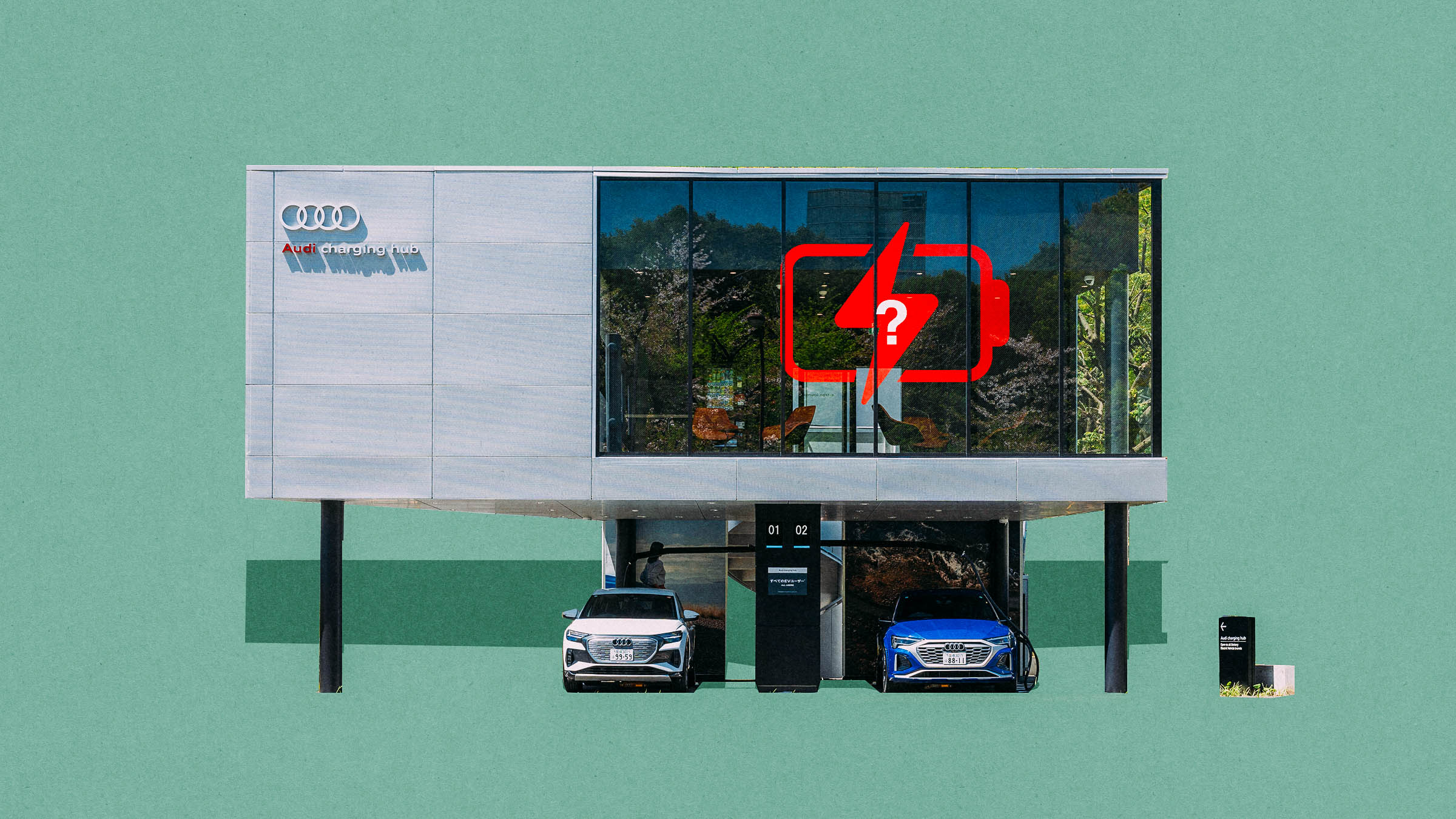
First was Audi with a series of reservations-only charging hubs in Germany, seeking to replicate something close to a dealership waiting room if not quite an airline lounge with lavish food and drink. The modestly luxurious concept was envisioned as a two-story structure with DC fast-charging stalls for several EVs, though not ten or twenty all at once.
The hub was also designed to be modular, composed of several flexible container cubes that could be assembled on site in a matter of days. It also featured its own battery energy storage system (BESS) with 2.45 MWh worth of second-life batteries to lessen its reliance on the grid. The first hub was inaugurated in Germany, with Audi touting the reservation-only feature as offering peace of mind for EV owners tired of waiting in line.
Since that time, Audi has opened only eight such hubs worldwide, most of them in major German cities, with the latest opened in April of this year in Tokyo.
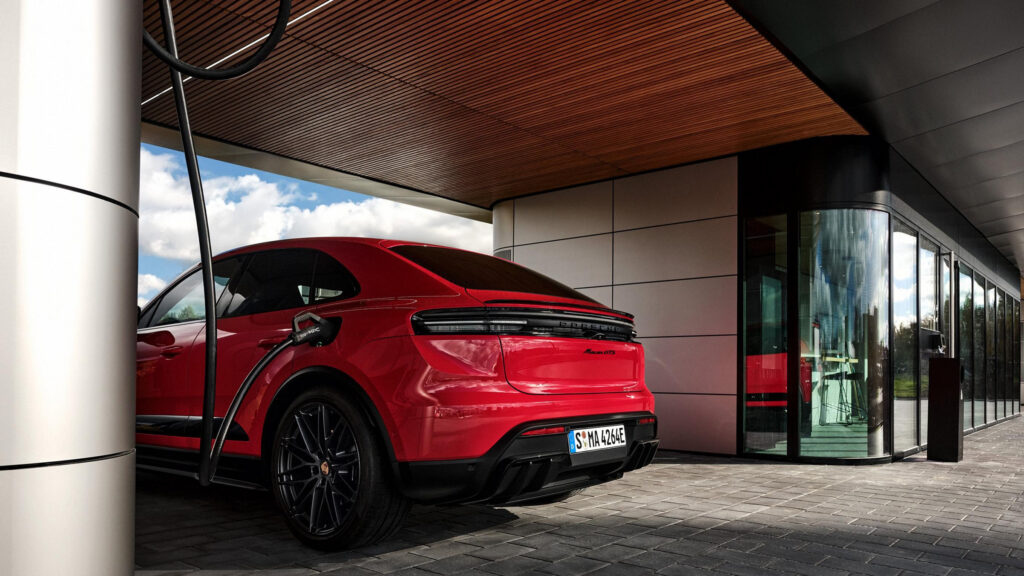
Porsche followed with a similar charging lounge concept of its own, open to owners who also have a Porsche ID or have signed up for a service that can open the gates via a license plate recognition system, adding a touch of members-only exclusivity.
Days ago, Porsche opened the tenth such hub in Himmelkron, Germany, doubling the number of such hubs since the start of the year. The latest one is just a couple of hours north of Ingolstadt, with six fast-charging stalls offering speeds of up to 400 kW.
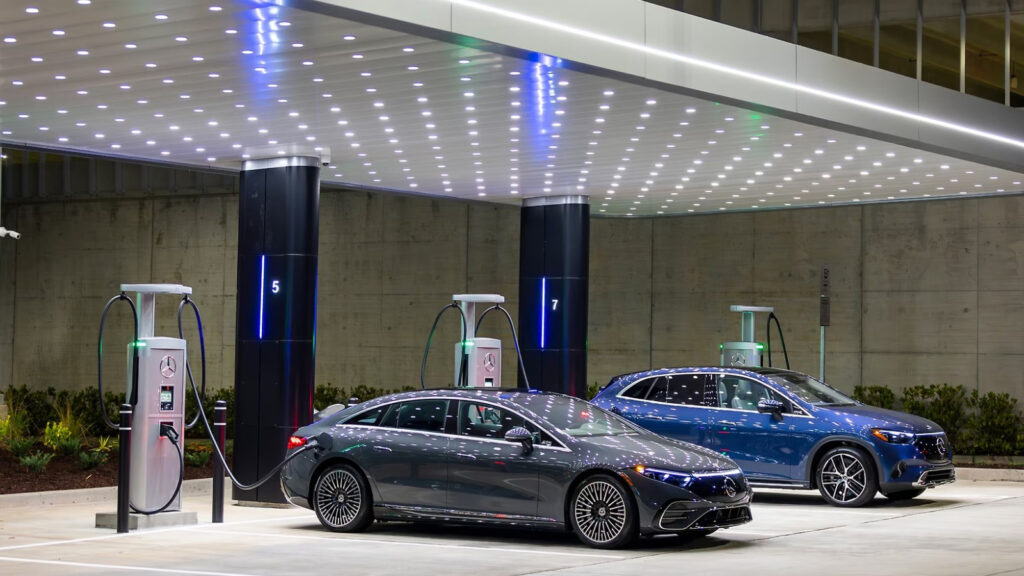
In 2023 Mercedes-Benz opened its own 400-kW charging hub in Sandy Springs, Georgia, on the site of its US headquarters, promising a vast number of such hubs in the coming years and open to all vehicle brands.
“By the end of 2030, Mercedes-Benz’s own charging network is expected to comprise more than 2,000 charging hubs globally, with over 10,000 charging points in the U.S., Europe, China and other core markets,” the automaker said at the time, aiming for a minimum of 400 such stations in the US.
Such grand plans also make Mercedes an outlier in this wary field, which also includes major charging network owners.
In early 2024 Electrify America opened an indoor charging hub of its own in San Francisco, offering many of the same amenities as the VW Group’s branded charging lounges in Europe. But EA’s indoor hub, despite some positive reviews, is far from seeing a wider rollout.
Even Tesla, having seen an undeniable win with its Supercharger network and NACS standard has been cold to the onsite lounge concept with the notable exception of the Tesla Diner in Los Angeles, preferring to let nearby retailers cater to EV owners’ needs. (Fortunately, Tesla has also been far better at picking Supercharger locations than many other charging networks).
And Revel’s charging hubs confined to NYC have also offloaded the convenience store experience to nearby businesses.
At first blush, it feels like such stations should be more popular, but all have stopped short of the fully-stocked onsite store experience.
Two big reasons have been the high costs of building and operating such stations without the guaranteed foot traffic of a mildly busy gas station, as well as the uncertain long-term business model of such projects.
Automakers are still wary of the branded charging hub concept and their up-front investment costs, absent much greater EV adoption rates in Europe and elsewhere. This goes for the costs of new grid connections as well as the volume of food on site, and it’s also why Audi and Porsche lounges have been largely confined to urban areas in Germany where there is at least some guaranteed critical mass of EVs.
Overall, automakers and third-party station builders alike still say that in the long term the big travel centers along highways should eventually cover more EV owners’ charging needs than they currently do. Mercedes seemed to internalize this better than others, striking a partnership with Buc-ee’s centers in the US south even as it announced bold plans for its own branded network.
Just how many of the planned 2,000 charging hubs Mercedes will actually complete before 2030 remains to be seen, but I wouldn’t bet on more automakers choosing to fund and build these on their own past a modest number of showcase stations.
As for the US, longer Thanksgiving travel is perhaps best left to planes, trains, and (internal combustion) automobiles, unless you happen to own a 520-mile Lucid Air or something with similar range.
Recent Posts
All Posts
March 2, 2026
February 27, 2026

February 26, 2026