Staria Bright
January 14, 2026
Alex KiersteinBrightDrop is gone, but the Hyundai Staria may be GM’s already developed EV van solution.
I am so far afield of the BrightDrop median buyer (fleet managers, to be clear) that it’s hard to see exactly what was wrong with the product, aside from it being an EV. But it didn’t sell, and whatever other charms or faults the BrightDrop vans presented to its customers (or lack thereof) are irrelevant.
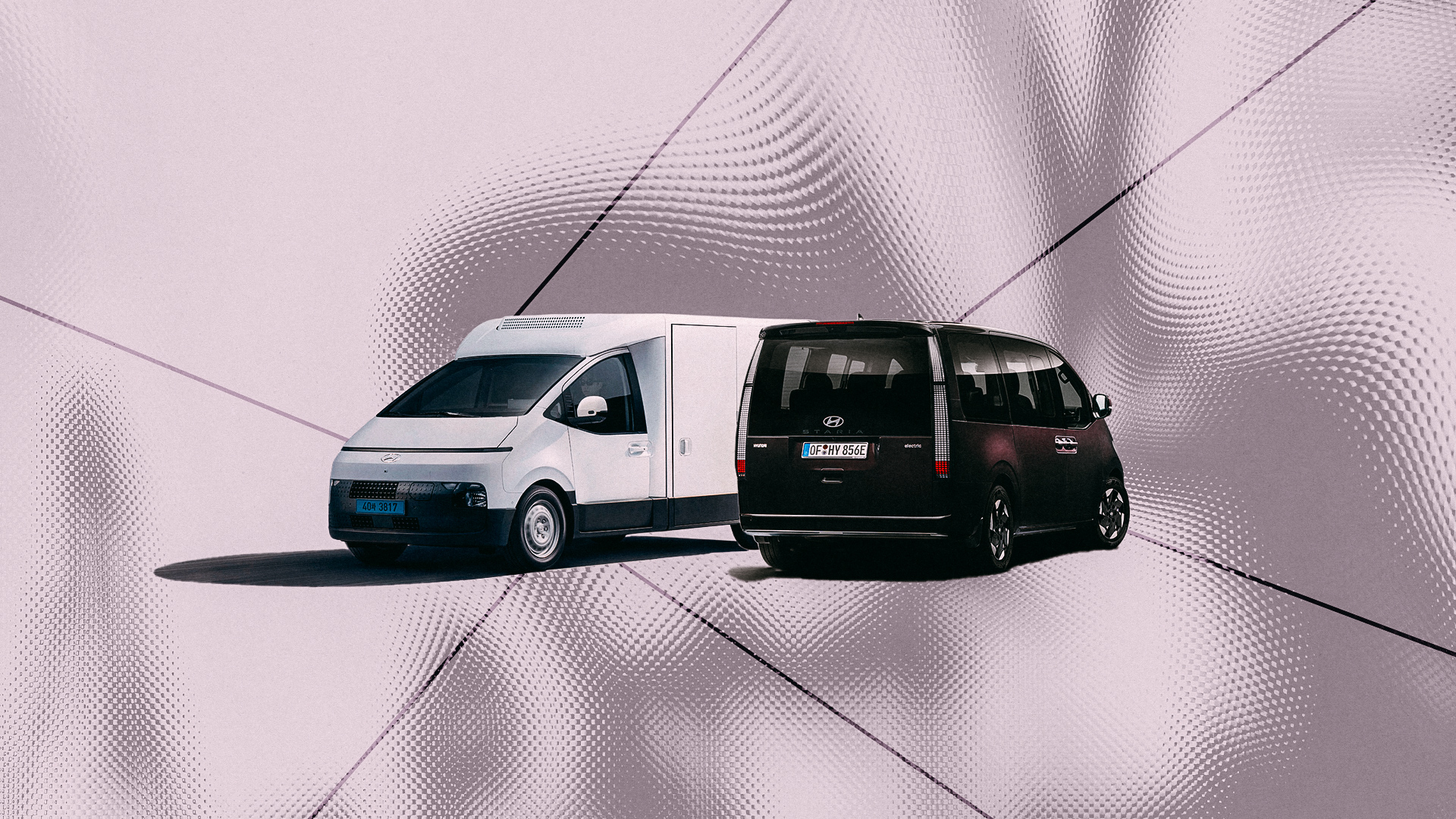
That leaves the commercial van offering a little thin for the fleet sales giant. It’s Express, Savana, and … well, after the BrightDrops are cleared out of inventory, that’s it. But GM’s vehicle development partnership with Hyundai is, as far as is publically known, still a thing, and so the recent reveal of the Staria EV in Europe has everybody’s ears twitching for possible rebranding news.
It’s honestly not a terrible idea if—and only if—the collaboration gets the price right for the American market. There are tariffs, production location questions, all sorts of things to hammer out that might impact feasibility and cost. But maybe Mary Barra can do a deal with the administration to smooth over some of those rough edges. After all, I wrote just recently that Barra believes (or professes to believe) that EVs are inevitable, that they’re superior. And then there’s the question of if the market needs a Staria EV to take the place of the BrightDrop vans and complement the ancient Express and Savana twins.
What else can you really say about them, having been introduced for the 1996 model year and having changed basically zilch in the ensuing decades? I know it’s cliche to harp on these old vans for being old, but it’s not purely ageism. They’re also comparatively inefficient both in terms of fuel economy but, maybe more importantly, space. The European-style vans from Ford (the big Transit) and Ram (the weird ProMaster) are considerably more of both. The Ford, for now, even has a decent spread of powertrain options.
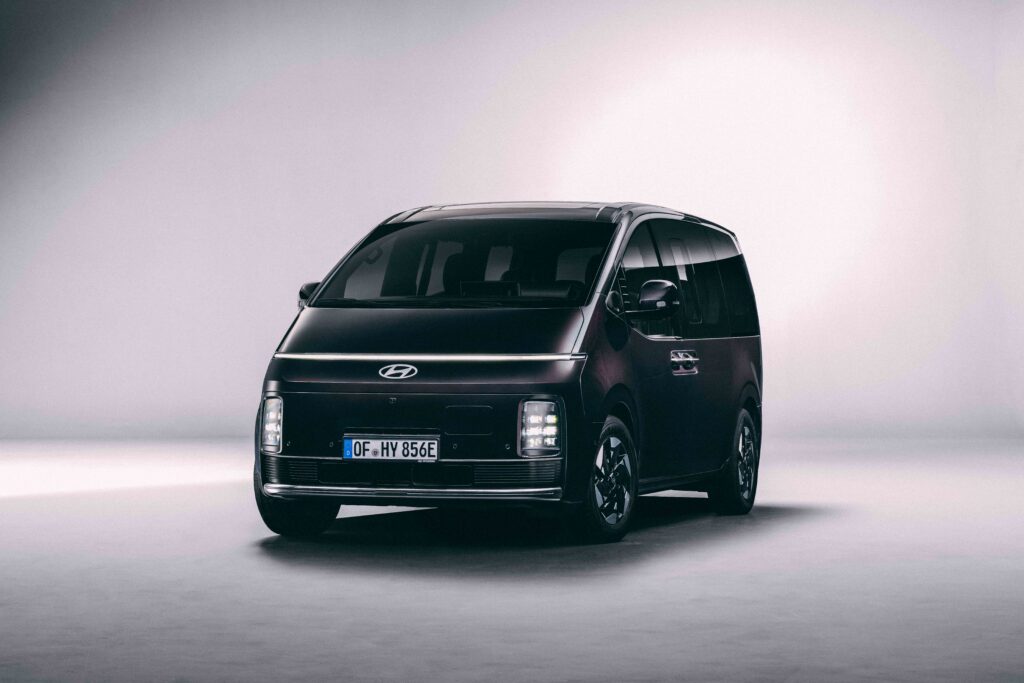
Like the Transit, the Hyundai Staria is built on a flexible commercial platform that can accommodate both the recently revealed EV and a variety of gas- and diesel-burning engines. It’s based on the basic platform that underpins the Sonata, Santa Fe, and Tucson, so it can fit USDM-certifiable engines, if the partnership wants to bring powertrain flexibility into the deal.
GM and Hyundai already have a deal that explicitly covers EV commercial vans. Hyundai has success and scale, offering a wide variety of EVs as Hyundai, Kia, and Genesis models. Meanwhile, GM’s Ultium battery partnership with LG is on the rocks given the headwinds facing EVs in general, and the Ultium name itself is dead. Plugging into a less in-house, off-the-shelf solution makes good sense to me.
The Staria EV features an 84-kWh battery with 800V charging (like many US products built on the dedicated EV E-GMP platform) and a 160-kW motor driving the front wheels. (The US single-motor EVs that use the 84-kWh pack also use a motor of roughly that output, at 168 kW.) It’ll also tow 4,400 pounds, although that is an international measure and may change for this market; in Europe, you can tow a camper with a Fiesta, so this may be a meaningless figure.
The Staria is not a small van. In its heaviest gas-engine form, it weighs around 5,000 pounds. It’s 207 inches long—10 inches shorter than the shortest Ford Transit—on a 129-inch wheelbase, which is within an inch of the short Transit. An international spec sheet pegs the non-EV Staria at 174 cubic feet of total cargo area by the German VDA standard, while by the same standard the smallest Transit has 293. So, a little smaller, but it’s in the ballpark. The cargo version of the Express, by US standards, has 239 cubes.
Otherwise, details on the EV version are sparse. It’s likely to be even heavier than the gas versions, it may have differences in terms of total cargo capacity and/or payload, and so forth. And we won’t even have a direct apples-to-apples comparison in terms of the important measures until it is well into the federalization process—if it goes through the federalization process at all.
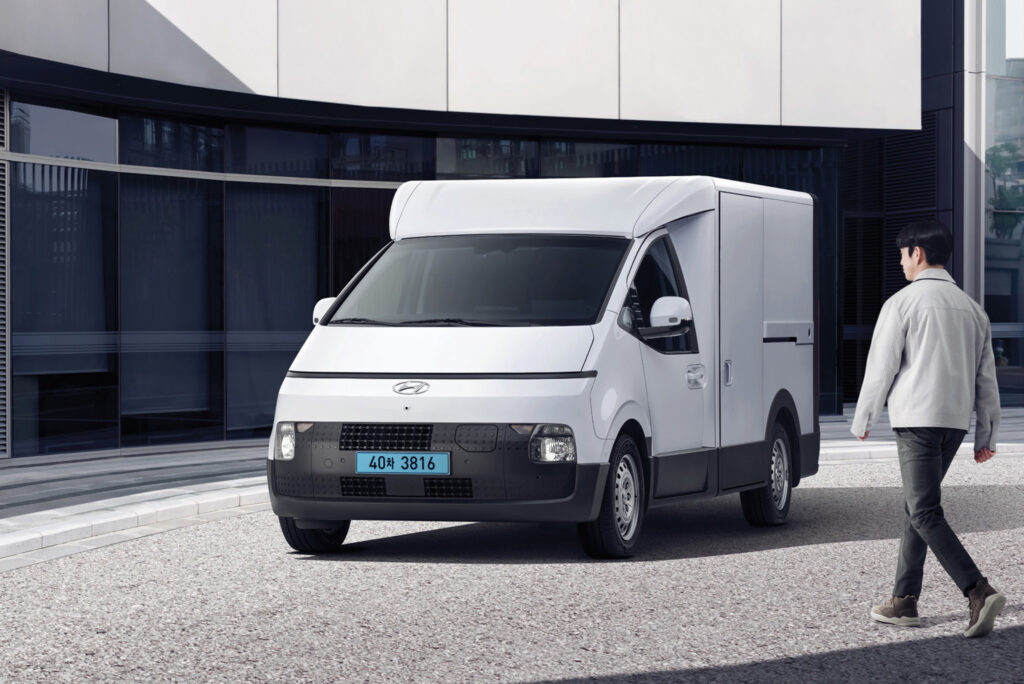
As our friend Brian Silvestro at The Autopian points out, the related ST1 (basically a chassis cab version of the Staria) is already sold in Europe as an Iveco (which is owned by Tata Motors), so Hyundai appears open to rebadging and rebranding efforts as they will help with economies of scale. A US-market rebranding effort could help with that, too.
Hyundai has two US factories. Hyundai Motor Group Metaplant America in Georgia is newer and builds the Ioniq 5 and 9, and Hyundai Motor Manufacturing Alabama builds N-platform vehicles like the Santa Fe. That makes US production at least conceptually feasible in Alabama, and possible in Georgia.
The Staria’s sleek looks are a major part of its appeal. Even the ST1 looks like a spaceship more than a box truck. Certainly it’s more visually interesting than the BrightDrop vans’ milquetoast blandness.
Lastly, if the Volkswagen ID Buzz is selling so badly here that it took a model year off (and prompted VW to profess its commitment to the model in America, which reveals that the PR problem had grown to a scale that caused executive anxiety), what makes the Staria a possibility? Well, it’s a commercial vehicle with a potential passenger application, rather than an expensive luxury item marketed toward regular consumers in a weak EV market after significant delays. I think Hyundai-GM’s job would be to sell the Staria to Uber drivers and last-mile delivery operators, rather than you as a van-curious consumer.
That said, it would certainly be something if the Staria ended up having success where the ID Buzz did not.
Recent Posts
All Posts
March 2, 2026
February 27, 2026

February 26, 2026
Leave a Reply