Big Brother is Billing You
January 16, 2026
Jay RameyThe FTC finally gets GM to stop selling data collected about people's driving behaviors to insurance companies, which jacked up people's insurance rates.
The age of modern cars has brought upon us various horrors, ranging from being able to pay subscription fees for heated seats already installed in your car, to incessant software updates the details of which aren’t disclosed to you in detail. That’s before we even get to having any system fixed at the mechanic of your choice or by yourself, versus having to take it to an official dealer.
But if you were under the impression that connected vehicle services, which you’re also subscribing to, couldn’t be “monetized” against you as the now-popular euphemism goes, you must be a time traveler from the 20th century. Oh, you sweet summer child! (Also, how did you build a time machine in the 20th century?)
This week the Federal Trade Commission actually did something odd for a federal agency: It didn’t use its power to punish Americans in some form, but actually did something entirely opposite.
The agency has banned General Motors from selling drivers’ behavior data and geolocation gathered via OnStar and GM’s Smart Driver to third parties, including insurance companies, which were buying it for the opportunity to, ahem, vary drivers’ insurance rates or deny them altogether based on their driving habits.
“GM monitored and sold people’s precise geolocation data and driver behavior information, sometimes as often as every three seconds,” former FTC Chair Lina M. Khan said in January 2025 in announcing the FTC complaint against the automaker.
“These consumer reporting agencies used the sensitive information GM provided to compile credit reports on consumers, which were used by insurance companies to deny insurance and set rates,” the FTC alleged in January 2025.
Moreover, the agency will now require GM to create a way for drivers to request copies of their data, and for the automaker to get express consent from drivers before collecting data via connected vehicle systems, especially for the purpose of sharing it with consumer reporting agencies and insurance companies.
“The final order approved by the Commission imposes a five-year ban on GM disclosing consumers’ geolocation and driver behavior data to consumer reporting agencies. This fencing-in relief is appropriate given GM’s egregious betrayal of consumers’ trust,” the agency said in a statement.
“For example, one consumer told a GM customer service representative that ‘[w]hen I signed up for this, it was so OnStar could track me. They said nothing about reporting it to a third party. Nothing. […] You guys are affecting our bottom line. I pay you, now you’re making me pay more to my insurance company,” the FTC relayed in a statement back in 2025.

More importantly, the FTC is also giving vehicle owners the ability to disable the collection of precise geolocation data in their cars, and to opt out of sharing driver behavior data, except in situations where a vehicle’s location is needed by first responders.
It took the FTC precisely a year to reach an agreement with GM to put a stop to these practices, to give you an idea of how much power the FTC does (or rather does not) have, and also just how much GM wanted to keep doing it.
On the one hand, this development is a rare and welcome relief for consumers who will be slightly more protected from being nickel-and-dimed by our purely American social credit system.
But on the other hand, I have little sympathy for those who signed up for these systems in the first place, thus sinking deeper into subscription usury. Remember what Nancy Reagan said: “Just say no!”
Some other, more sophisticated customers, have long been aware of the perils of connected car services.
Many vehicle armoring specialists routinely rip out all connected hardware from new cars as part of the build process, including microphones and GPS antennas, and sweep the cars for other hidden trackers and devices under the skin. In their place, they sometimes install completely proprietary communications systems that don’t even use cell signals, but rely on vintage, encrypted radiotelephone technology, or don’t include any phone-related hardware at all.
This has become more difficult over the past decade or so, as a lot of new cars now require software updates all the damn time. But in those cases where they cannot be avoided, they are done manually, with wires at the dealership. (And then the car is swept for tracking and listening devices again).
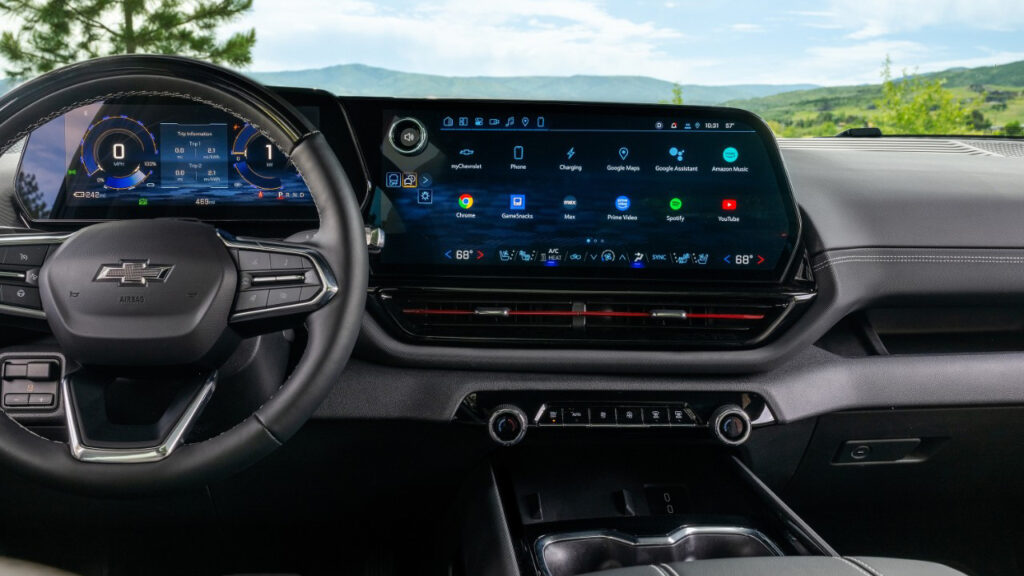
Of course, it’s not very practical for Americans just buying a Caddy crossover to rip out or otherwise disable all the connected hardware inside their cars even if they don’t subscribe to it, as often they’re just leasing a car. But those in the cybersecurity industry know that even if you don’t subscribe to something that’s installed, it doesn’t mean it’s not keeping track of you anyway for whatever reason.
If there is a possible sequel in the making, it could be the way in which conversational AI is now being integrated into cars, including GM cars. In 2022 GM teamed up with (surprise!) Google to bring Google Cloud’s conversational AI technology, Dialogflow to GM’s OnStar virtual assistant, which handles more than a million customer questions a month.
“The successful deployment of Google Cloud’s AI in GM’s OnStar service has now opened the door to future generative AI deployments being jointly piloted by GM and Google Cloud,” GM said in 2023.
That system is mostly geared toward helping drivers with navigation and routing. But at the end of the day, you’re still talking to a computer that is transcribing what you say on a server somewhere for the AI assistant to process it. So that’s something to keep in mind with any conversational AI, whether in a vehicle or not.
Ultimately, this whole depressing FTC episode is symptomatic of the 21st century drive to monetize everything imaginable through surveillance, now that the tech exists to make it a reality. So this won’t be the last time we’ll see a case like this, whether it involves in-car tech or not.
This is also why people move to places like rural Wyoming to live off the grid and drive hardware-defined vehicles (HDVs).
Recent Posts
All Posts
March 11, 2026

March 10, 2026

March 10, 2026
Leave a Reply