Untested
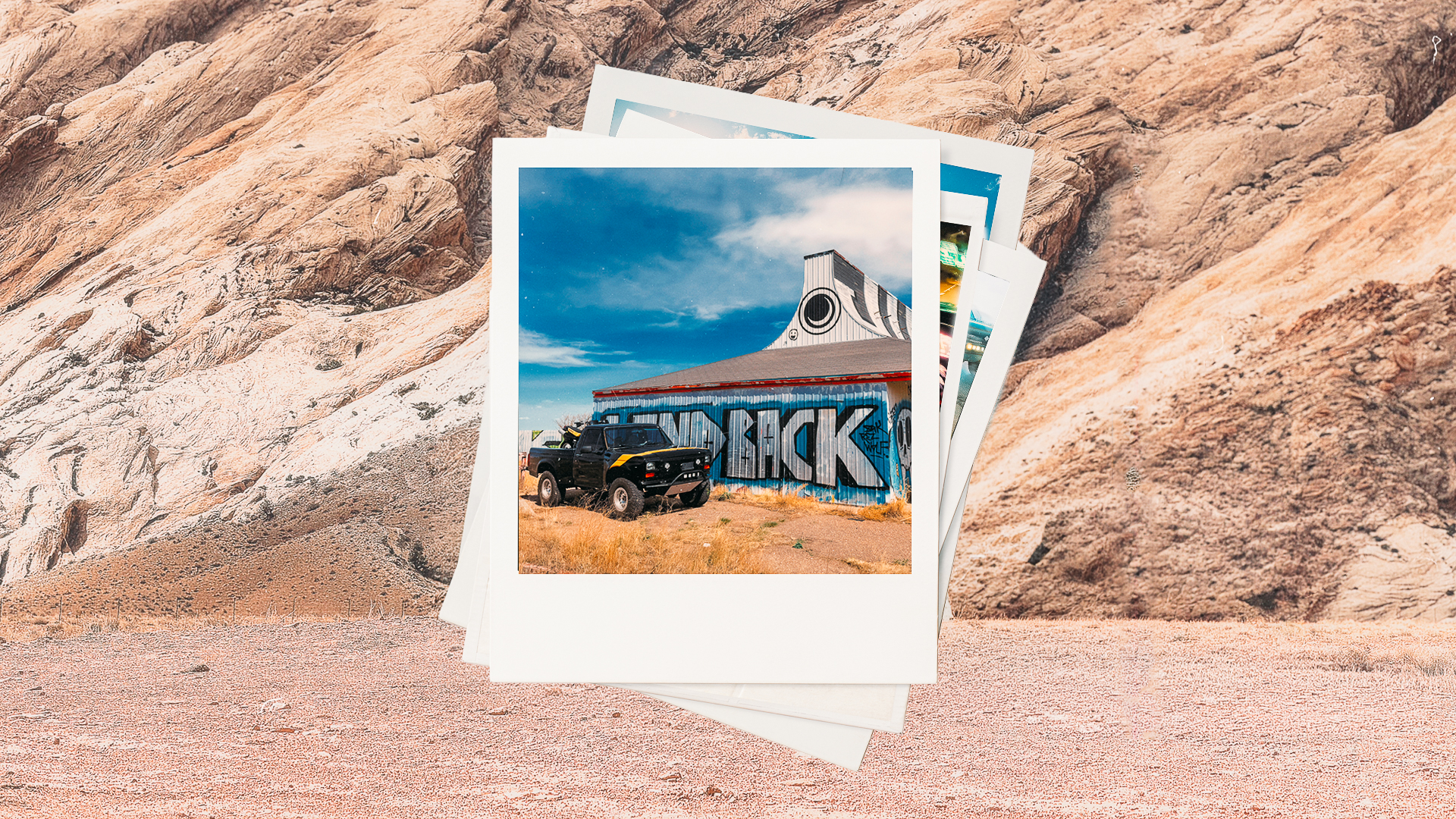
Facebook Marketplace is a menace. All I wanted was a reasonably priced used pickup truck to haul my motorcycles and work equipment. I had no intention of buying another crazy project vehicle, but my buddy Tarik, a notorious Marketplace enabler, sent me the link to an insane banana-yellow 1986 widebody F-150 off-roader. What would I even do with it? The ancient fuel-injected V8 engine made an anemic 150 horsepower, it had no AC, the shocks were rusted in place, the wiring was a homemade mess, and the welds keeping the modified suspension in place looked highly suspect. Yet, I was drawn to it.
On my first test drive, it was clear it was really rough, but the truck was unlike anything I had ever seen. It made me feel like a character in an ’80s action movie. We can all picture the scene: two determined protagonists preparing for their final battle with their evil nemesis. As they finish gearing up, they walk into the back of an old, dusty garage and whip the tarp off a hulking shape in the corner. A glistening black battle truck is revealed to the tune of Mötley Crüe’s “Kickstart My Heart.” Looking at the F-150, all I could think about was how much it deserved to be resurrected. “Basher,” as I began to call it, would rise from the ashes of its ill-planned and dated custom build to become a hero of its own story.
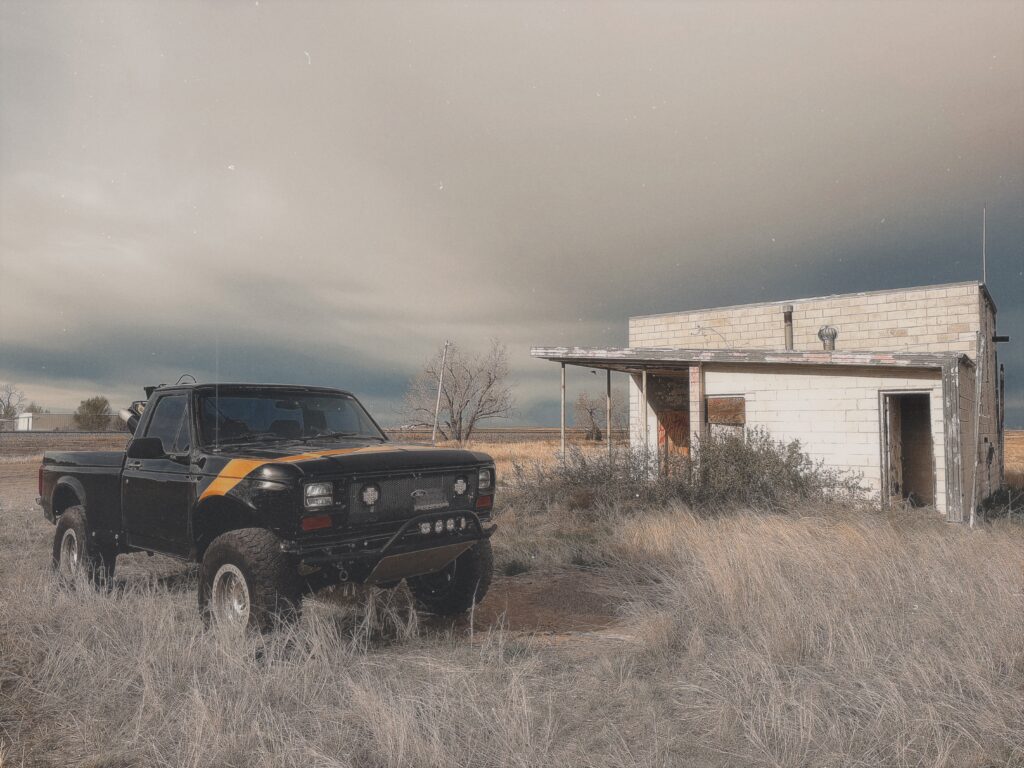
Tarik and I spent the next year tearing down the original build and giving it a new life. There were rust holes to be patched and it needed fresh paint, new wheels and tires to replace the dated and cracked ones, and a complete rewire. There were many times where I wondered what the original builder had been thinking when he dreamed it up.
The truck would eventually leave NYC for my friend Tim Harney’s shop in Long Beach, California, to finish the final, big elements of the build. The off-road suspension needed a complete rework, and the chassis needed proper reinforcement because it was one bump away from splitting in half.
Sadly, the Flareside bed that came with it, although cool-looking, was barely hanging onto the truck. It was constructed mainly of Bondo, cracking paint, and prayers. We sourced a used ’90s short bed in decent condition that would fit. Tim got to work retrofitting it to the F-150 while also cutting it up to fit the new, improved off-road shocks and towers.
We also sourced a used but very clean LS3 engine, transmission, and transfer case. Our friends at Holley helped us source the right EFI and fuel-system components, along with their 12-inch digital dash. We purchased a sequential-style sport shifter from Lokar with an 8-ball handle that suited the project. Tim then got to work building an entirely new dash and console from scratch, using aluminum and a lot of welding skill to fit all of these futuristic parts that were never intended for an ’80s Ford.
When it came time to dyno tune, Basher would put down about 415 horsepower — a gratuitous amount of power for a lightweight old truck. It was power I very much looked forward to exploring as I did the ultimate shakedown road trip from Southern California back to NYC.
Tim is a GREAT friend, and an incredible builder and fabricator. Like anyone with a heart, he was nervous about me flying into LA to drive 2,500 miles in a completely re-engineered ’80s F-150 with a barely-tested engine. The last thing we wanted was for me to be stranded with a broken vehicle in the Nevada desert or on some long stretch of Iowa highway. It would have been nice to test the truck for a few weeks in various scenarios before undertaking a cross country trip. On something completely bespoke like this, you never know what kind of gremlins may pop up. In fact, the truck was barely two days removed from the dyno and alignment shop when I landed at LAX to hit the open road.
Nothing could prepare me for seeing my truck reborn for the first time. Tim had me wait out front of his shop while he pulled Basher around. I could hear the roar of the LS from around the block as he flew around the corner, the BFGoodrich KO2s hanging on for dear life. I was in love all over again. It had a fresh stance with brand-new long-travel suspension at all four corners, a rumbling modern powerplant, and a new cyberpunk cockpit fabricated from aluminum by hand.
The cabin was now equipped with a Holley 12-inch digital dash, a JVC Apple CarPlay unit in the center console, a Vintage Air AC unit, and that Lokar shifter. When I climbed up and into the driver’s seat, the cockpit wrapped around me and I felt ready for battle. I fired up the tuned LS3 and the Holley dash came to life, displaying the status of the truck’s various systems as the exhaust rumbled beneath me.
I’ll never forget the first time I gripped the 8-ball shifter and shifted it into drive with a hard metallic “thunk.” You feel the power beneath you. It wants to go. I mashed the pedal and the oversized KO2 tires melted the asphalt. So much power in a sub-4,000-pound old truck. I was smitten.
Tim and I took some time to grab some beachside empanadas near his shop in Long Beach and catch up. He emphasized that this truck hadn’t been fully tested and ironed out since its powerplant had been completely replaced. I felt emboldened when he told me it was a bit crazy on my part, but he was all for it.
We took the next 24 hours to prep the truck for the journey. Tim ran me through the various new systems, fuse locations, fuel-pump setup, engine-cooling system, and things to look out for during my 2,500-mile journey. We also loaded up a 1999 Suzuki DR350 dirt bike we found on Facebook Marketplace for pennies. It mainly needed a carb rebuild and some paint, so we painted it black and yellow, and I designed some “Basher Jr.” gas-tank stickers since it would live mainly in the bed of my truck when it wasn’t being ridden.
Sunday morning, we had one final meal at my favorite SoCal hang, Bike Shed Los Angeles, with some local motorcycle buddies before I began my three-day adventure. I scarfed down some steak and eggs and did one last walk-around to make sure nothing was falling off or leaking. Well, no issues I could see, so all systems go!
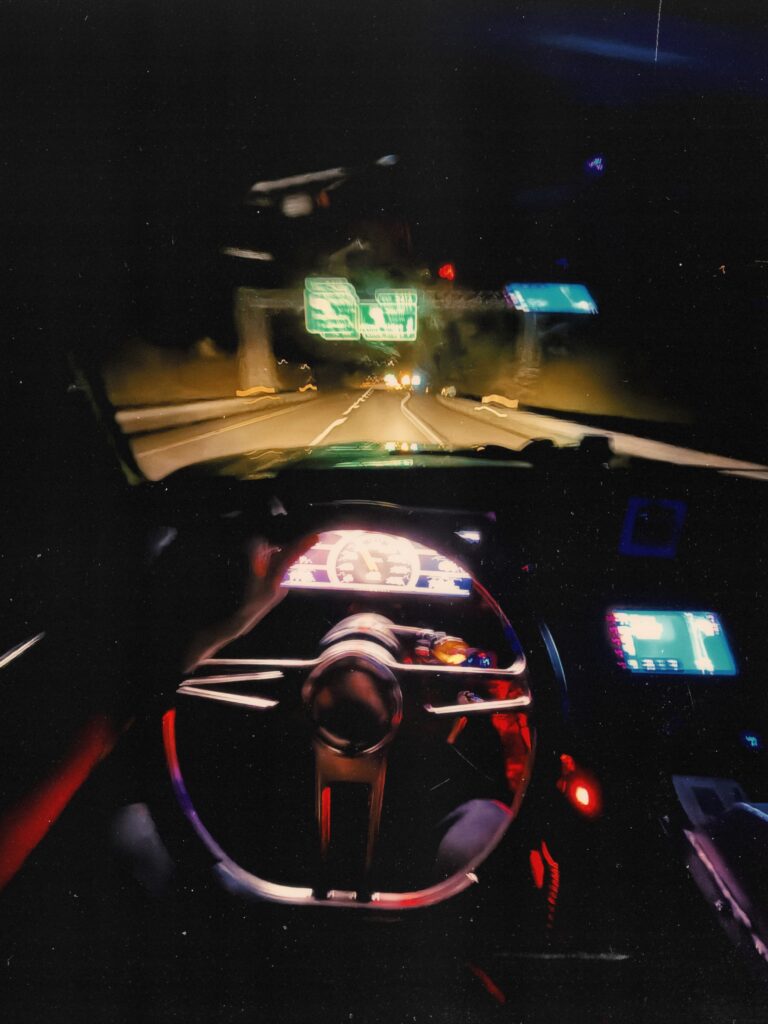
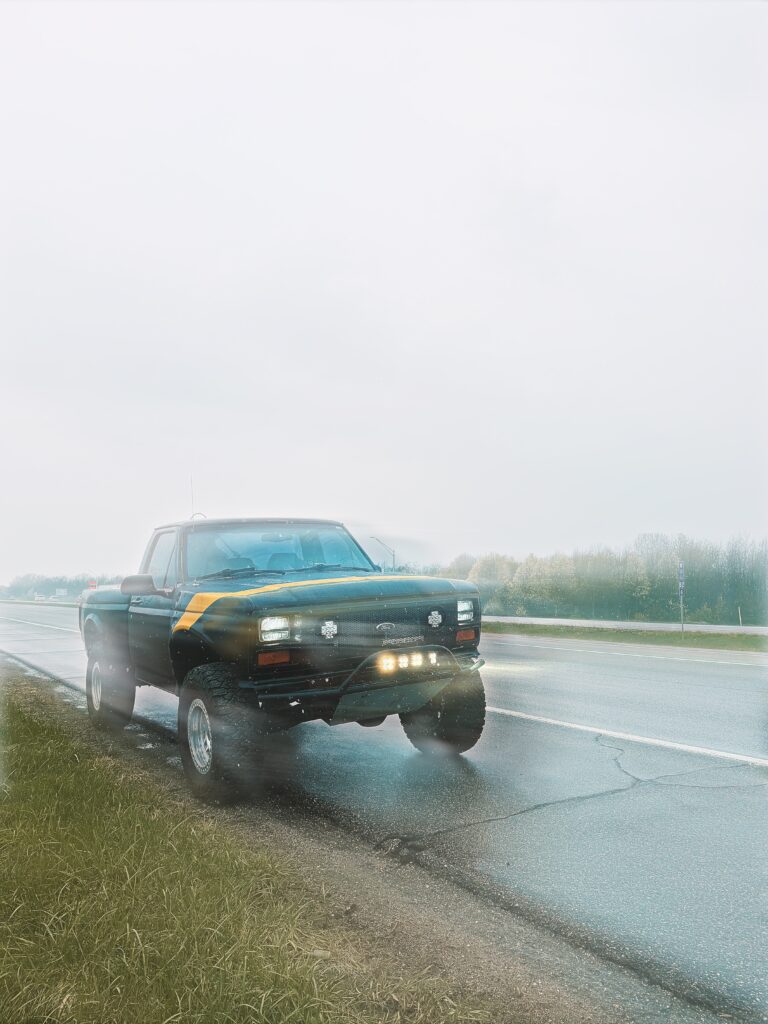
As I opened Basher up on the SoCal freeways headed toward Vegas, I found it was now capable of driving in a straight line, and the steering was actually responsive. If you’re familiar, most old trucks like this had steering boxes, not modern rack-and-pinion setups. Over time the gears would wear out and the steering would become dangerously loose. I had done a fancy Desolate Motors steering-box upgrade a while back, but the improvement wasn’t apparent until Tim removed the old shocks and essentially re-engineered the suspension. I couldn’t believe it: I could take my hands off the wheel safely, and the truck would hold a straight line. I could steer around obstacles and corners with relative ease!
In 1986, air conditioning was a rare option for an F-150 work truck. Heck, you were lucky to have working heat and defroster. Tim had fitted a slick Vintage Air unit that was working incredibly well. I’d survived a sweltering summer in NYC with no AC in that truck, and it was not fun.
About 200 miles in, I could tell something was up with my exhaust headers. You could hear that telltale “tick tick tick tick tick” every time I’d hit the gas. At my next gas stop, I popped the hood and could see black exhaust marks around the exhaust gaskets. Apparently, this is common with new LS builds. You’re supposed to retorque the headers after some break-in miles. I didn’t have the tools or the time to resolve the issue, so I would just have to embrace the annoying noise for the next three days. With the pretty intense wind noise and worsening header leaks, I opted to drive with my AirPods in for the next 2,000 miles.
Overall, I was pretty happy with how things were going. The engine was staying nice and cool, thanks to a new thermostat and the radiator Tim pulled from a literal retired Ford NASCAR race car he had at his shop. The ride was pretty decent, if a bit stiff over bumps, and the dual-reservoir shocks all around could be tuned and adjusted when I got home. As I approached Nevada, I opted to hop off the highway and enjoy some backcountry roads for a bit.
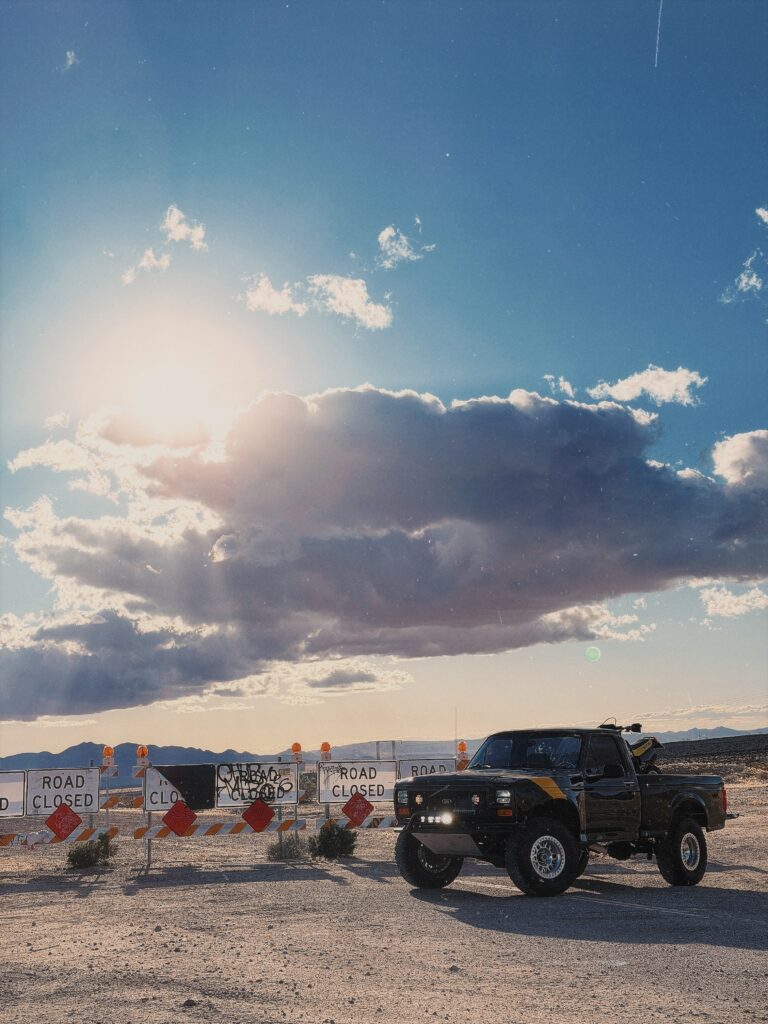
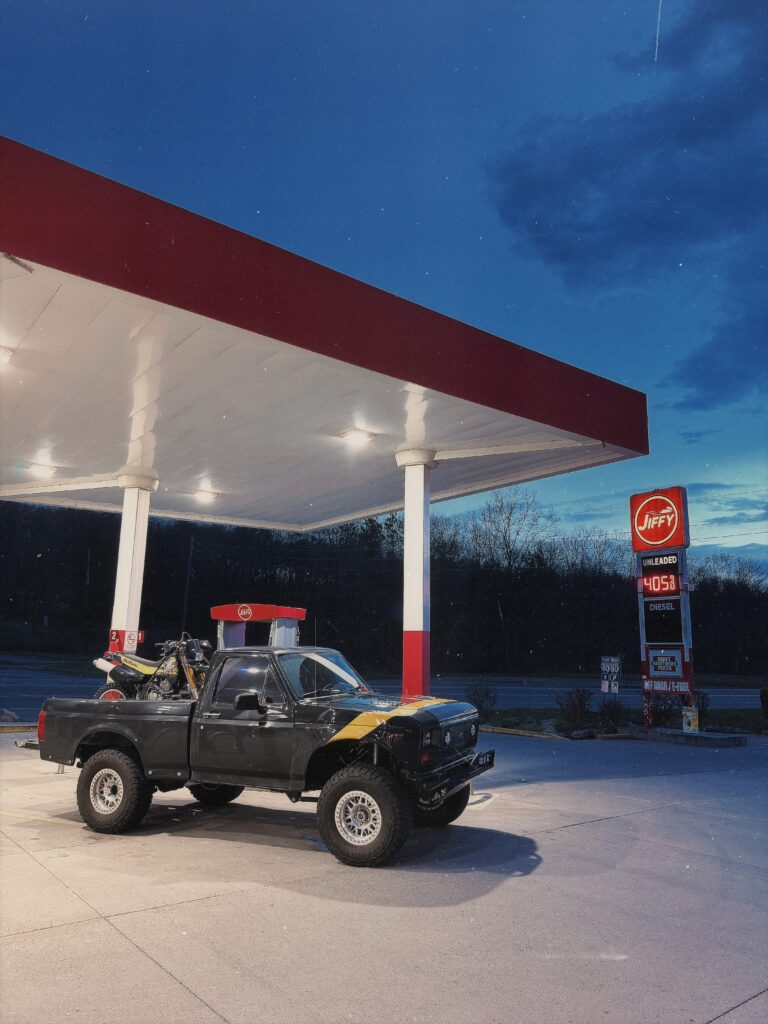
I found this amazing dirt road that would keep me progressing east and thought it would be a good chance to test the truck’s two-wheel-drive and four-wheel-drive rally-performance capabilities. I launched down this long stretch of road, rocks flying everywhere, Don Henley on the CarPlay. I shifted the Lokar 8-ball into sport mode and gunned it. I took the first few corners with a nice, easy slide. For an old boy, Basher was feeling quite nimble.
I saw another pickup coming over the horizon toward me and eased back on the throttle to allow for a safe pass. I offered a friendly “Jeep Wave” to the passing late-model F-150 just as the engine decided to sputter out and die. Uh-oh.
Thankfully, there was no other high-speed traffic to be seen, and it was easy to pull over. I started to do a mental checklist of what could be wrong. I still had power to the accessories like the radio and the dash, but I could see that my fuel-pressure and temp gauges had disappeared from the dash. It had to be something with the master switch we had for the fuel pump and engine accessories. I reached down to check the switch, and it was limp—literally limp to the touch. I couldn’t turn it on or off. Well, that’s new.
I called Tim, and he picked up on the first ring. He was apparently waiting for me to call with my first problem so he could be there to help. I explained the issue, and he suggested I reach back into the console, yank the wires leading to the actual switch, and manually tie them together until I could get to an auto parts store and replace the switch. I’m reasonably handy, but more of a problem-solver than a mechanic. I felt like MacGyver when I was able to reach under the console, yank those two wires, tie them together, and hear my fuel pump fire back to life.
I would later discover, after two more failed switches on my road trip, including one breakdown at highway speeds in Nebraska in the pouring rain, that there was a voltage issue frying the fuse inside the switch. It was pretty annoying that a $5 switch could make or break whether my truck ran reliably. Thankfully, I knew how to patch it up so I could make it home.
I was making great progress toward Moab, Utah. Things were going so well that I knew my next challenge was due to arrive soon; just on cue, the engine started sputtering and the fuel pump started whining as I took a steep mountain curve near the end of the first night. I was able to coast to one of the rare gravel pull-offs to try to diagnose this new issue. By the sound of the fuel pump whining, I could tell Basher was struggling to get fuel, as if it were out of gas. That was strange, because I had just filled it up 20 minutes prior. I cranked and cranked but wasn’t able to get it to fire.
Thankfully, I had a couple of gallons of gas in an emergency jug Tim had put in the bed. After spilling quite a bit on myself, I was able to get a gallon or so down the filler neck. Still, there was something strange going on. The gas was coming back up as if the tank was full after the first gallon. That would be an issue for another time, because I was able to fire the engine back up and get back on the road. The goal was to make it 10 miles down the mountain to the next gas station, where I could look further into what was going on. Unfortunately, the fuel pump had other plans.
I had only made it another couple of miles before the engine started to sputter again. I knew I was in trouble, and there was no cell signal for miles. I was nervous because it was pitch black out, the twisty roads were filled with 18-wheelers, and there were no pull-offs on this two-lane road. Just as my engine died, I saw blue and red flashing lights around the bend ahead of me. I knew if I could just coast far enough, there would most likely be a safe pull-off and an emergency vehicle with a radio I could use to ask for help.
I came upon a very nice police officer at the end of his 16-hour shift who had just pulled over a speeding car. I knew I either needed more gas or a tow, and I knew I couldn’t reach AAA with no cell signal. The officer was kind enough to call AAA for me and gave me a 30-minute ETA.
At this point, I knew I had some sort of fueling issue. I had been putting gas in the tank pretty regularly, but every time it would take less and less fuel. At the first stop, I’d put in 15 gallons or so; at the next, it would take only 10 gallons; and at the next, only five. I figured my gas gauge was miscalibrated and the engine was way more efficient than I thought it was. Apparently, that was not the case.
As I sat waiting for the tow, I kicked myself for not bringing the little Garmin GPS communicator I had used while directing a Nat Geo film in the jungles of Africa for two months. Wait, that gave me a great idea! I remembered the iPhone ads about satellite texting on the iPhone 17, available mainly in the U.S. I pulled out my phone, and despite having no signal, I saw a satellite icon. A prompt popped up asking me to point my phone to the sky. Little arrows guided me to turn my body until I reached a nearby satellite. I held still as the light turned green, and I was able to send Tim a quick text explaining the issue. After a stressful few minutes of holding my phone to the sky, Tim replied and confirmed my suspicion that there was some sort of fuel-pressure issue. Air was not escaping the tank as I filled it with gas, so it was essentially filled with trapped air that would not allow gasoline in.
He guided me via text to climb under my gas tank, which was thankfully pretty easy to get to, and unscrew the hose that’s supposed to relieve tank pressure. I was able to muscle it by hand, considering I didn’t have the right wrench with me. As soon as the hose came loose, a good bit of gas sprayed out of it, which should not have happened. It meant there was a clog somewhere in the pressure-relief system. Either way, the problem was solved by the time AAA arrived a few minutes later. Thankfully, I would just need some gas and not a tow to a shop. I was able to put in the full five gallons of gas they provided and easily made it down the mountain to the nearby gas station, where I added 18 gallons. Whew.
I was exhausted from lots of miles and the stress of roadside fixes. I found a nearby Motel 6 that allowed me to back Basher up to my door so I could keep a close eye on my truck and Basher Jr. in the back. I have stayed in many shady hotels in my day, and this one was no exception, but what was I to expect for $50 a night? The AC was broken, there were stains on the walls and floor, and the faucet leaked, but the bed was soft and I slept soundly.
Six hours later, I was ready to hit the road. I was hoping for smooth sailing. I was able to pass through beautiful Moab, Utah, and grab some lunch. I wish I had time to go off-roading or pull out the dirt bike, but I had lost too much time and had to get back on the road. Work and life were beckoning back east.
Day two would end up being fairly uneventful. I did notice that my header leak was getting louder, and with that, my gas mileage and power were getting worse. I would definitely have to address this when I got back.
I took time to explore more backcountry roads and small towns along the way. Basher would get plenty of thumbs up and smiles at every red light and gas stop. I’m sure there are plenty of photos taken by strangers of us on our journey.
Day two would conclude near Nebraska, where eerie lightning and rainstorms were rolling through. I was happy that Basher was holding up, but the blaring header leak, wind noise, and bad weather were exhausting. I opted for an actual hotel where I could get some solid sleep. I felt beat up, but literally no regrets.
On day three, I was determined to get home that night: 14 to 16 more hours in my 40-year-old truck. I hoped it was going to hold up. Basher started the day strong. He fired up every time, the engine and transmission stayed cool, and the AC was working well. I was super proud of Basher and the work Tim did to get this truck going. I know it needed some things buttoned up, but that is what this 2,500-mile shakedown test was for. I wanted to experience and enjoy my beloved old truck, learn more about how it ticks, and know how to diagnose when something was wrong. Thankfully, this old guy was going to give me one last test.
I was about 400 miles from home, somewhere in Ohio, making good time and feeling pretty good. I pulled into a RaceTrac gas station to fill up and get snacks. I remember the dread I felt when I climbed back into the driver’s seat and the engine wouldn’t start. I knew it had been going too well.
It would crank but not fire. Was it the fuel system again? It wasn’t the starter. Maybe the EFI system was malfunctioning? There was no way I could decipher that, but there were more simple things to check before I got more technical. I called Tim, and he was happy to hop on FaceTime to help figure it out. He had the foresight to install a fuel-pressure gauge in the engine compartment. I placed my phone in the engine compartment with the camera facing the gauge. I cranked the motor, and we confirmed my suspicion that I had no fuel pressure. I could hear the sound of a straining fuel pump as well. Thanks to my fuel-pressure issue on day one, I recognized the sound.
Tim had an idea. He said to climb under the fuel tank and identify the wires going in and out of the fuel pump, then unplug the fuel-pump and sending-unit cables and plug them back in. I had to muscle them apart, but I finally got them reconnected with a “snap” sound.
I begrudgingly hopped into the driver’s seat to test it, and it started up without drama. Apparently, the vibration of the last 2,200 miles must have shaken something loose and the power cables needed to be reseated. Without Tim’s help and my desire to decipher the issue, it could have just as easily ended the day on a tow truck.
Thankfully, that would be the last major technical issue I would face on my journey home. Mentally, though, I was spent from this three-day sprint. I was ready to get home, hug my girls, and sleep in my warm bed.
As I mentioned before, I had no regrets from this road trip. I probably would have saved a lot of money by shipping Basher home as opposed to what I spent on gas, hotels, food, tolls, airfare, and time away from work. Yet, without this adventure, I probably wouldn’t have found the various little issues it had or learned how to solve them. They would have plagued me during daily driving for months.
I took an untested 40-year-old custom truck and made it 2,500 miles. When a problem arose, with a little guidance I could learn to fix it myself. I loved how it performed, and I will adore it even more after my friend Tarik at Hofmeister Haus in New York sorts out the little technical gremlins. I could have bought a newer, trouble-free F-150 Raptor for what I’ve put into Basher, but I am thankful to have an adventure machine that my friends and I made and put to the test.
2 responses to “Untested”
-
Thanks for letting me share the story!
-
Any time!
-


Recent Posts
All Posts
June 24, 2026
June 23, 2026

June 21, 2026
Leave a Reply
You must be logged in to post a comment.