Shape of the Future
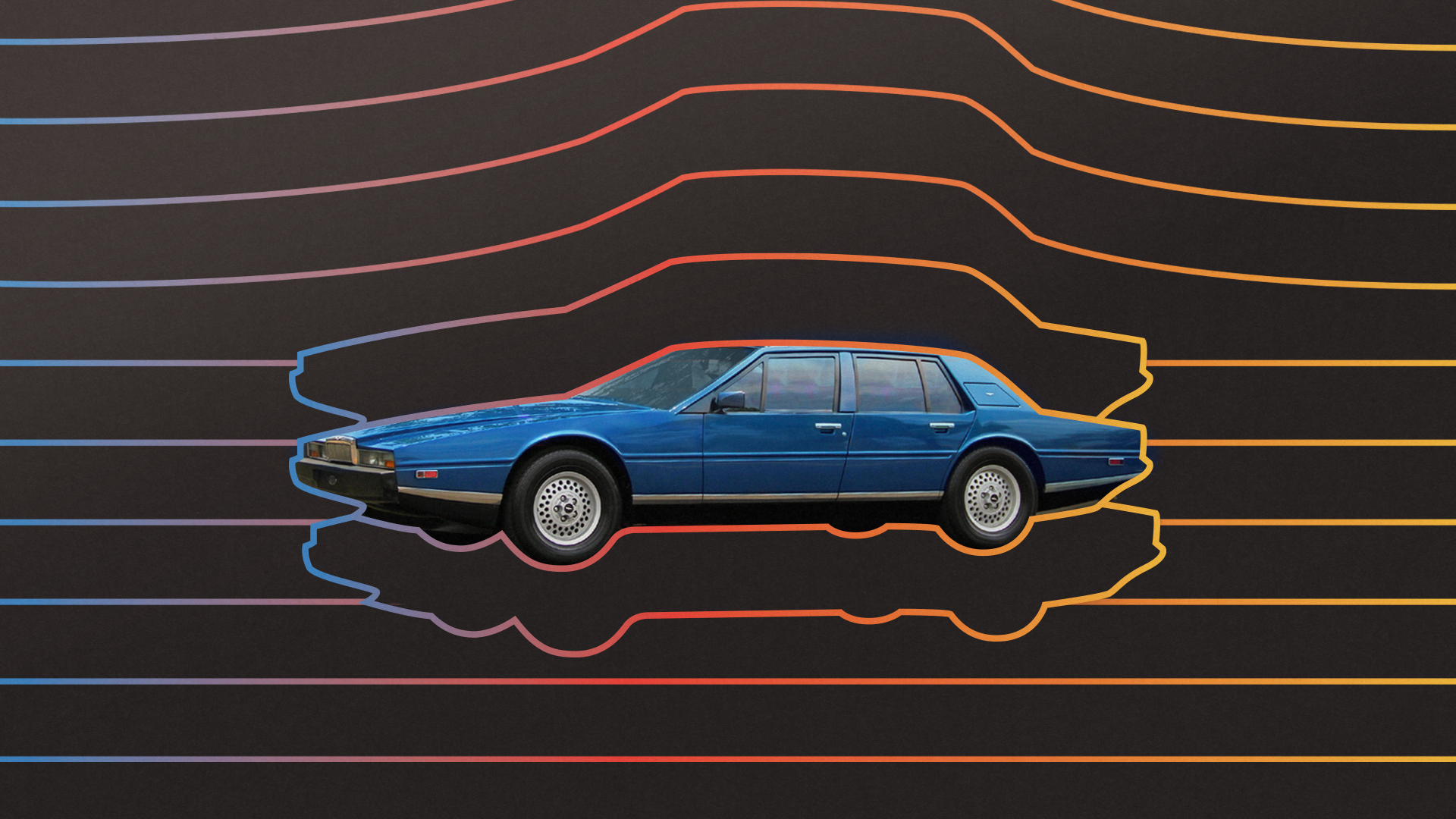
The Aston Martin Lagonda was easily one of the most unusual luxury cars of the past half century—and the most polarizing. Sharply contrasting the rest of Aston Martin’s range, the Lagonda seemingly traded the muscular yet conventional surfaces of the DBS-era cars for a collection of straight lines with sharp edges. Or so it seemed.
In reality, just about every surface of the futuristic sedan has a slight curve to it, merely creating the impression of flat shapes. It also added an element of advanced interior tech to go along with the futuristic exterior, in trying to predict the look and what today would be called the “user interface” of the next decade.
Today, the Lagonda mostly seen as an ultra-luxury experiment that was perhaps too futuristic and too expensive for its own good, with just 645 units built over the course of a little over a decade, depending on how you count it.
But Aston Martin’s efforts to produce a credible sedan date back decades before the Lagonda of the 1970s arrived on the scene.
Sir David Brown purchased the Lagonda marque in 1947, the same year as Aston Martin, gradually folding the small sports car maker launched in 1906 into the latter company. Until that time, Lagonda had been a part of Britain’s sports car cottage industry, and had been far from only boutique automaker that found itself struggling in the lean post-war years in England.
The Lagonda name ostensibly gave Brown the ability to credibly offer sedans to his customers, while leaving Aston Martin to focus on coupes and convertibles. And it seemed like a logical division of priorities for the model range, at least in theory. The actual production volumes heavily favored Aston Martin from the start, while Lagonda remained a lesser-known part of the automaker’s lineup for years, building sedans in relatively small numbers, with the best-known effort being the Rapides of the 1960s.
Seeking to increase its volume and money-making potential in the 1960s, Brown’s next go at Lagonda sedans was the Aston Martin V8 coupe itself, with the company producing a small batch of four-door models that were quite attractive in retrospect. But the company’s clientele thought otherwise, and this seven-car run of Series I Lagonda four-doors failed to find a wide audience.
Even as the company faced dire finances in the early 1970s, Brown did not give up on the idea of a sporty yet luxurious sedan that could upstage offerings from Bentley, which was in the midst of its own challenges.
However, before Lagonda’s next chapter could take shape, Aston Martin the company entered receivership at the end of 1974 after collecting hefty debts. The Newport Pagnell plant closed its doors in December 30 of that year.
But the plant did not stay closed for long. In 1975 the company was acquired by a group of British and American businessmen led by Peter Sprague, with the Lagonda sedan project seen as the key to the company’s relaunch, and perhaps financial salvation.
Under new management and amid a mad dash to complete the project, the company used the 1976 London Motor Show to take the wraps off the Lagonda sedan in front of crazed crowds.
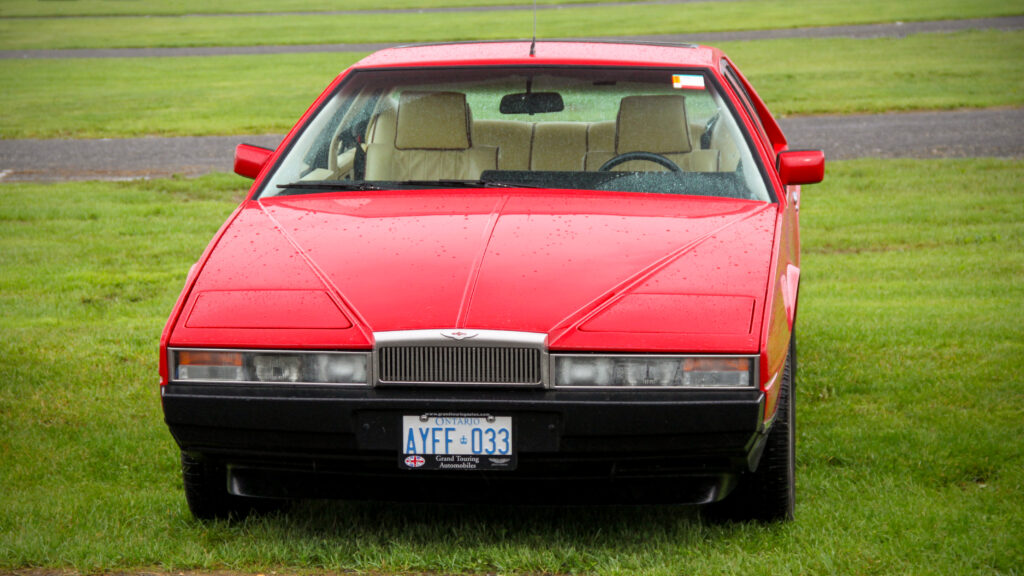
As the crowds at the motor show saw firsthand, the long four-door’s design had nothing in common with the DBS and V8 models that were still fresh at the time. Towns opted for a wedge-shaped profile with a rakish windshield, thin A pillars, a very nominal grille, pop-up headlights, and seemingly razor-sharp edges, at least seen from afar. In 1976 it seemed like the shape of the future.
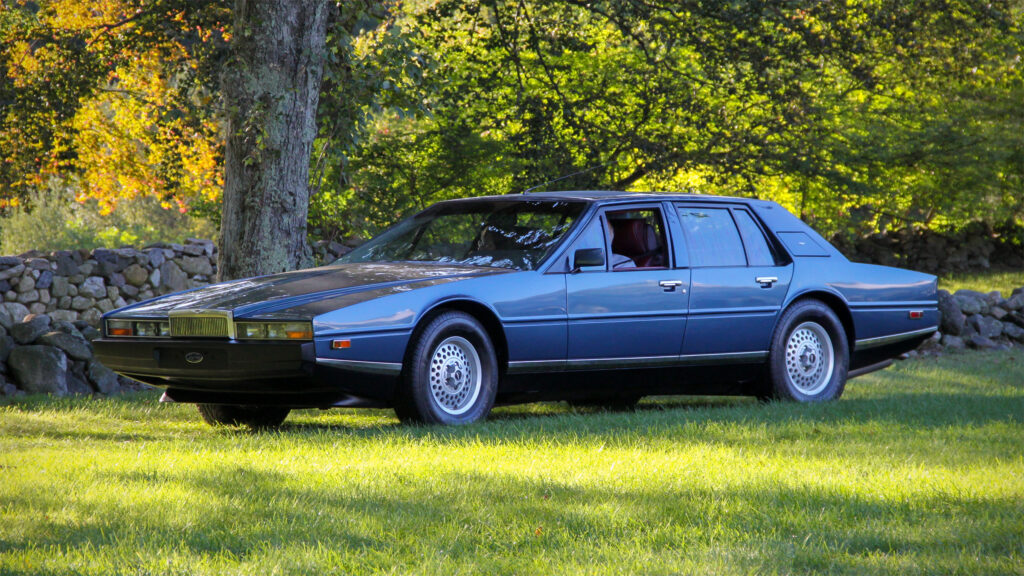
In reality, the Lagonda was a bit less wedge-like than it seemed. Towns’ design utilized a visual trick of sorts to make the sedan appear thinner than it was in profile by using a thin strip of chrome that traveled through the hubs of the wheels. But the chrome strip was not the true bottom of the sedan’s sides — there was more bodywork below, but it was painted black to blend in with shadows.
This gave the Lagonda a far more high-riding appearance than it really had, while taking some of the bulk off its profile.
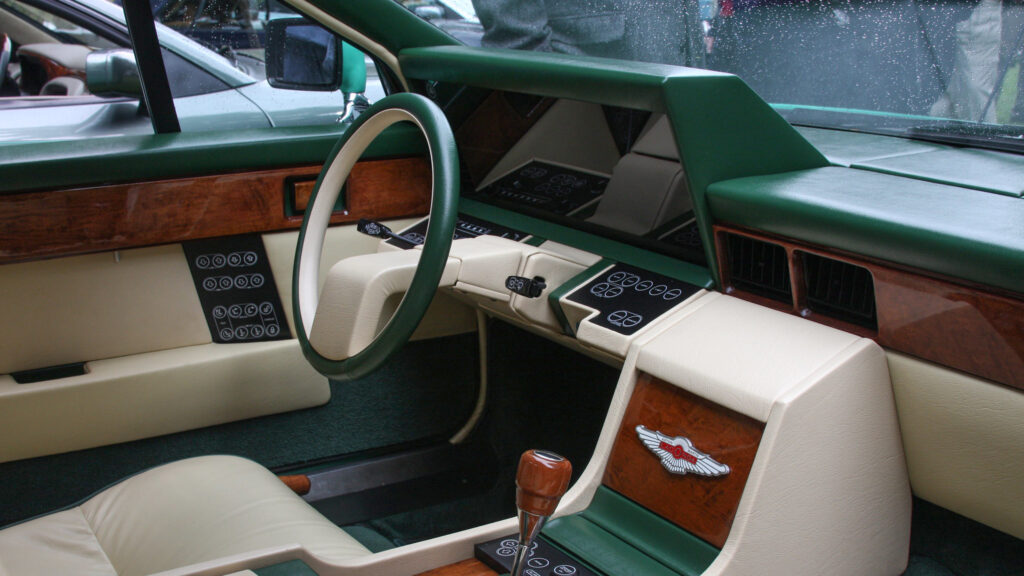
The wedge-shaped theme continued to the interior, which featured an exceptionally tall and boxy LED instrument panel and dashboard. Another futuristic feature — perhaps too futuristic for its own good — were touch-sensitive buttons on the dash, doors, and center console.
Despite the prototype being far from production-ready, the debut was a resounding PR success for the automaker, with Aston Martin collecting a total of 76 deposits for the Lagonda and other models. This bought the company some time to sort out the prototype’s issues.
Powered by a 5.3-liter V8 with carburetors, good for 280 hp and 360 lb-ft of torque, the Series II Lagonda used largely the same engine as the prior V8-styled Series I models. The burly V8, paired with a TorqueFlite three-speed automatic, gave it a fairly brisk 0-to-60 sprint time of 8.9 seconds in Road & Track’s instrumented test in 1982, as well as a top speed of 148 mph, according to the automaker.
Admittedly, it’s still tough to get a sense of the Lagonda’s true scale in photos.
With an overall length of 207.9 inches, the Lagonda is about as long as the modern Mercedes-Benz S-Class or current Lexus LS. But its height of just 51.3 inches, long hood, and rakish windshield, the Lagonda offered somewhat modest accommodations inside, even compared to the boxy and upright Rolls-Royce Silver Shadow and its Bentley twin of the era.
The first Lagondas didn’t arrive into customer driveways until 1979 due to delays with the advanced electronics inside. And its appeal did not revolve around buyers from Europe, unlike its sibling marque.
“Lagonda created a wave of publicity for the company and the order book filled rapidly, particularly from the Middle East market,” the automaker noted.
With a starting price of £20,000 or about $180,000 in today’s money, the Lagonda required a thick wallet and some patience for electronic gremlins. In fact, as driver recollections from the Lagonda’s heyday indicate, the V8 engine and the Chrysler transmission were the most reliable aspects of the car. Just about everything else was a gamble on any given day.
Rudy Wood-Muller, the longtime president of the US chapter of the Lagonda Club, told Alloy of one particular cross-country trip in the US in the mid-1990s with a club member’s car, traveling from the east coast to the midwest.
“The car already had some issues by the time we set off,” Wood-Muller said.
“The dash wasn’t working so we didn’t know how fast we were going. But a few hours into the trip more electronics started acting up, and we couldn’t even get the headlights to stay up while driving at night on the interstate. So we to improvise and prop them open just so we could see and so we wouldn’t get pulled over.”
“How did the drivetrain behave on that trip?” I asked Wood-Muller.
“The engine and the transmission were fine, but they were just about the only part of the car that were working fine. It was still a very comfortable car inside, if you didn’t worry about some of the other things—the instruments and various buttons.”
“Still, it was a car built for the highway. Just not for every day,” Wood-Muller concludes.
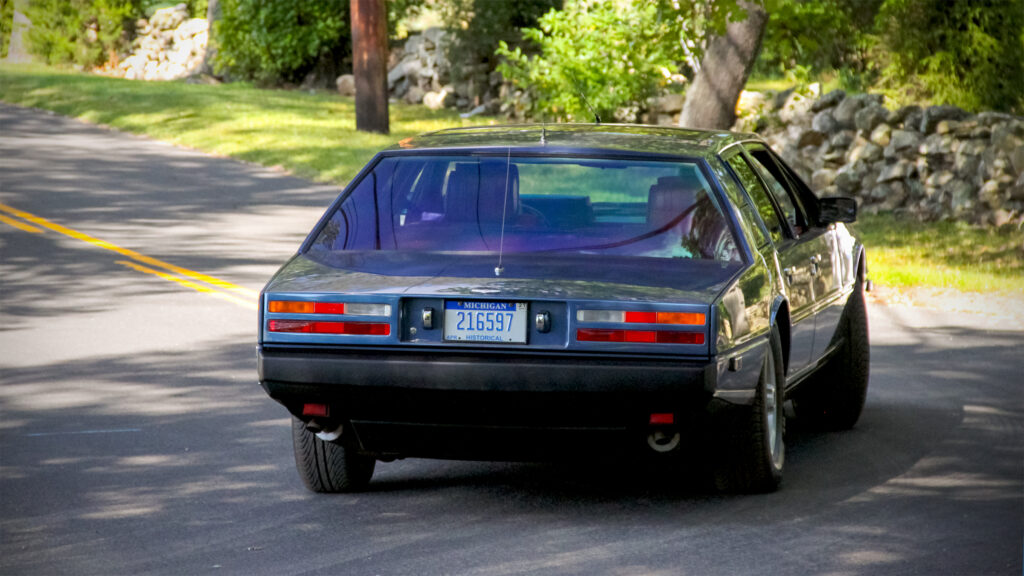
The US market did end up being one of the more important ones for the Lagonda sedan, but perhaps only in relation to how many were produced. The first federalized example was not delivered until 1982, quite some time into the model’s production run, with Aston Martin completing about 25 units per year for American buyers.
So the Lagonda was a boutique effort even by the standards of Rolls-Royce and Bentley of the time, which were busy with a lineup of large V8 sedans of their own. Despite the modest annual production volumes, with Aston Martin completing one car per week, the model received evolutionary changes through the year.
1983 saw the arrival of the Tickford limousine with an optional slightly stretched wheelbase, which bought the rear-seat passengers some extra legroom that was lacking in the debut model. This was a version produced in-house, and in addition to some more luxury features like a color TV and a VCR, as well as upgraded hi-fi audio system, the exterior featured flared wheelarches and a single-tone paint job that extended down to the rocker panels and gave the Lagonda’s still-slabby fuselage a greater visual bulk.
And it wasn’t the last evolution of the sedan through the 1980s.
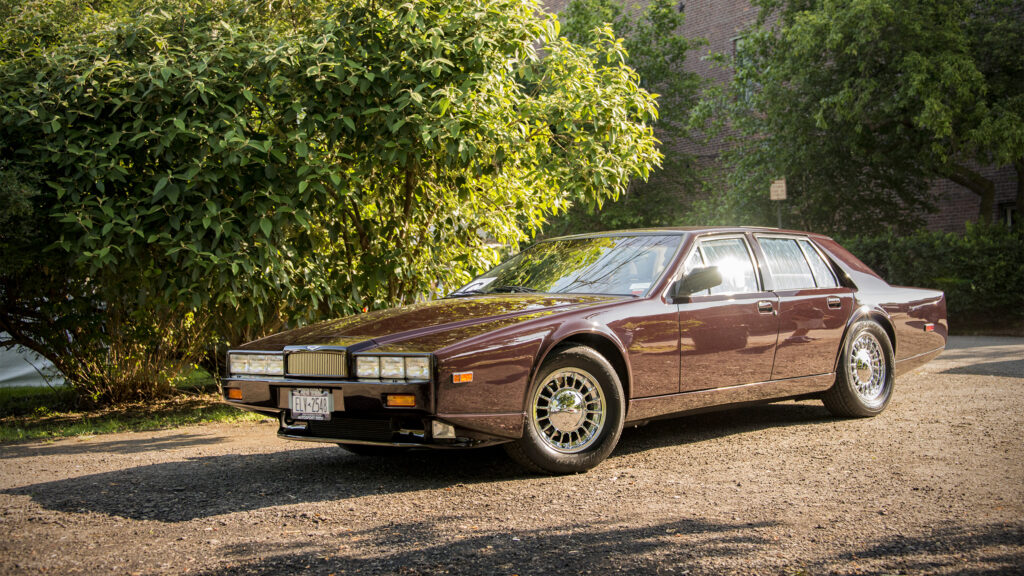
“The Aston Martin Lagonda was updated again in 1987 when William Towns rounded off the edges of the car giving it a fresh new look. Enhancements included a re-designed nose where six smaller lights replace the pop-up headlamps and new 16” alloy wheels,” the automaker notes.
Production finally ended in 1989, with 1990 formally being the last model year. And with the end of production, the Lagonda sub-brand also took a break as the automaker focused on the new generation of Virage models ahead of another period of financial instability that stretched into the first half of the 1990s.
A sedan from the company would not be seen again, this time without the Lagonda name, until the Aston Martin Rapide arrived in 2010, featuring a nod to some of the design elements of the Series I models of the early 1970s. During the Rapide’s ten-year run, there was yet another sedan effort: the even more exclusive Lagonda Taraf launching in 2015, once again based on the DB9.
But neither of these later efforts sought to seriously challenge design conventions, instead focusing on performance and luxury. And the Taraf sold in small numbers compared to the 1976 Lagonda, with just 120 units leaving the factory over the course of two years.
Nearly 50 years after its debut, the Lagonda certainly got a few things right about the cars of the future when it came to interior controls and instruments. But, as with a number of cars that were ahead of their time, getting the futuristic technology to work right all the time was the hard part.
Recent Posts
All Posts
July 17, 2026
July 16, 2026
July 13, 2026
Leave a Reply
You must be logged in to post a comment.