Smart-Sized
It seems like just yesterday that Smart launched its latest model in America: An electric version of the ForTwo. It was also its last model in America, because the brand packed up and left shortly thereafter, with the EQ ForTwo hurt not only by a rather constricting 58-mile EPA range, but also by everything else that made the ForTwo a rather unique automotive experience. In hindsight, the fact that the ForTwo had stuck around as long as it had in the US was a triumph of automaker scale over business sense, especially in a country where people commute to their desk jobs in Ford F-150s.
But in a short span of time, since corporate parent Mercedes-Benz entered Smart into a 50/50 joint venture with (rabid brand collector) Geely in 2020, the brand has reinvented its entire image and lineup, quickly churning out a series of slightly larger but mostly normie cars that look like Minis with Mercedes-Benz styling.
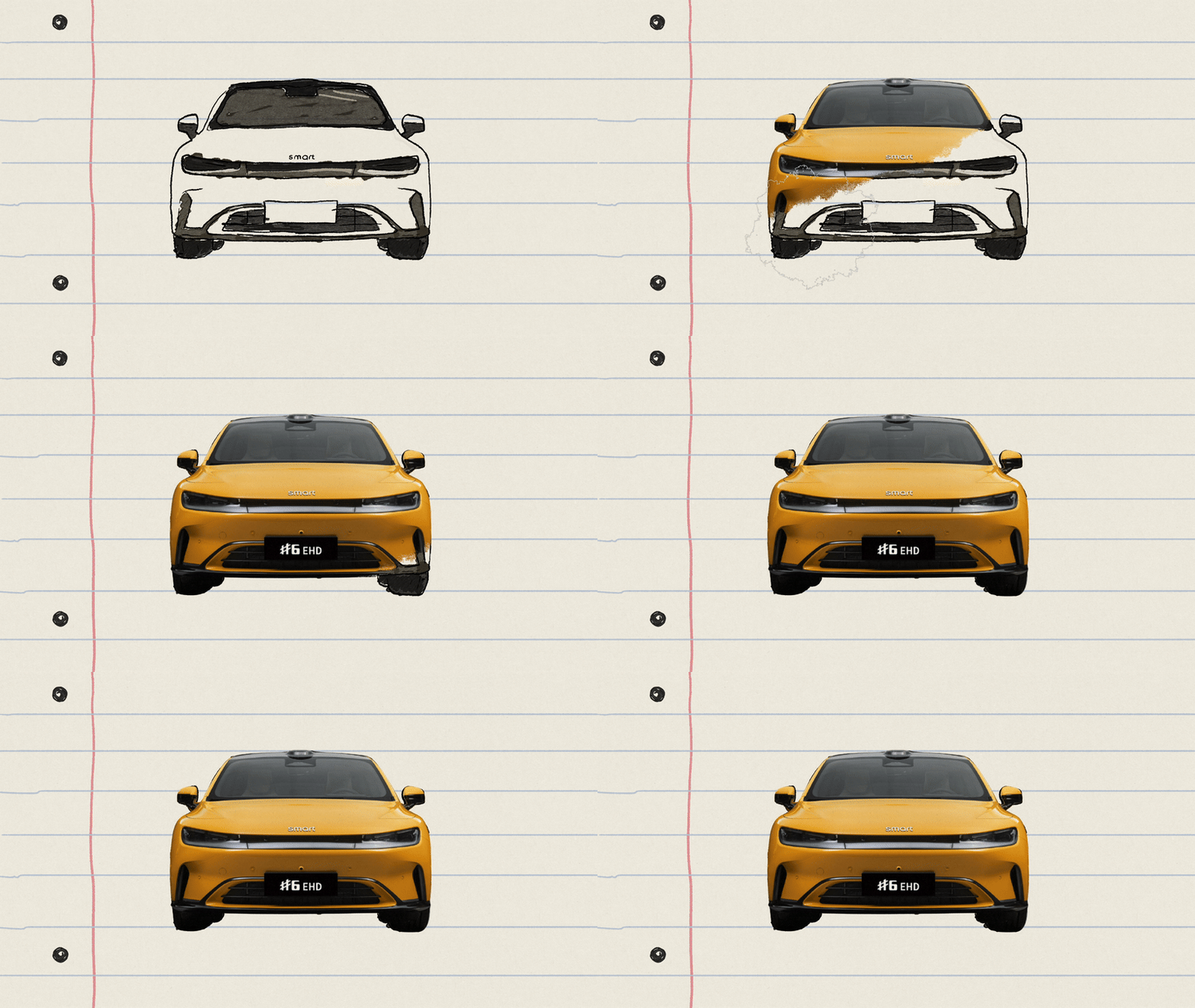
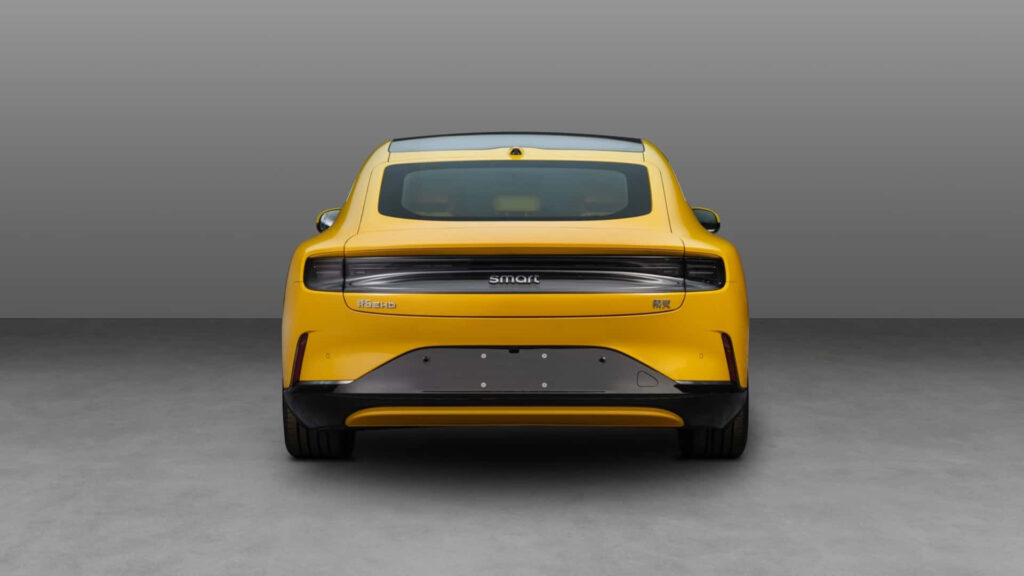
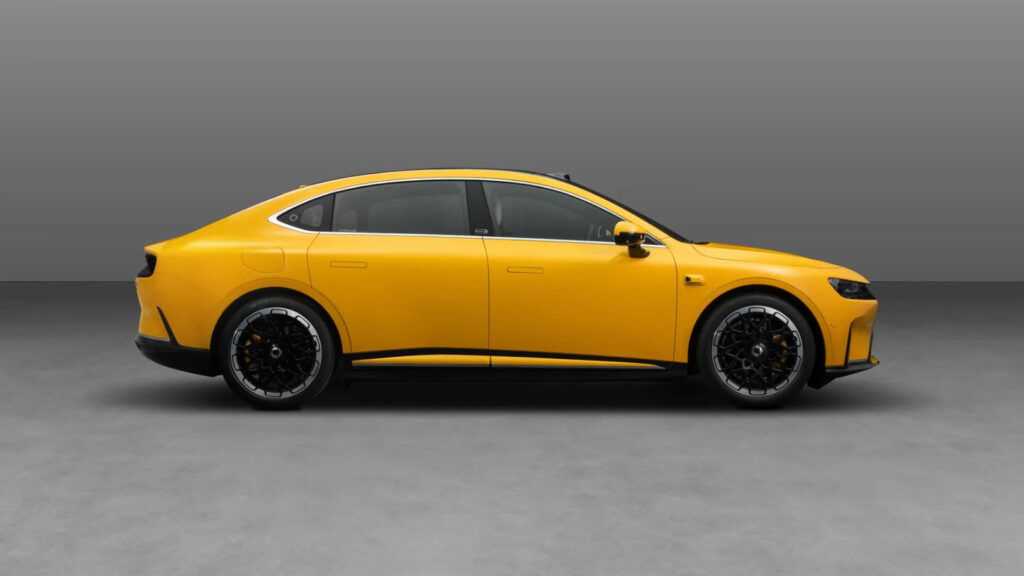
The brand’s latest model is simply known as #6. And not only is it the brand’s first sedan, it’s the most conventional looking model the revamped Smart has produced thus far, and its largest.
The Smart #6 is nearly identical in length to the modern Toyota Camry, measuring 193.1 inches front to back. So it’s just a bit longer than the Tesla Model 3, which measures 185.8 inches in length. And as you’ve noticed it’s also a little anonymous for 2025.
If the badges were removed, would you be able to guess that this is a Smart?
This could plausibly be a smaller Lucid sedan, positioned below the Air and called something inoffensive like Water. Or it could be one of the many Tesla design imitators orbiting Shanghai’s ring road. It’s as if its design was the product of all the EV sedans on the market fed into a program that “averaged” them, which AI is now happy to do for you in a matter of seconds.
But it’s not an EV at all, with #6 EHD (Electric Hybrid Drive) being Smart’s second PHEV model after the #5 SUV.
The powertrain teams up a turbocharged four-cylinder 1.5-liter engine with an electric motor placed inside its three-speed DHT transmission. This is essentially the Super Hybrid setup from the greater Geely parts bin, as seen earlier in Smart’s #5 SUV, and in the new sedan it churns out a combined 429 hp.
The battery specs have not been revealed thus far, though if the powertrain is identical to that of the #5 this sedan should have a pretty big (for a PHEV) 41.6-kWh LFP battery. That’s another curious aspect of some PHEV models in the Chinese market: Large batteries that permit more than token EV-only ranges.
And in the #6 that EV-only range is an impressive 177 miles in the somewhat optimistic CLTC cycle, while the combined range is estimated to be 1,125 miles.
The greater trend here is that in a matter of just a few years Smart has transformed from a maker of novelty cars that were often too small and too limited for their own good, into a maker of larger but still compact EV and hybrid models with some of their combined ranges exceeding a thousand miles.
Given the fact that Smart struggled in its former life due to its unique packaging, I can’t really fault it for trying to go mainstream but retaining a luxury veneer. And it’s not being forced to compete with China’s multitude of small and inexpensive EVs.
It’s not abandoning the idea of tiny city cars completely, plotting a return to the idea of the ForTwo. And Europe is still in its crosshairs. “With the successful feasibility completion of ‘project: two’ in September 2025, the brand returns to its iconic roots with the development of the smart #2 as a new all-electric city car,” the automaker recently revealed. “The ultra-compact two-seater is set to launch in 2027, with a focus on urban centers across Europe.”
As much as I’d like to pretend that compact cars with PHEV powertrains offering enormous ranges would make sense in America, the reality is that they likely won’t absent some kind of dramatic shift away from crossovers, trucks, and SUVs.
So Smart’s return to the US, which gets brought up half-seriously in publications from time to time, just isn’t likely to happen for a number of reasons besides vehicle size. (For one thing, Smart models are manufactured in China, and we all know what that means).
At the moment, the slow EREV pivot by a number of automakers gives some hope to those interested in more practical but still electrified transportation than BEVs currently permit. And the related but distinct approach of PHEVs with large batteries is starting to seem just as sensible, though we’ve yet to see such a model land stateside.
With China now slowly shifting to setting powertrain trends for other major auto markets, the Smart #6 could be a distant preview of what we could see from other, perhaps related brands here in a number of years. And that’s not a bad thing.
Recent Posts
All Posts
March 16, 2026
March 12, 2026

March 11, 2026
Leave a Reply