The EREV shift

November 6, 2025
Jay RameyEV makers are taking a sharp turn toward extended-range trucks and SUVs, as current lithium-ion battery tech approaches its limit.
The modern EV pickup era began with a scene that could have been a TV news segment in a Paul Verhoeven film. Standing in front of a massive screen displaying the words “DEMO TESLA ARMOR GLASS” in a bright red digital typeface, Elon Musk instructed Tesla designer Franz von Holzhausen to throw a metal ball at the driver window of the just-unveiled Cybertruck concept, boasting that the glass was as good as armored. (It was not). He tried again, shattering the rear window.
The Cybertruck was ultimately neither the first nor second electric pickup to actually make it to market, and by the time it arrived it was obvious that the segment was going to see some painful sales duds. The calculation of “what’s the strongest selling, most profitable segment in the American car market? Pick-ups? Let’s do a pickup.” was met with the reality that EV buyers and full-size pickup buyers are different types of people who choose cars for very different reasons.
Six years later we are in a different era for electric trucks, with most of the sugar rush having worn off by now and a big portion of the more ambitious EV truck startups having folded. The next chapter for electric pickups might be EREVs, or extended-range electric vehicles that couple gasoline engines with batteries, with engines acting solely as generators.
The reasons for this seemingly abrupt turn were the lessons learned the hard way by automakers other than Tesla over the past few years. Mainly that truck buyers imagine owning a car that can do anything at any time. They buy trucks for the edge cases, max towing, max capability, etc. They don’t want to think about whether they’ll make it to where they’re going if they’re towing a boat.
The interest in EREV powertrains also highlights a greater, often unspoken truth about this moment in the EV era: Current lithium-ion battery technology is close to reaching its limit and was never well-suited to vehicles larger than a midsize crossover. From a wider historical perspective lithium-ion compositions might some day be viewed as an early, transitory phase in the evolution of EV battery tech.
In that light, a return to BEV-only powertrains for trucks and large SUVs might only make sense when advanced solid-state compositions achieve significant weight, energy density, and cost targets that could permit vastly higher EV ranges and charging speeds than those we are used to seeing. At that point, BEV powertrains in larger and heavier models might make sense from a consumer perspective.
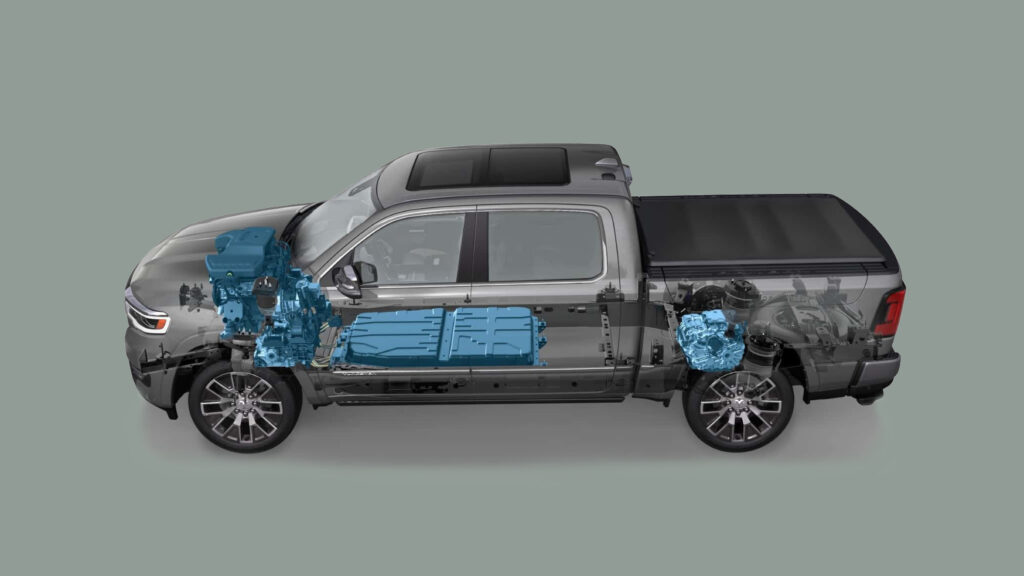
Automakers including Ram, Ford, and Scout have already made plans that reflect this reality. And already there are a few indications that this should have been the approach from the beginning.
A couple of months ago Ram shelved plans for its 2026 Ram 1500 EV truck, now planning to launch the Ram 1500 REV in its place. The truck promises a combined range of 690 miles courtesy of a 92-kWh battery and a 3.6-liter Pentastar V6.
And Stellantis’ EREV plans aren’t confined to trucks; an extended-range version of the Grand Wagoneer is in the works as well following a lukewarm reception to the BEV Jeep Wagoneer S.
Days ago, Scout CEO Scott Keogh told Bloomberg that over 80% of reservations for the Scout Terra pickup and its Traveler SUV sibling are for the EREV versions of the models, which are expected to offer combined ranges of about 500 miles.
Ford, for its part, is not stopping with pickups, with plans to offer EREV options in its SUVs citing the increased popularity of this approach in China. This means we could see EREV options in its large SUVs like the Expedition, a BEV version of which was cancelled not long ago.
Hyundai has stayed out of the EV pickup truck battle for now, but the EREV trend has already reached its product plans, along with Kia’s. The automaker is planning to deliver EREV versions of some of its larger SUVs a year from now, promising over 600 miles of combined range, with its Genesis luxury brand following suit.
Volvo has hinted at EREV plans as well, at least in the US, with the first such powertrain likely to land in the XC90 for 2028.
The first models are still about a year away. That’s a worryingly long time in the EV industry, which could experience other unforeseen shocks in the interim. But, if this all comes to pass and the trend holds, EREV powertrains will not be confined to pickup trucks. They may be employed in midsize and full-size SUVs for largely the same reasons, including the flexibility of offering smaller and less expensive lithium iron phosphate (LFP) batteries.
For now, it appears that the people behind the Chevy Volt might have been right this whole time and they were merely too early.
Recent Posts
All Posts
March 6, 2026
March 6, 2026

March 5, 2026
Leave a Reply