Decline
January 5, 2026
Jay RameyTesla's waning influence is more than just about the demise of the EV tax credit in the US.
Tesla’s journey over the past two years has not been a tranquil one, with the automaker seeing everything from waves of vandalism to federal safety probes in a seemingly short period of time. The automaker has been focused on its robotaxi program, its Optimus humanoid robot, and AI, while neglecting its aging lineup.
The automaker recently revealed its Q4 2025 numbers. It delivered 418,227 vehicles compared to 495,570 in the same period in 2024, recording a 15.6% drop.
Among other things, this has propelled Chinese automaker BYD into the number one EV seller spot in 2025, eclipsing Tesla by a significant margin. In all, BYD sold 2.26 million EVs in 2025, compared to Tesla’s 1.64 million, besting it by roughly 600,000 vehicles.
While it may be tempting to chalk up Tesla’s declining performance in the fourth quarter to the demise of the $7500 EV tax credit or other recent headwinds, the reality is that this is Tesla’s second consecutive year of decline. And it follows a long list of other trends and unforced errors over the past few years, including its CEO’s role in the short-lived Department of Government Efficiency (DOGE) that sparked boycotts and vandalism against Tesla cars and stores in the spring of 2025.
2025 was yet another year in which the Model 3 and the Model Y, both of which debuted last decade, accounted for the vast majority of Tesla’s overall output. Out of 418,227 vehicles delivered in the past quarter, 406,585 were its smaller sedan and crossover duo. The automaker does not break down its sales by individual model, rather grouping them into two categories, with the other 11,642 vehicles being the Model S, Model X and the Cybertruck.
This makes the other three models not quite rounding errors, but hardly significant to its bottom line, pointing to just how relatively little demand these three models command even if we split up that 11,642 number into perfect thirds.
Tesla’s second consecutive year of decline comes amid significant gains by Chinese automakers in Europe, where Tesla has seen some dramatic drops in demand, as well as its shrinking market share in China. BYD is certainly the best-known Chinese automaker at the moment when it comes to gains in markets outside China, but it’s not the only one finding new fans in Europe and elsewhere, with Leapmotor, Geely, MG, Chery, Xpeng, and newcomer Xiaomi gaining ground.
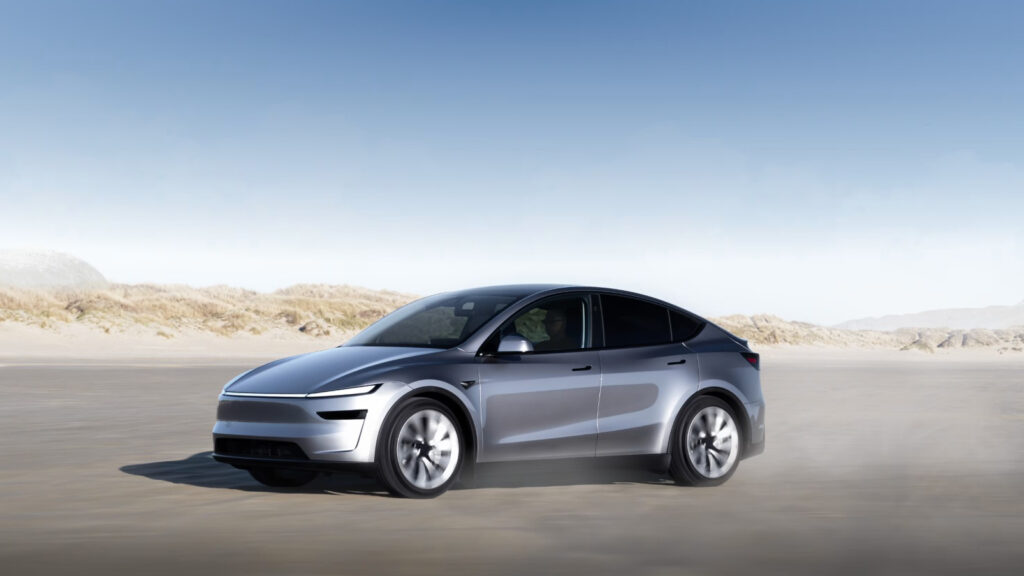
Tesla’s decline in deliveries also comes amid yet another year with few hints of future consumer-aimed models, not counting refreshes of existing vehicles like the Tesla Model Y “Juniper,” which saw a facelift introduced a year ago. In fact, when it comes to models other than the Cybertruck, Tesla has only introduced refreshes and variants of its models this decade, with one of the latest being a six-seat, long-wheelbase version of dubbed the Model YL in China.
Besides losing the sales crown to BYD, 2025 will also be remembered for Tesla’s launch of Model Y robotaxis in its hometown of Austin, Texas, months after Waymo launched its own in the same city.
Tesla says still intends to put its two-door Cybercab into production in 2026. But the utility of this effort to its bottom line is perhaps questionable, as other robotaxi companies with models in operation or development are still posting losses and are expected to do so for quite some time.
One of the few positive notes for the EV maker has been its continued grip on the EV market in the US, estimated at just over 40% by late 2025, despite the appearance of competitors in every segment it occupies.
Another arguably positive development for actual Tesla buyers this year has been the launch of budget versions of the Model 3 and the Model Y in the US in lieu of an entirely new entry-level model that has been rumored to be on the backburner for over half a decade. These two Standard models have brought the price of entry down for Tela buyers and lessees, albeit in a market now seeing quite a few tempting deals for buyers owing to wild fluctuations in demand and the sudden departures of certain EVs.
2026 promises to be another challenging year for the EV maker due to these longer-term trends, though it’s worth noting that Tesla has shown resilience even in the face of a rapidly gaining competition.
Recent Posts
All Posts
March 16, 2026

March 12, 2026

March 11, 2026
Leave a Reply