Pumped Up: Part 1
February 25, 2026
Alex KiersteinGasoline grades, toxic octane-boosting chemicals, and fraud at the pump. For something so ubiquitous, there’s a lot going on with gas.
If you want an illustration of the hierarchy of fraud, misunderstanding, and marketing that surrounds the world of gasoline, read through this article about gas stations in the New York area allegedly allowing lower-octane-rated gas to be sold at premium prices. It raises valid issues, pointing out some lapses in what is generally a highly regulated industry. It also points out some lapses in general understanding of gasoline in general: what the various octane rating grades mean, how octane actually affects an engine, and how refiners blend gasoline with additives to get the final products.
I’m not intending to write a “what is octane?” sort of SEO-gaming article here. Think of this as me filling in some gaps in my understanding of gasoline formulation and marketing, and follow along.
I want to start with octane ratings, octane additives, and octane effects. I realize that while I understand the story of tetraethyl lead (TEL) and how it was phased out of gasoline due to its rather horrific environmental and health effects, I have almost no idea about what replaced it.
It’s better than lead, but it’s not exactly innocuous.
Knock, Knock
I have to do a little exposition to make sure we’re all on the same page about why TEL, and other anti-knock additives, are in gasoline at all. You might already know this; skip ahead to the next section for a discussion of methylcyclopentadienyl manganese tricarbonyl (MMT)—the mouthful that initially replaced TEL.
For a four-stroke engine to run well, its ignition timing needs to be precise. The spark needs to ignite the fuel-air mixture at exactly the right point, when the piston’s upstroke has compressed the air and fuel in the cylinder and the resulting pressure will reach its maximum point when the piston is just beyond top dead center, extracting the most mechanical work out of the chemical reaction.
As fast as gasoline ignition is, it’s not instantaneous. A flame front propagates out from the point of ignition, filling the combustion chamber. There are many techniques to make the ignition as homogenous as possible (and thus predictable), including swirling the intake charge, multiple spark plugs, et cetera. But the point is, this is complex fluid dynamics. If something causes the gas to ignite before or after the ideal point, bad things happen.
It’s not just the combustion chamber you have to worry about. It’s the fuel. Think about all of the various feed stocks that go into oil; you have shale, you have oil sands, you have thick or thin stuff pulled out of the ground. It all needs to be refined and blended and modified so that any gas engine around can squirt some into the cylinder and the result will be predictable.
And remember, we’re talking about extremely precise actions here. Precise fuel metering. Precise ignition timing. And precise ignition characteristics of the fuel. Get one wrong, and—once more for emphasis—bad things happen.
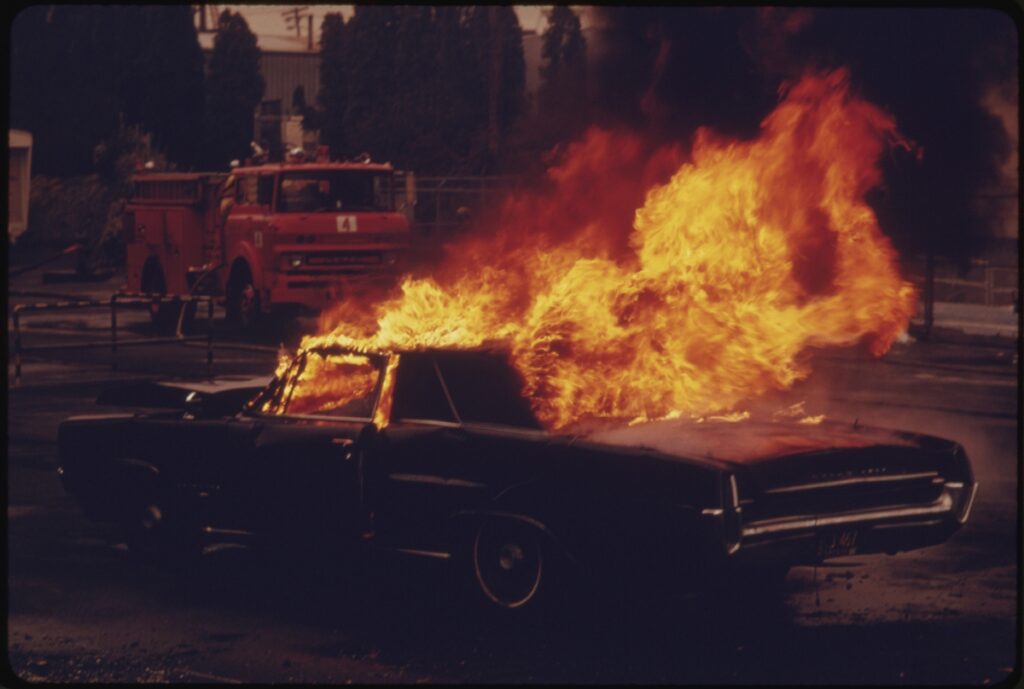
Detonation, or knock, occurs when something goes wrong. The fuel is too volatile to hold off on blowing up before the the spark plug fires. The ignition timing is wrong, firing the spark plug too early. There isn’t enough fuel in the air-fuel mixture (a lean ratio), causing the cylinder temperatures to increase to the point at which the fuel starts spontaneously combusting early. Even carbon deposits in the combustion chamber can build up to the point at which they can create a little hot spot that lights off the fuel early.
Detonation creates a spike in pressure at the wrong time, which can cause mechanical damage. This is usually damage to the piston, which results from the intense heat and additional mechanical stress of an improperly timed detonation event.
Octane Ratings, Explained
Octane rating is a measure of the fuel’s resistance to detonation. The number basically compares the fuel to how certain reference chemicals behave. Octane, the chemical, is a hydrocarbon that is highly resistant to detonation. A unit of pure octane gets an octane rating of 100. That means gas rated at 100 RON (research octane rating) has the same knock resistance as pure octane. Heptane is the inverse, being highly unstable, with a 0 RON rating.
That means 87 RON gasoline behaves like a mixture of 87 percent octane and 13 percent heptane. That’s it. It doesn’t influence how much energy the fuel has, the amount of detergents, any of that. Just how much pressure it can withstand before it goes all explodey.
Engines are designed around these reference ratings. You can add more heat and pressure to a mixture of higher octane rated gas, which is why it enables higher performance engines. You can tune the ignition characteristics to suit the fuel, extracting more power by using greater cylinder pressures (and generating more heat). Run a lower octane than designed and you risk detonating the mix early. You know the drill: bad stuff happens.
Role of Anti-Knock Additives
Anti-knock additives are how refineries ensure that the gas has predictable ignition characteristics that match the reference octane-heptane ratio. An anti-knock additive is basically an ignition suppressant. There are lots of chemicals that can work, but not all of them are practical. For example, diethyl telluride is apparently a great anti-knock agent. But if you ingest, or absorb through your skin, a trace amount of it, it causes you body to emit a hideous odor, for days, that you can’t wash off. “Satanified garlic odor,” as one of the researchers described it. Tetraethyl lead (TEL) was much more practical. It was cheap. And it worked really, really well.
One problem with lead is that it builds up in engines, so during the interwar period fuel-providers had to add some compounds that essentially react with the deposits to create volatile lead bromides, which then exit the engine as part of the exhaust gas. No harmful build-up in the engine, but instead a harmful build-up in the environment and in your blood. And that, in a nutshell, is why we don’t use TEL anymore. TEL-burning cars were producing clouds of lead bromides. This has been blamed for a number of health issues—and even a rise in violent crime that diminished when TEL was phased out.
What Replaced Lead?
Several additives were explored as a replacement for TEL during its phase-down period from the early 1970s through its prohibition (for cars) in the 1990s.
One was methylcyclopentadienyl manganese tricarbonyl (MMT), already in use as an additive for leaded gasoline. There was broad hesitation to use this in unleaded gas, as the health effects of TEL were apparent and the effects of MMT (which, of course, contains manganese, which isn’t great for you) were unknown but generally concerning. California banned it for these reasons, and because it could damage catalytic converters, in 1991. The EPA investigated MMT and couldn’t determine if it would cause widespread health concerns; eventually the producer of MMT sued and won a waiver to use it in gasoline in certain concentrations. For now, MMT is allowed to be used in gas in the US, but it basically isn’t. All of the information I’ve seen shows it makes up a very small percentage (less than a percent) of the additives used in gas in the US and Canada. Automakers have also long been concerned that MMT might damage emissions control equipment, and have advocated against its use.
Methyl tert-butyl ether (MTBE) is another TEL alternative, with equally controversial implementation. MTBE tastes terrible, and if there’s a spill of gas using MTBE additives, it can very quickly spread aned ruin drinking water supplies, even in extremely small concentrations. Because of this, California (with its sensitivity to water supplies) banned MTBE in gas in the early 2000s MTBE usage has fallen off significantly, essentially being completely phased out of US fuel stocks by 2006, although some is produced and exported to other countries.
Other ethers, like ethyl tertiary butyl ether (ETBE) and tert-Amyl methyl ether (TAME), were also phased out in 2006.
Ethanol—which has its own issues—is the current anti-knock agent of choice in the US. The most common blend is E10; some states allow E15 and E85, but not all vehicles can use this fuel. Higher-octane fuels than this are created using different combinations of the various petroleum distillates that are combined to form what we call gasoline, and then generally blended with ethanol to reach the target octane rating.
Alkylation units
There are processes that refineries can use to turn lower-octane fuelstocks into higher-octane components. Alkylation is one.
The process takes certain hydrocarbons, like butene and propene, and reacts them with sulfuric or hydrofluoric acid to create high-octane hydrocarbons that can be blended with lower-octane fuelstock to create a high-quality final product. An advantage is that the resulting hydrocarbons, known as alkylates, aren’t volatile, so they don’t run afoul of the various volatility specifications.
Basically, any region that requires what’s referred to colloquially as “clean” gas—low-sulfur gas for areas with specific smog or pollution concerns—is using alkylates. The big concern with alkylates is the production process, which involves highly corrosive acids and the attendant workplace safety and exposure concerns.
Other Octane-Boosting Agents
Some chemical compounds present in gasoline—like xylene, toluene, and benzene—are anti-knock agents. They are also highly toxic, and have been the subject of various EPA studies looking at the downstream effects of burning these chemicals and pumping them into the air.
It should be noted that benzene is specifically regulated, and that the other chemicals—xylene and toluene—are volatile aromatics. The EPA has long been interested in reducing gasoline’s volatility, and regulates this via the Reid vapor pressure measure. And yet, relaxed standards for certain fuel blends have led some observers to conclude that xylene and toluene will be used more commonly as octane-boosting agents in more US fuels. (And, perhaps, unregulated benzene derivatives.)
Aromatics levels are modified by refiners to hit octane targets, so yes, aromatics—xylene, toluene, et cetera—are sometimes blended in to hit those targets. But the volatility specifications and the overall incentives to use ethanol—policy, and cost—have led to an overall reduction in the percentage of aromatics in US gasoline.
Ferrocene is another anti-knock agent. It’s been around for decades, and is available as a user-added octane booster. But while it has less demonstrable health effects than other metal-based additives like MMT or TEL, it isn’t EPA-approved for on-road use, so it isn’t available at the pump. There’s a broad consensus that metal-based additives aren’t great, and they aren’t allowed in Europe. They can foul spark plugs, for instance. The bottom line is that ferrocene isn’t an issue for pump gas in North America or Europe.
Knock Sensors
A quick note: in most vehicles, and almost certainly yours, using the wrong RON gasoline won’t do much to your engine. If your vehicle requires “premium”—91 to 94 RON—and you dump in some 87, a sensor will detect knock and retard the ignition timing until it stops. This reduces power slightly; the engine is basically detuning itself. But it won’t hurt the engine.
Now, if you have an older vehicle with a high-performance engine, and you use an octane it wasn’t designed for, you don’t have the benefit of that automatic feedback loop. Hopefully you’ll hear the knock and carry out those adjustments manually, or fill up with the right octane.
If your car only requires low-octane gas and you put in high-octane … absolutely nothing happens. Your engine isn’t designed to take advantage of the additional knock resistance. All you did was spend more.
There are a lot of myths around the qualities of high-octane gas, and I’ll get into all of that in the next article on the subject.
Recent Posts
All Posts
February 27, 2026

February 26, 2026
February 24, 2026
Leave a Reply