Big Pug
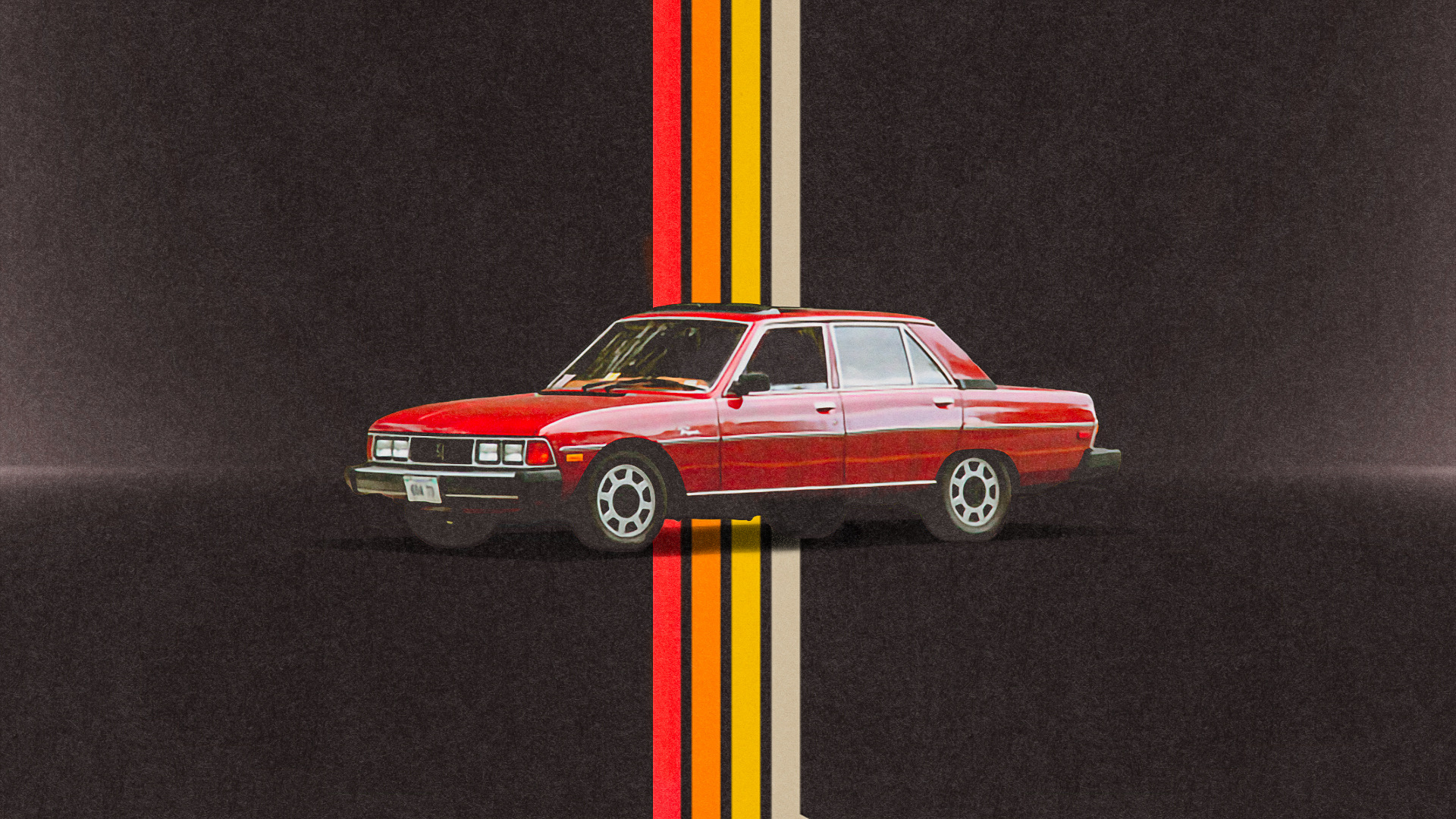
Spotting a Peugeot 505 parked on a leafy Portland street or in the Bay Area is still possible these days if you look hard enough. But finding a Peugeot 604 still in use is a much taller order.
During the 1970s for Peugeot’s lineup in the US was easily dominated by the 504 sedan and station wagon, with the model’s long production run and diesel engine availability resulting in a fleet of diesel taxis for NYC.
But as popular as the 504 had been in some narrow pockets of the country, primarily on the two coasts, it was by no means a large or particularly common car by US standards, merely fitting into the midsize category at the time and competing with the likes of the Volvo 140 and 240.
But the 504 went on to spawn yet another, much larger model, representing the French automaker’s luxury aspirations.
Peugeot revealed the Pininfarina-styled 604 in Geneva in 1975, with the French automaker using much of the 504’s architecture, albeit stretched in all directions. The slab-sided, three-box sedan was big by European standards, and if you squinted hard enough you could see the lines of the Fiat 130 Coupe that Pininfarina had also designed for Fiat four years prior.
The 604 was easily the marque’s most ambitious luxury offering in decades, and also a bit of a gamble as Citroën had a solid grip on the luxury sedan market by that point with the DS and the later CX.
What was Peugeot counterpoint to Citroën?
The 604 sought to offer a plush ride, plenty of room, and some modest luxuries, all while using a lot of the tech developed for the smaller 504. This included the infamous PRV V6, co-developed with Renault and Volvo, with 2.7- and 2.8-liter units offering plenty of power for the boxy barge. Two inline-four diesels were also on the menu during its production run.
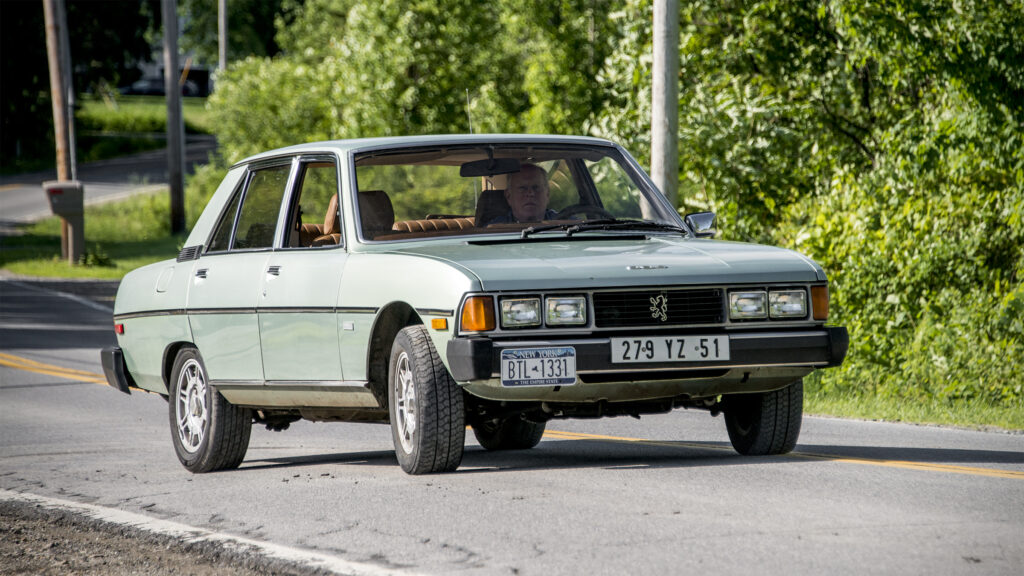
But at its core, the 604 was mostly a deeply disguised, bigger 504.
Peugeot’s 604 was also far more conventional looking than anything Citroën fielded at the time, with Sochaux seeking a broader audience that might have balked at Citroën’s unique styling and technology. The 604, therefore, was an effort to be modern yet not polarizing, adopting conservative lines and simpler, proven engineering underneath.
Sales of the 604 in Europe were strong during the first year, and this convinced Peugeot to market the 604 in North America, where big European sedans offered a certain cachet and commanded a premium. It could woo American buyers with its plush cabin, soft ride, precise rack-and-pining steering, and crisp exterior design. At least in theory.
In practice, the 604 was a niche offering upon arrival stateside in 1977, and was soon upstaged by the more agile yet still roomy 505 in 1979.
But with a sticker of $10,990 for the PRV V6 model, the 604 managed to undercut in price some European favorites such as the BMW 5-Series, Mercedes-Benz 280E, and Jaguar XJ6. And it was a shocking bargain compared to the larger German sedans of the time, besting some of them in interior accommodations, including its generous rear legroom.
At roughly half the price of the first-gen BMW 7-Series, it was hard to argue with the value it offered.
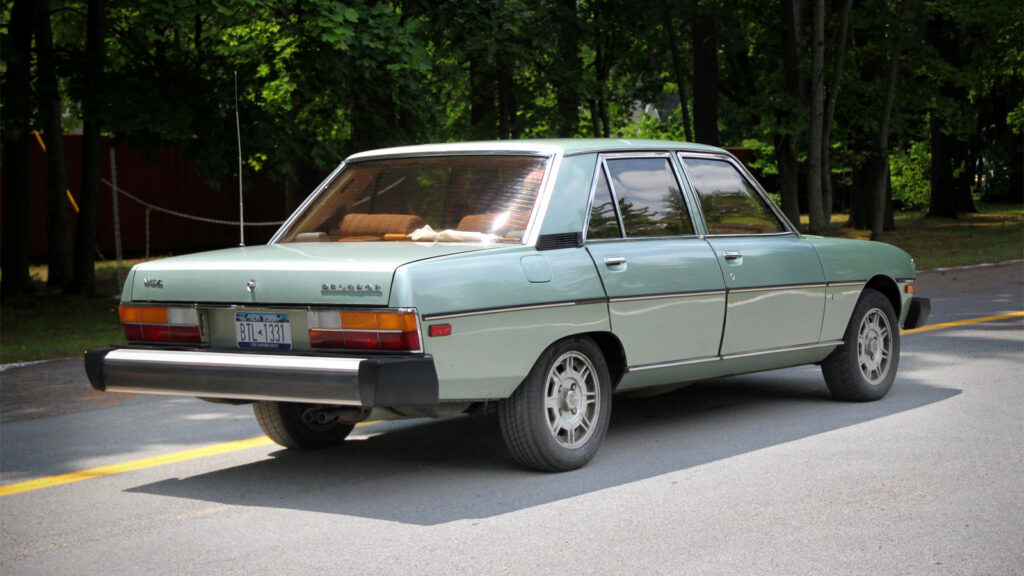
The 604 landed in the US in an altered cosmetic form, complete with some truly generous DOT-mandated 5-mph impact bumpers (that have to be seen to be believed), and quad rectangular sealed-beam headlights. Emissions equipment for the PRV V6 dulled some of its power as well, but the same was true for just about everything at the time.
Still, with MacPherson struts up front, semi-trailing-arm rear suspension, and anti-roll bars front and back as well as disc brakes all around, the 604 ticked a lot of the boxes that had been drawing consumers to the Germans.
With 133 hp and 162 lb-ft of torque courtesy of the still-carbureted 2.8-liter PRV V6, it made the jog to 60 in just over 10 seconds with a five-speed manual, which wasn’t bad for the era with a curb weight of 3,435 pounds to pull. A Borg-Warner three-speed auto was also on the menu for American buyers.
Reviews of the time, including those of Road & Track, generally praised the plush ride and roomy cabin, but found fault with a few ergonomic items, including the flat, bus-like angle of the steering wheel, and early lock-up tendencies of the front brakes. (Needless to say, this was before ABS).
“However, the Peugeot is great fun on the open road, never losing its Gallic dignity because of irregularities in road surfaces,” Road & Track wrote in July 1979.
If there was one thing that gave the 604 an unexpected boost in the US market, it was the continuing gas crises that gave a leg up to automakers with diesels in their lineups.
The 504, 505, and 604 all had diesel-flavored engines on their menus at this crucial time, and for some buyers this was a deciding factor, with the 604 offering a 2.3-liter Indenor four-cylinder turbodiesel. After 1981, it was the sole engine option stateside, with Peugeot deciding to ditch the somewhat thirsty PRV. And the turbodiesel’s 32 mpg on the highway was tough to argue with.
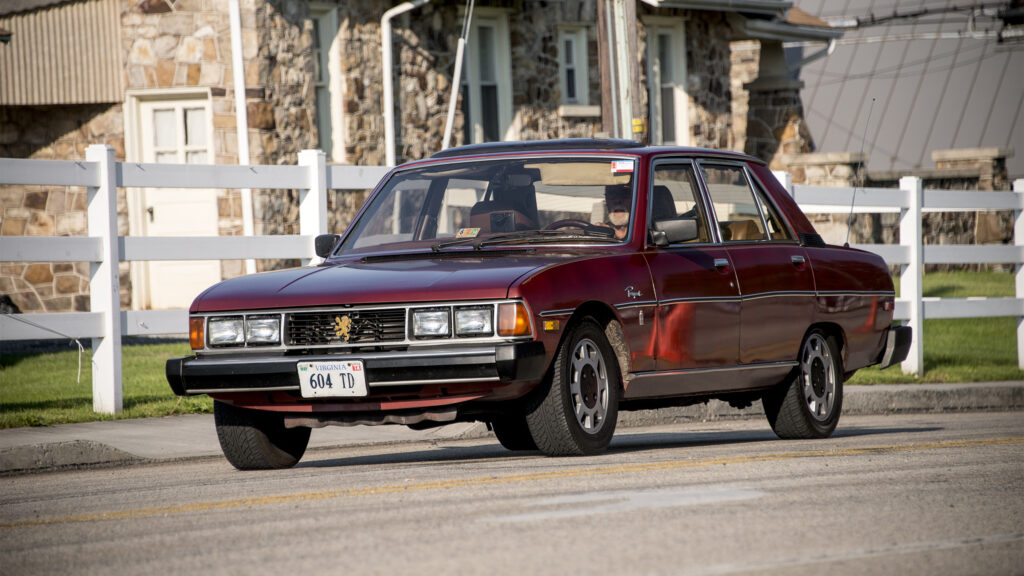
However, as the gasoline woes began to fade during the first Reagan administration, so did the fortunes of these diesel models. In hindsight, Mercedes-Benz took advantage of its powertrains to the fullest with models like the W123, and a solid percentage of Peugeot 505 and 604 sales were indeed diesels in the first half of the decade.
But while it’s still possible to encounter the odd 405 or 505 on the road, at least in fair weather, spotting a 604 is an entirely different matter.
What ultimately went wrong for the American-sized 604?
The arrival of the Peugeot 505 gave the brand a real mid-size American offering, complete with slightly less boxy styling, and a much livelier suspension along with tidy European road manners. The 505 sedan and wagon would go on to be the marque’s bread and butter through the 1980s and beyond, which was also the last full decade for the brand amid a gradually thinning dealer network. Sales of the smaller 405, launched in 1989, were a tiny drop in the bucket and never replaced the 505.
Also, Peugeot’s sales network was purely regional with strongholds in the northeast, the mid-Atlantic, the Pacific coastline and other Euro-friendly enclaves. Many northeast US states had over a dozen Peugeot dealerships each, sometimes just minutes from each other, while other states had just one.
And the 604, while certainly available at these stores, was never a sales leader.
The 604 remained on sale in the US until the 1984 model year, with Peugeot concluding that the closely sized 505 fit the market better.
Recent Posts
All Posts
March 16, 2026
March 12, 2026
March 11, 2026
Leave a Reply