Longterm
June 24, 2026
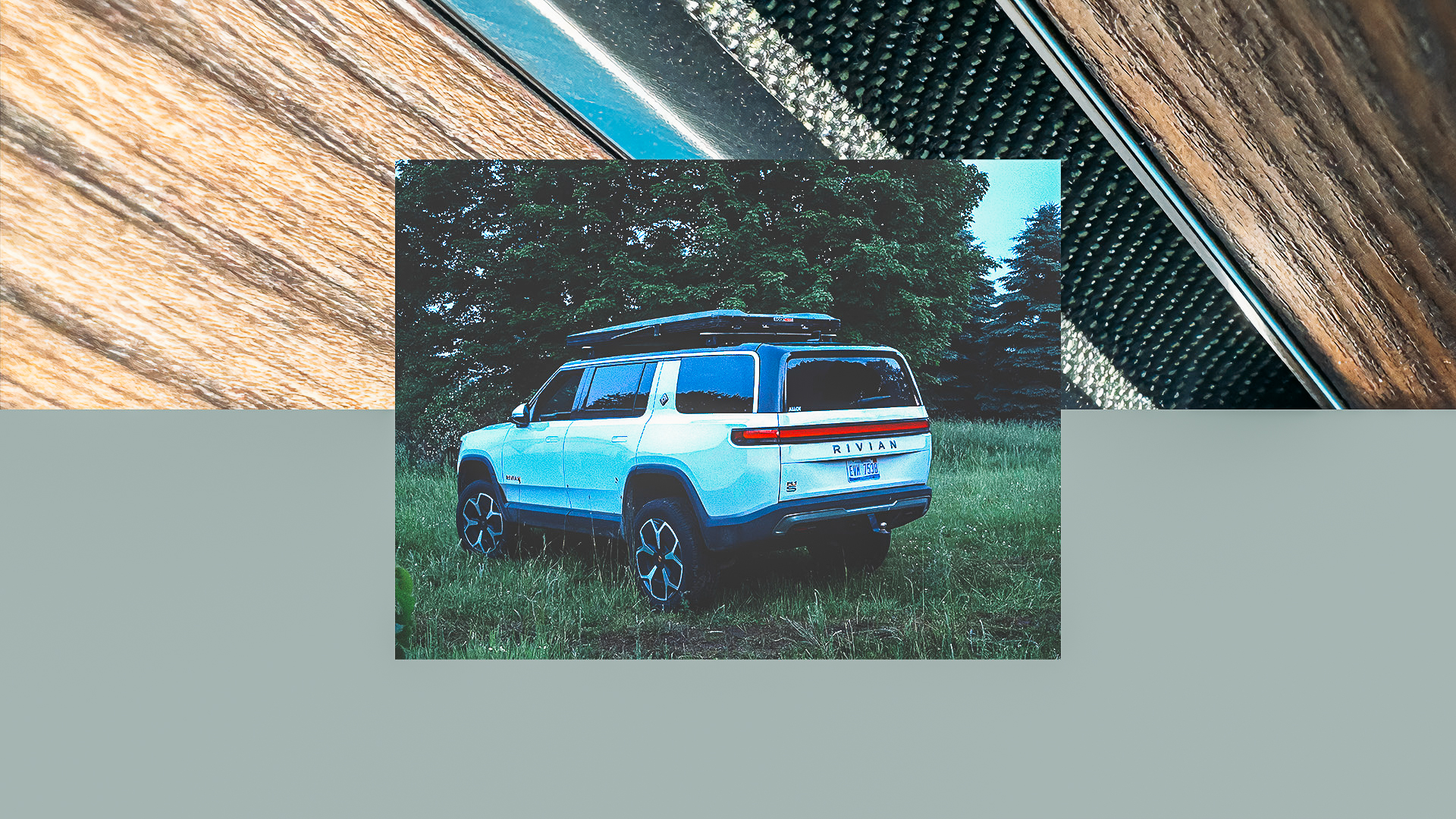
Rory CarrollI don’t know what I was thinking, exactly. I was in the middle of trying to buy Jalopnik. I was annoyed at having had to fix some little issue on my old Lexus GX. I was really einto the new Lexus GX 550, but swayed by a Rivian R1S payment that was around half as much per month. I had come under the belief that everything was about to take a drastic turn for the better. I thought maybe I was the kind of person who would drive a brand new car that I didn’t have to think about. Here I am two years later, returning that leased R1S to Rivian. I am optimistic about Alloy, but very little else.
The 2024 R1S Adventure Quadmotor Large Pack I just gave back is almost 7,000 pounds. It has a beautiful green interior. It makes 835 hp and will do 0-60 in around 3 seconds. List price was $95,534. I paid a $1,000 deposit and I think I put $10,000 down and paid $713.44 for it per month. Typically, Rivian’s site will show you the cars that are available in your region, you pick one and they deliver it to your house. Rivian helped me find a Quadmotor Large Pack with a green interior but I had to fly to Virginia, pick it up and drive it back to Northern Michigan. I chose to sleep for an hour before driving it to Watkins Glen for the IMSA race. That first massive road trip ate up a lot of lease miles, but it also left me really impressed.
Service:
-I ran it to 0 charge once, about 100 feet from my driveway. That killed the 12V battery but I was able to resolve it myself by pulling a couple of leads through the bumper and jumping it. They’re still in there, wrapped in tape.
-A mobile tech was dispatched to tighten “hub to knuckle fasteners in 4 locations” but he said it wasn’t necessary in climates with moisture and road salt. It may have been done during a subsequent service.
-After running through the field behind our house at high speed, the suspension dumped a lot of green fluid onto the driveway. Rivian sent a flatbed for it and repaired it at no cost, though I did have to drive a couple hours to the nearest service center to retrieve it. With my travel schedule it took me a while to find a whole weekday to blow and the Rivian Service guys started threatening to charge me for storing it in their parking lot. Fair enough.
-A windshield wiper failed trying to move some heavy snow and I damaged the shift lever. Both were replaced at no cost. I drove the car to the service center and they fixed it while I waited.
-The charge door is actuated by a motorized screw drive. During a particularly long run of cold weather, it iced over and came out of its track. Over two visits, a mobile tech was able to get the door to mostly shut but it now sticks out about an inch from flush. That cold stretch had also caused a coolant leak, I think maybe an o-ring shrank and let some fluid out. Rivian service had been arguing with me about driving it to them, but I didn’t want to drive the car two hours on the freeway if it was low on coolant. Luckily the tech who worked on the charge door was able to confirm that the coolant system was no longer leaking, though Rivian service continued to call, asking me to deliver the car to them.
When I took delivery of my R1S, two other local dads asked me if I’d recommend a Rivian and I did. One bought an R1S and the other bought an R1T. The Rivian service center recently asked the R1T owner to deliver the car to them to fix a leaking air suspension. I told him it wasn’t safe to drive it on the freeway with the suspension on bump stops and eventually they relented and picked his truck up, though they told him he’d have to pay for the tow if it ended up being outside of warranty.
Rivian is in a tough spot here. Adding service capacity is expensive and mobile techs can only do so much in a customer’s driveway. Still, it’s one thing to ask a customer to drive across town, but asking a customer to drive a couple hours in a car that isn’t working correctly is a level of risk I would not want to assume. Traverse City, where I live, has a fair number of Rivians and I wonder how many of them have limped down to Caledonia or some other service center under sketchy circumstances over the last few years. I don’t want to narc on anyone in particular but my service experience overall was pretty inconsistent and I often felt like I was being asked to do Rivian a favor. I wonder how owners that traded in a Lexus or Mercedes-Benz found their service experience.
Quality:
I was very pleasantly surprised by the build quality overall. The interior didn’t develop any annoying squeaks or rattles over 24,000 miles and two years and it still looks about the way it did when it was new. There was a small amount of factory paint oversrpray where the white A-pillar met the black roof and there were what appeared to be tape-lines where the B- and C-pillars met the beltline. Other than that, it was surprisingly well knocked-together.
Appearance:
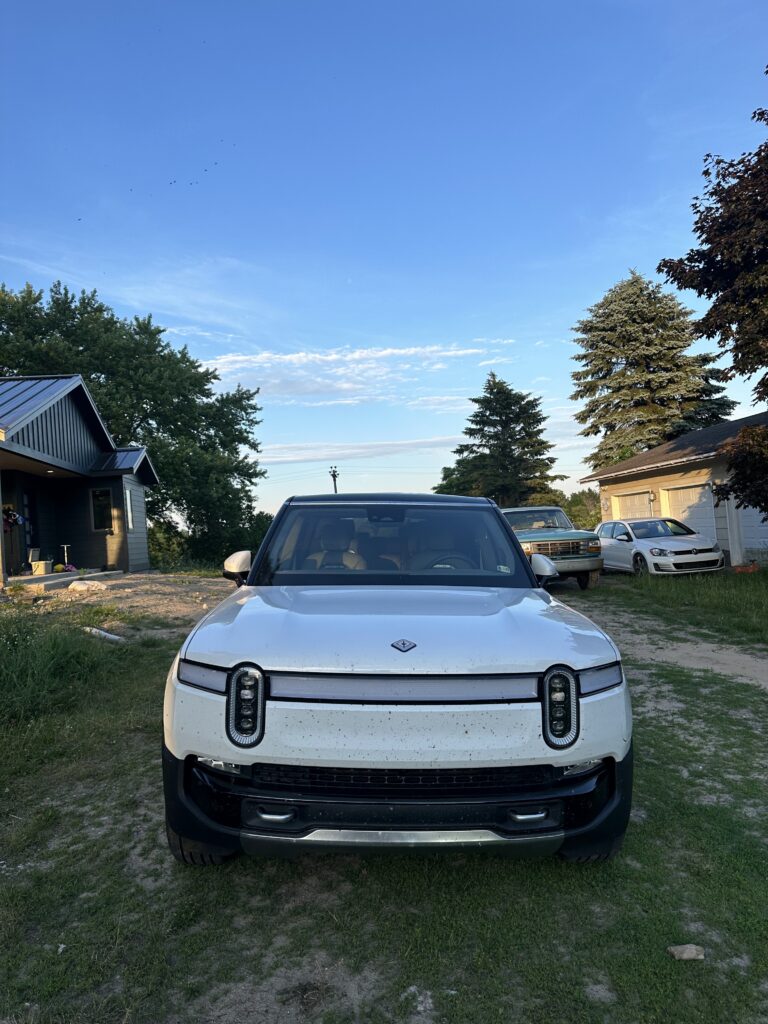
Early on, someone told me the Rivian looked like an axolotl, which is very important to science because it can regrow lost appendages. That resemblance aside, I think it’s probably one of the more successful SUV designs of the last few decades. It manages the balance between projecting “friendly” and “capable” well. The proportions are fantastic, I’d put the rear three-quarter in the conversation with some of the all-time great SUV designs. If I were going to keep it, I’d be on the lookout for a set of smaller stock wheels in one of the more off-roady styles.
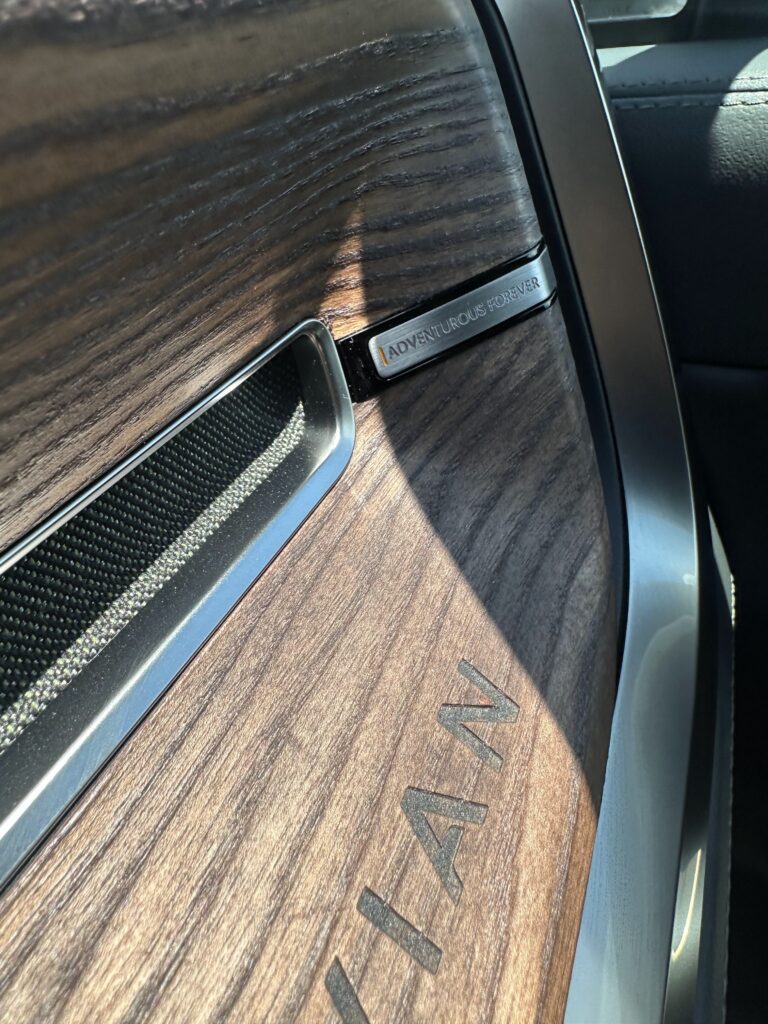
The interior really is on another level aesthetically. The green upholstery and open-pore wood trim was an unreasonably large factor in my decision to lease the car in the first place. The little “Adventurous Forever” badge on the dash was a little cringy, but the whole Rivian thing is a little millennial cringe. It’s just so perfectly targeted to the WFH Patagonia dad. It worked on me and a bunch of the other guys I see every day at school drop off. I don’t really buy Patagonia stuff anymore, but for a minute Rivian had me dead-to-rights. I have to respect it.
Performance:
The tires (Pirelli Scorpion Verde) were the weak link in the entire package. Stiff but ok on dry pavement, bad in the wet, terrible in the snow, useless offroad, and cooked after 25,000 mostly easy miles. I can’t imagine what Pirelli’s design object was. I hope Rivian got a good deal on them. When we turned in the R1S, Rivian asked us to buy them a single tire. We’ll see if Rivian gets that money from me, I think you could make a case that tire wear should fall under “normal wear and tear.”
Some early experiences with the Pirellis kept me from ever really pushing the R1S off-road, which is a shame because from what I’ve seen, they’re really capable. It is also really capable of blowing the doors off just about anything you’re likely to encounter on the road on a given day, which comes in handy if you do a lot of divided highway driving where passing opportunities are limited. I don’t typically care about driving fast in an EV, the sensations I’m looking for just aren’t there. The Rivian did give me enough motor whirr on hard acceleration to create a little excitement, and the drive mode calibration is really incredible. If you want to slide the hulking SUV around like a sports car, you can. Ater the initial novelty wore off, after it stopped being fun to shock a carload of people with a hard launch, I spent most of my time in normal mode. I will also note that the Rivian is a monster tow vehicle over short distances.
Because it shares a wheelbase with the R1T, there is a damping issue at the rear that presents over highway expansion joints or badly broken pavement. I don’t know if I’d have noticed it if I hadn’t been told about it in advance, but it was notably improved by software updates over the course of my time with it and it’s been addressed in the Gen 2 Rivians.
The UI/UX is among the very best in the car business and will make you forget all about Apple’s goofy ongoing CarPlay experiment. It’s just intuitive and thoughtful in a way that other systems aren’t. It made the experience of using the car better, which isn’t something I can say about the systems in a lot of other cars.
Unfortunately, the car was also hampered by a number of very frustrating tech decisions that felt divorced from the reality of using the car in the real world. If you’ve used a car off-road, in deep grass, you know there are a number of situations where you might need to move the car a few feet without closing a whole bushel of grass in the door. Rivian won’t let you do this, the car will not move with the doors open. You’re taking some grass aboard. The “phone-as-key” thing means that if you’re working in the yard with headphones on and get too close to the Rivian, it’ll steal your Bluetooth connection. If you’re in the shop and someone else moves the car, it’ll steal your Bluetooth connection. The only way to fix this is to “forget” the Rivian. Why not use a sensor that detects weight in the driver’s seat as the trigger to connect?
(Yes, it’s maddening that Apple hasn’t figured this out on the iPhone/AirPod side, but their UX has long been aggressively anti-user. I don’t expect them to act in my interest.)
And then there’s the way the Rivian does seat memory. If your significant other hops in the passenger seat before you, the Rivian assumes they’re driving and moves the driver’s seat all the way up to the dash. Again, there are weight sensors in the seats—keying this function to the sensor in the driver’s seat would solve the problem. The door handles often take a few seconds to recognize you and present, often when you’re standing in the rain or snow. If you attach a roof-top tent to the beautifully designed roof bars, you’ll have to physically stop the power liftgate from hitting it when you open it. Why can’t I set a limit for travel?
The era of the “software enabled vehicle” was supposed to allow us to customize these experiences, but it’s mostly created new ways for cars to be annoying. The R1S was so thoughtfully designed in so many ways that the things they didn’t think of really stick out.
Overall:
I think Rivian is right to go without dealerships but that they also need to spend some time improving the service experience. They may not have the money to drastically increase their service footprint, but just getting it organized would make a big difference. A consistent and well-articulated policy on when a car gets flat-bedded versus when it needs to be delivered would be a good first step. I can’t believe Rivian wants their cars running on the freeway without coolant or with suspension problems.
The system by which customers are contacted by Rivian for service could also use a look. In my experience, Rivian would often contact me to schedule service that had already taken place or multiple Rivian representatives would call me about the same issue. This was especially annoying when they were trying to get me to drive the car to them for the aforementioned coolant leak, something they continued to do after a tech noted that the leak had been resolved, and after I explained that to their service people.
The Rivian’s biggest limitations are kind of inherent in the idea of the car. It’s an adventure-ready family off-roader, provided you can get into nature without getting too far away from a charger. If you do live somewhere where charging is available at a trailhead, or there’s great camping near your home charger, it’s an incredible thing. Because of where we live and the tire situation, I didn’t make much use of the incredible capability engineered into it.
It is a fantastic commuter, but so are a lot of cheaper, more practical cars. Rivian was conceived in a time when a lot of people anticipated endless expansion of EV market share and infrastructure to match. A lot of people also anticipated that EV owners would buy SUVs and trucks, and that SUV and truck owners would be open to EVs. None of this has materialized in a version of the United States that can’t maintain infrastructure, provide basic services or even build war materiel anymore, let alone get aligned behind a fledgling technology. No matter how good the product is, Rivian is facing a tough market and a government that has gone from insufficiently supportive to openly hostile.
My personal conclusion is really just conventional wisdom: An EV is great for the type of driving I do 99% of the time. But for the kinds of tasks that require a larger car, family road trips, camping, towing, I’d be better off with a conventional SUV, which is something I could rent for those edge cases. That said, I have and will continue to recommend Rivians to people who live in places where they make sense. If you’re a weekend warrior in Denver or LA, there’s no other EV I’d tell you to consider. (I haven’t driven an R2, but I’m hearing great things.) If the service experience gets better, I’d happily drop that caveat from my recommendations. At the end of the day, I think I’m more of a “maintain my own old car” type of person than a “I like having a car under warranty” type of person. Apparently that’s something that I needed to be reminded of.
Recent Posts
All Posts
June 23, 2026

June 21, 2026
June 19, 2026