I Roll?

January 5, 2026
Brett Berk
The 99 year-old Swedish automaker faces a confluence of crises in one of its biggest markets. We ask its new regional president how it can pull through?
Will Volvo Make It in the US?
Despite an American vehicle market that has expanded overall for the past few years, Volvo’s sales in the United States fell significantly in 2024 and fell even further in 2025. This is not great news for the Chinese Geely Group-owned Swedish automaker as it heads into the final year in its first century. Particularly if, as Luis Rezende—Volvo’s new president of the Americas—told us, the company “aims to grow from selling 120,000 cars here this year to 210,000 cars by 2030,” a startling 75% increase.
Many of the issues facing the brand are nearly universal in the American auto market in this bizarre moment, and some blame for them can be placed squarely with the capricious revanchist blowhard, and his cronies, who control what remains of our federal government.
Volatile protectionist trade policies have slapped hefty, and at times unpredictable or indecipherable, tariffs on imported cars. A bellicose antipathy to electric vehicles (and climate science) has eliminated tax incentives aimed to help consumers make the switch to the often-pricier cleaner powertrain option, and initiated a reactionary shift against EVs, renewable energy, and conservation. This radical whiplashing against long-term industry progress toward full electrification has stranded automakers with battery-powered platforms that they can’t count on selling here in the future, and without gasoline-powered ones that they can.
“In the US right now, we are seeing that it was a year that was, let’s say, a little bit unusual,” Rezende says. (Understatement alert.)
But the unusual is likely to remain typical so long as this administration remains in power. So how is Volvo planning to endure, what Rezende calls “this less globalized world”?
First and foremost, it is moving more production to its 10-year-old American facility near Charleston, South Carolina. “We are bringing so much investment to the U.S. in the coming years,” Rezende says. “Today Volvo imports 95% of our product here. In 2030 we’re going to be producing locally around 60% of our sales.”
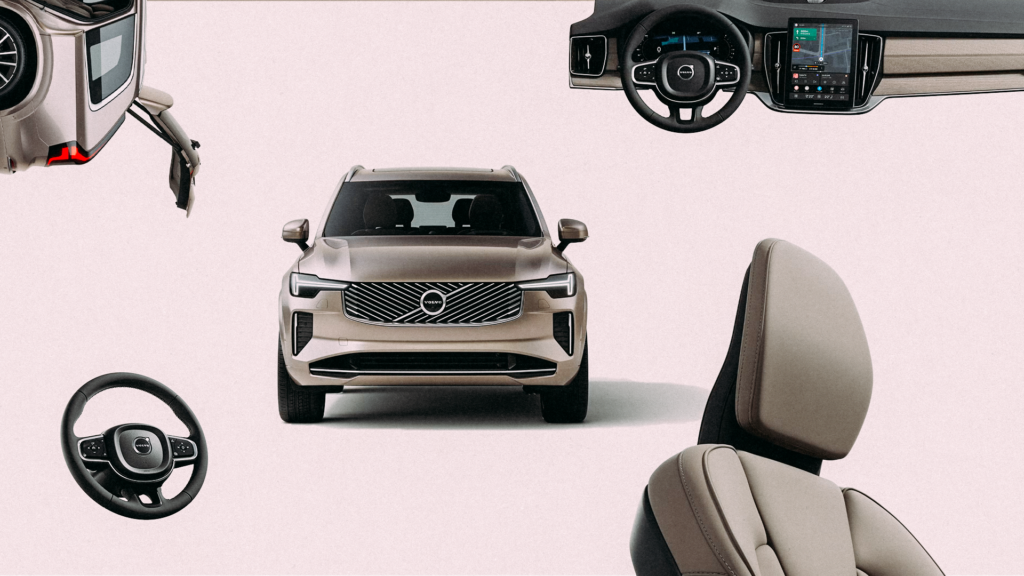
It is also shifting the vehicle mix that it will be producing domestically. In addition to continuing to build its flagship EX90 three-row electric SUV in the Palmetto State, it will begin manufacturing a new full-size plug-in-hybrid SUV in 2029, intended for the U.S. market but capable of being exported globally. And, intriguingly, in 2026 it will also start assembling in Charleston a continuation variant of its best-selling, aging, gas/electric hybrid XC60 crossover.
“XC60 had its best sales year this past year. So that is extremely important for our portfolio,” Rezende says. “We’re going to have a facelift. We’re going to have a change in the interior. A full refresh. We have done this with XC90. We are going to do the same with XC60. So, it will be a continuation of these cars for sure in the coming five to ten years.”
The current XC60 began production in 2017, so it has already surpassed its standard 7-year life cycle. And its underlying SPA platform dates back even further, to 2015, with the introduction of the current XC90, also still in production. These cars were supposed to be replaced entirely by the battery-electric EX60, and EX90. Neither has occurred, and now Rezende has confirmed that they may remain in production for up to another decade.
This continued investment in and use of such outdated underpinnings reflects one issue that is more particular to Volvo in the current automotive landscape. It, nearly alone amongst automakers, went all-in on a planned transition to a fully electric lineup by 2030. It has since renounced this plan, and won’t provide a new date for the change—“Maybe 2035, maybe 2040. We don’t know,” Rezende says.
But because of the current, in many ways manufactured, challenges with EV adoption, and Volvo’s lack of other options, the brand has “had to continue supporting and even developing updates for those old platforms,” says Sam Abuelsamid, vice president of market research at automotive research firm Telemetry. “For a relatively smaller volume manufacturer like Volvo, that’s a problem, and they’ve got to make hard decisions about what they’re going to do, and what products they’re going to invest in for the next five to 10 years while they try to make this transition.”
Similarly ahead of the curve compared to its competitors in the legacy automaker space, Volvo has also already executed a shift, with its EX90 and EX60 electric vehicles, to a more “Software Defined Vehicle.” This means that technology, drivetrain, and driver assistance systems are all controlled by centralized processors, instead of individual modules. Given the growing complexity of in-car needs, this seems to be the way of the future. Unfortunately, in completing this transition, Volvo ran into serious trouble.
“The EX-90 and its platform mates like the Polestar III were delayed over a year because of problems that Volvo had with their software development,” says Abuelsamid. “And they had a lot of issues getting that finished and validated and debugged, to the point where, even now, well after launch, they’re still having significant software issues.”
This practice, inherited from the consumer tech industry, of putting out a buggy “Minimum Viable Product” and then fixing it after the fact with over-the-air updates, might work for an iPhone. But it doesn’t inspire confidence in a 3-ton vehicle laden with advanced tech, capable of moving at over 100 mph, and responsible for protecting its occupants and other road users.
Rezende seems oddly non-plussed about this major setback. “Normally when you launch a new car, you have some issues,” he says. “Of course, we tried to improve. But that’s something that happens to not only Volvo but to all manufacturers when you have a new platform, especially in a country like the U.S. where the consumer demands are extremely high.”
While this may be generally true, not every automaker has staked its entire identity upon safety, stolidity, and reliability the way that Volvo long has. Might the repercussions of failing to meet these core consumer expectations have something to do with the brand’s declining sales? Seems plausible.
One significant change Volvo will implement in the States in its effort to increase sales is to regionally tailor its messaging and its allocations of vehicles to dealers. This is meant to address vast differences in powertrain and model preference in different areas of the country, and also to bring in a more diverse group of owners than Volvo’s current demographic, which Rezende defines as “majority, 50-plus white men.”
“The way we do business in California, it’s completely different from New York or Texas. The consumer trends, the consumer wants, the wants for us, even the market for leasing or buying,” Rezende says. “Since we have three regions, we’re going to empower them much more to be much closer to the consumer.” He compares this to the company’s strategies in Europe, where continent-wide campaigns have lost favor to those targeted at individual countries. “The 50 United States are like 50 separate countries,” Rezende says.
This is quite an about face from Volvo’s recent strategies, which revolved around building one electrified “World Car” that could be sold in any market around the globe. But might attempts to build different vehicles, messages, and plans for every country or state threaten the company’s long-term existence? Might atomization atomize a small automaker like Volvo?
“Yes, they have a questionable prognosis,” Abuelsamid says flatly. “But a lot is going to depend on Geely’s ability and willingness to continue to invest in Volvo—to provide them with the resources to continue to develop down these multiple paths, with hybridized combustion vehicles, as well as with full electric.” As long-term fans of the brand, we hope its first century isn’t its last.
One response to “I Roll?”
-
I’m such a rabid Volvo fan. Five wagons, one 2 door sedan, one SUV, they’ve been so good. As Volvo crosses the terrain of the current anti-EV “president,” clearly it’s focused on software, marketing. I can’t encourage enough, that Volvo dicects other brands currently known for reliability. BMW, Lexus, instead of chasing the mythical “perfect tech.” We just want gorgeous, safe, RELIABLE Volvos.
I’ve been finanically able to afford a slightly used XC90 for about six years. It would serve me SO well, yet, I’m not a fool. This brand is consistently in the bottom of reliability surveys. Volvo needs to focus on bulletproof trustworthyness. When I should have been buying my eighth Volvo, I didn’t even consider it, and drive a BMW suv, now. Only because of stupid software and short-lived ERAD, AC systems, so plaguing to the brand. It’s a pity.

Recent Posts
All Posts
March 2, 2026
February 27, 2026

February 26, 2026
Leave a Reply