Catch ‘Em

November 5, 2025
Cole Pennington
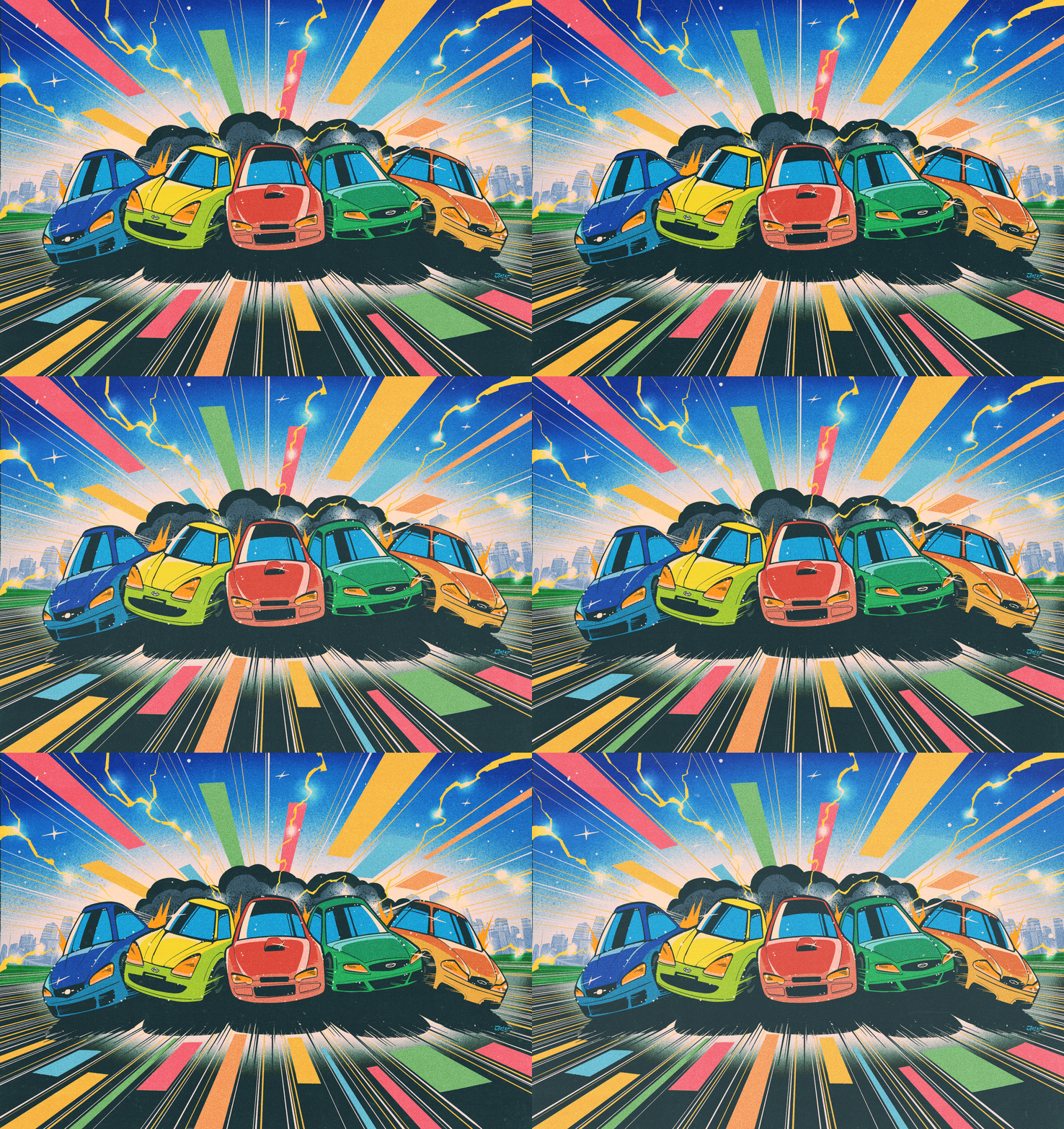
Forget the six-figure Skylines and Supras and check out these overlooked gems from Japan.
Back when most of the cars on this list were made, in the early 2000s, otaku culture was relatively fringe in the USA. Dragon Ball Z had reached mainstream status but you had to go to specialty bookstores to get the really good stuff. The 90s anime boom fizzled out by the time the millennium rolled over. Now, of course, that’s not the case. There’s another wave of Japanophilia upon us, and with it, the prices of ‘90s JDM icons have risen, too.
But just like it was worth taking that long drive for deep-cut manga, it’s worth peeling back the layers of hype today to find the lesser-known JDM gems from the ‘90s and early 2000s that deliver on the cool factor (and sometimes weird factor) but still remain relatively affordable. The interesting thing about broader otaku culture is that there’s a group of people with a deep sense of appreciation and admiration for just about anything, and that means cars, too. That’s the fun part, delving into the annals of the internet and digging up long forgotten JDM cars that deserve a second look–and maybe even a purchase.
Nissan Sentra SE-R Spec V S-Tune and R-Tune
The standard Nissan Sentra SE-R Spec V was often called a “baby Skyline” for its resemblance to the R33, but it really didn’t have anywhere near the get-up-and-go that even a naturally aspirated Skyline had–let alone the panache. To punch up the Sentra SE-R Spec V, Nissan offered two dealer-installed bolt-on NISMO specials called the S-Tune and the R-Tune. S for street, R for Racing.
The idea here was that instead of the aftermarket addressing the points of the car that left room for improvement, Nissan would address them with factory-backed upgrade kits installed by your local dealer. You could order these parts packages a la carte or as a complete set. For instance, with the S-Tune package, you got upgraded springs, bars, and struts along with a cat-back exhaust and Nismo wheels. This was all under warranty, too. The R-Tune treatment really took the FWD econobox-turned-performance-coupe to an entirely new realm. You got some hot NISMO cams, a cold-air intake, and a catless header on the engine side, then for suspension, you got a front strut-tower brace, a front tie bar, and a beefy 25mm rear anti-roll bar…and then all the S-Tune stuff as well.
In hindsight it makes perfect sense to go with the same “tuner” that built the exact car that’s being tuned. But it never really worked out that way, with buyers generally favoring the tuning vets like Greddy and HKS. Not to mention the cost of NISMO parts. The S-Tune and R-Tune treatments left owners with very expensive Sentras, which makes them rare these days. But they’re out there.
Nissan Altima SE-R
It’s an Altima, so at its core it’s the relatively staid sedan, but the SE-R was dialed up to a pretty impressive level of performance for its day that resulted in a respectable 6.1-second 0-60 time. It featured the ever-popular VQ six-cylinder, and that meant a loud howl through the twin-pipe performance exhaust fitted along with a manual six-speed. A chin spoiler, a rear spoiler, seat bolsters, and red stitching throughout the interior were the little signs that this was something special. Nissan certainly isn’t putting red accent stitching on any old Altima, that was reserved only for the SE-R. But the most obvious visual distinction of the SE-R was the forged 18-inch wheels wrapped in sticky Bridgestones, which of course by now should have been replaced. It came in four colors: red, black, grey, and silver….yup, that’s right, the Nismo colors!
Last year one sold for $16,250 with only 44k miles on the clock. Perhaps the price of these should be considered one of the most attractive modern features of the car.
Subaru WRX STi ESX
Few have heard of Ali Afshar, and even fewer have heard of the “ESX” version of the legendary STi. And that’s because it’s a project that really never got a ton of traction, even though it was pretty neat. Afshar is behind ESX Racing, a team that focused on campaigning the WRX platform in North America starting in 2001. Subaru backed the team with factory support, and out of that relationship, the STi ESX was born. The idea was remarkable for the time, a 50-state legal, warranty-supported version of the STi tuned by ESX that was sold through Subaru’s dealer network. And the best part? A whopping 425 hp out of the Subie 2.0-liter flat-four. The color scheme reflected the race car that was campaigned in NHRA–red with white racing stripes.
In 2005 when the STi ESX debuted, an initial run of 40 cars was produced. All the cars were badged and individually numbered, wearing a plaque featuring Ali Afshar’s signature. At the time, you could order the STi ESX through a dealer, or you could take your existing STi to ESX and have them do the conversion. The “blobeye” was the first WRX STi model to get the ESX treatment, but it wasn’t the last. For the 10th anniversary of the 2015 model, Subaru and ESX launched the “Red Dragon” limited run. Of course this time around, it was a 2.5-liter they tuned, but the general tuning program remained the same producing just 355 hp this time.
Scion tC with a TRD Supercharger
“Scion tC, but make it supercharged” is what the folks at TRD had in mind when they came up with the forced-induction factory add-on for the Scion tC. Released in 2004, the tC was a smash hit with the tuning crowd. There was one massive flaw with the platform: it was slow due to the 2AZ motor from the Camry. Despite it being the best selling Scion, enthusiasts bemoaned its blatant lack of grunt. Scion even sold a trim level called the “spec package” that was stripped down, and meant to serve as a blank canvas for tuners. Toyota kept them in the Toyota-verse with a TRD catalog of all sorts of performance parts. One of these go-fast bits was a supercharger kit developed by Vortech specifically for the 2.4-liter inline 4 in the tC. It was 50-state legal, dealer backed and installed, and bolted right on. It even came with updated ECU mapping that was flashed at the Toyota dealer. In other words, it was an easy process–but it cost $3200 at the time, and the base price of the car was around $17,000. Now they can be had for less than ten grand.
Mazdaspeed Protege
Even though they’re picking up some steam lately, the Mazdaspeed Protege is still ignored and we can’t figure out why. It’s got it all: a turbo (a punchy little Garrett T25), special wheels from Racing Hart, a limited slip diff, and a very “of its time” Kenwood stereo system. And the best part? The whole package is tied together with Sparco pedals and a shift knob. This is truly–in stock form–an “Early 2000s tuner” starter pack on wheels. There were 2,000 of them made, and given the target demographic of the model, many of them have been modified and abused. Finding one isn’t too difficult, however, and they’re usually under ten grand.
It’s better to drive a slow car fast–and that’s kind of what driving the Mazdaspeed Protege is like. It’s got 170hp, so it doesn’t feel fast, but it does offer an exhilarating experience with all the whooshing from the turbo and the snarl of the inline four. There’s a little torque steer, too, but now that it’s a classic, it’s charming rather than annoying. You know, a feature, not a bug.
The Mazdaspeed Protege was specifically developed for the North American market in conjunction with MAzda USA, and it truly reflects the micro-trends that dominated the States in the early aughts. It’s not just a fun car for cheap, it’s primary source from two decades ago.

Toyota Corolla Compressor
This is a forgotten gem that’s perfect for the plan outlined in this article. And that means buying one of those 1-Euro houses in Italy and parking this UK-spec car there for a couple of years until it can come over stateside. Of course that means annual pilgrimages out to fire it up and make sure the fluids get circulated. The Corolla Compressor is exactly what the name implies–a supercharged Corolla, but not the Corolla we got in the US. This one is based on the Corolla T-Sport, an already hopped-up two-door Corolla squeezing 189 horsepower out of the 2ZZ-GE when revved out all the way to its 8,000 rpm redline. Now add in some boost and you’ve got 25 more horsepower, not to mention factory Toyota reliability. Many automotive journalists in-period didn’t fall in love with it, but as we now know, it’s not something Toyota would iterate on. It’s very of its time and that’s what makes it absolutely charming. There are only 250 of them in the UK and who knows how many are still in decent condition, but they do pop up from time to time.
Honda Civic Mugen Si
Let’s get this out of the way. Back in ‘08 when these Civics hit dealership lots, they were a whopping $30k. We’re talking about Evo or STI money here. That was a lot for a Civic–any Civic, even one that had a cohesive package of go-fast goodies and came with a factory warranty. It was about $9k more than a Civic Si, but it didn’t make any more power. Instead, it got suspension tweaks, Mugen wheels, and bodywork. And that made it truly special. This is something that the would-be buyers of the car in 2008 might only understand now, in 2025. More power doesn’t make it any better–in fact, the Mugen mods made it handle better and created a version of the Civic Si with a sense of occasion. Honda did have an in-house tuning program called HFP (Honda Factory Performance), that produced a tuning package for the Civic Si, but Mugen had that “special sauce” that the sterile HFP package just didn’t quite have. There were 1000 of them sold in the US, so they’re not quite rare, but they’re also not easy to find in unmolested condition given the original target demographic.
Infiniti M45
The M45 stuck around the US for just two model years, 2003-2004; in Japan it was the Nissan Gloria and it was beastly–on both sides of the Pacific. It had a 4.5 liter V8 up front sending 340hp to the rear wheels. In other words, it was a super sedan. But for some reason, it didn’t sell particularly well and it’s only in the last few years that Japanese car nerds started talking about them. And that’s because it’s becoming increasingly clear that it’s the kind of car that we’re probably never going to see again. You only get an autobox, but that totally fits in with the VIP tuning culture in Japan that the Gloria belongs to. Plus it just makes the M45 a great candidate for a daily driver with some personality, unlike a lot of what you can buy new these days.
Subaru Legacy Spec B
In Europe, Subie fans got a version of the WRX STi called the Type G, “G” for Gentleman, and that meant it dropped the wings and scoops and gained a handsome leather interior. Think of it as an “upmarket” STi with a premium slant. This never made it to the US, so if you loved STI performance but wanted something a little more stealthy, and you lived in the States, you went for the Legacy GT Spec B. It was sold from 2006-2009, but the ‘07s and up got the six-speed out of the STi, so those are the ones to go for. Additionally, you got an exclusive “brick red” leather interior, navigation, and most importantly–a Biltstein-tuned suspension. To tie the whole package together, you also got exclusive 18” wheels and some subtle aerodynamic bits. The Legacy sedan doesn’t have the rally king status of the WRX STi, but what it lacks in street cred makes up for in character, and the Spec B has loads of it. Only 500 were sold in the US the first year of production, and fewer and fewer were sold until the end of the run in 2009.
Toyota MR-2 Spyder
$10,000 used to be the benchmark for a fun, “cheap” car. Many say that those days are behind us, but the MR-2 Spyder proves them wrong. Plenty of examples can be found for well under $10,000 and for that you get a mid-engined, rear wheel drive two seater with Toyota reliability and the option to take the top off. Back in the early 2000s, the MR-2 never really landed with the enthusiast community, even though it ticked all the right boxes– so much so that many automotive journalists of the time postulated that it could dethrone the Miata for bang-for-buck in the segment. That didn’t quite happen; it was passed over as a mainstay platform in the enthusiast world. But if it had been more widely embraced, it wouldn’t be the bargain it is today.
Artwork: James Martin
Recent Posts
All Posts
February 27, 2026

February 26, 2026
February 25, 2026
Leave a Reply