Panorama
February 13, 2026
Peter Hughes
Start planning your trip to Bathurst in 2027. Tell ’em Hughesie sent you.
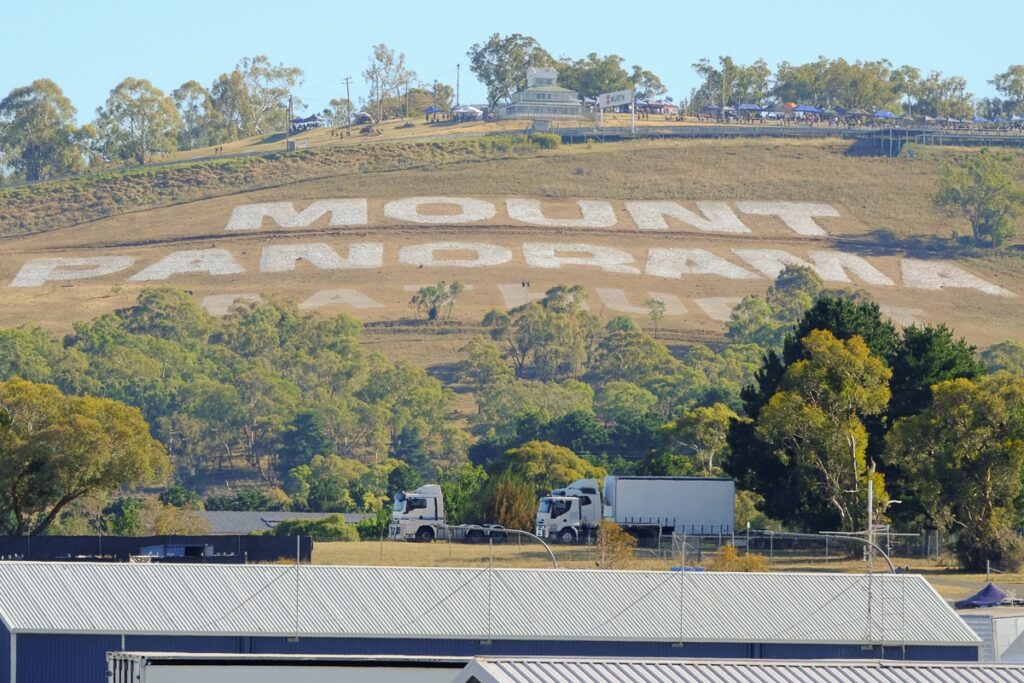
The moment I still puzzle over from my trip to Bathurst a year ago came at the end of the last day, race day, one that had begun for me when I awoke at three in the morning and, realizing there was no point in trying to go back to sleep, got dressed and walked over to the track in total darkness. It was late afternoon now, sliding into evening—the sun having disappeared behind Mount Panorama, the last distant echoes of exhaust across the valley faded into silence, the podium celebrations concluded, champagne drying on the concrete—and I’d headed back to the spooky old convent that was my hotel, utterly spent but still buzzing from the day’s, and indeed the entire journey’s, adventure.
For reasons I can’t quite remember, I entered through the unstaffed main lobby rather than the odd brick staircase turret that led more directly to my room, and it was there, taking in the memorabilia lining the walls one final time, that I encountered another returning race-goer, a woman, middle-aged like me. We exchanged greetings and perhaps some small talk about the day, and it was at this point I noticed something off in her tone, a hint of distress.
Her sister had meant to be here, she told me, but she’d passed away a month prior. Her voice trembled; she began to cry. I offered my condolences and attempted to comfort her by saying something lame, that I was sure her sister was here with her in spirit, glad she had still made the trip, the kind of well-meaning but useless platitudes people feel compelled to proffer on such occasions.
“There were treatments she could’ve gotten,” she continued, her grief now laced with bitterness. “But certain people told her not to. They told her she should wait.” The pointed reference—the blame—hung in the air for a beat, a fragile bubble lofted up in the stuffy stillness of the lobby, the most delicate of membranes separating the poison of her anger from the atmosphere.
Then, flatly: “It was my parents.”
I think it was at this point that the futility of my continued presence became obvious to me, and I managed an “I’m so sorry” in place of the “damn, that’s crazy” I was actually thinking before excusing myself.
I’m not a monster, man. Had I not just come from an entire day watching race cars on a mountain in the hot sun on a few hours’ sleep, had I done something less than 50,000 steps over the course of the weekend, had I not been on the absolute verge of collapse from exhaustion, I would probably have tried a bit harder to console this poor person, I swear.
It is also the case, however, that I know actual professional comedians who have devoted entire lives and careers to mastering the timing with which this woman, without even trying, delivered the line about her parents.
I climbed the stairs and navigated the byzantine hallways to my room feeling like I’d taken a hammer blow to the head. What just happened?
***
The Bathurst 12 Hour is back!
Back in the sense that it is happening again, this weekend—a couple weeks later than usual—but also in that, for the first time since its growing momentum was derailed by a global pandemic, the grid actually looks pretty healthy. The opening round of the Intercontinental GT Challenge, which also includes such noteworthy enduros as the Nürburgring and Spa 24-hour contests, the 2026 edition of the Bathurst 12 Hour boasts no fewer than 35 entries representing 12 manufacturers across four classes, the most since 2020 and a marked improvement over last year’s somewhat paltry 22 cars.
This is great news.
Here’s the thing about Bathurst, though. I was there to watch that 22-car field, and it wasn’t the first bucket-list race I’d ticked off during a down year. I also went to Le Mans in 2019, a race you could ask the winners about right now and they’d be hard-pressed to tell you anything. Not me, though. Because for someone witnessing it for the first time, even a forgettable Le Mans is an unforgettable experience.
And Bathurst? An event attended by tens rather than hundreds of thousands of people, with a fraction of the history and a similar ratio of entrants? Put it this way: if you offered me the choice of a return trip to either one of them? Total coin toss. That’s how good Bathurst is.
And now that competition for Le Mans tickets has reached a level previously known only to Swifties, I feel a responsibility to share a bit about why, exactly, you might consider moving Bathurst from your bucket list column over to your Actual Intention one.
AUSTRALIA
If you’ve never been, Australia is like the separated-at-birth sibling of the U.S. that grew up on the other side of the planet and turned out exactly the same, only different, and way more chill. Australians’ primary interests include beer, barbecue, muscle cars, pickup trucks, and sports. It’s just different sports, and the pickup trucks are the muscle cars. More importantly, Australians relate to each other with precisely the same informality and openness that Americans do, a casualness easily taken for granted until you travel abroad and first encounter its absence. Sounds corny, but it’s been my consistent experience over many visits spanning more than twenty years: Australians feel like family.
The difference is that Australia is roughly half a century behind the U.S. in its national race-to-the-bottom program. There is still a reasonably healthy middle class; people are generally less consumed with the struggle to survive. The ambient stress, suspicion, and hostility that permeates every aspect of life in the U.S.—another thing you don’t notice until you experience its absence—doesn’t exist there. You find yourself genuinely wondering, why is everybody in a good mood? Why do my shoulders suddenly feel so loose?
BATHURST
Bathurst is an old 19th Century gold rush town. Yeah, Australia had those, too. To get there you head west from Sydney for three hours, a lovely drive over and through the Blue Mountains via the Great Western Highway, which deposits you in the verdant and expansive valley that is the Bathurst Basin.
The town itself is home to a population of about 45,000 people, and even on a race weekend—at least this one—the vibe is pleasantly sleepy. The picturesque downtown encompasses maybe a square kilometer of two- and three-story colonial-style buildings, with plenty of shops, restaurants, and pubs, all very friendly and walkable.
Wherever you grab dinner, you’ll be surrounded by fellow racing fans, and as likely as not entire race teams, with restaurant staff struggling to accommodate the Kitchen Nightmares–style rush. It’s all good, though! Remember, this is Australia, the country that gave us the phrase, “no worries.” (No, really, they did.)
MOUNT PANORAMA
It is a truism about race tracks that however dramatic a particular circuit might appear through the lens of a camera, the reality exceeds that impression by a factor of at least 2, and usually more. I’ve experienced this effect enough times to have internalized it as axiomatic, and it’s something that I’d borne in mind over the years and many, many hours spent watching video from Mount Panorama.
If you’re familiar with such footage, you know what I’m talking about. It looks absolutely insane. And you know that means it must be even more so in real life. But how much crazier could it actually be?
Friends, I am here to tell you that nothing can prepare you for the physical reality of this place. “Jaw-dropping” is a cliche, but in my case it was literally true. More than once.
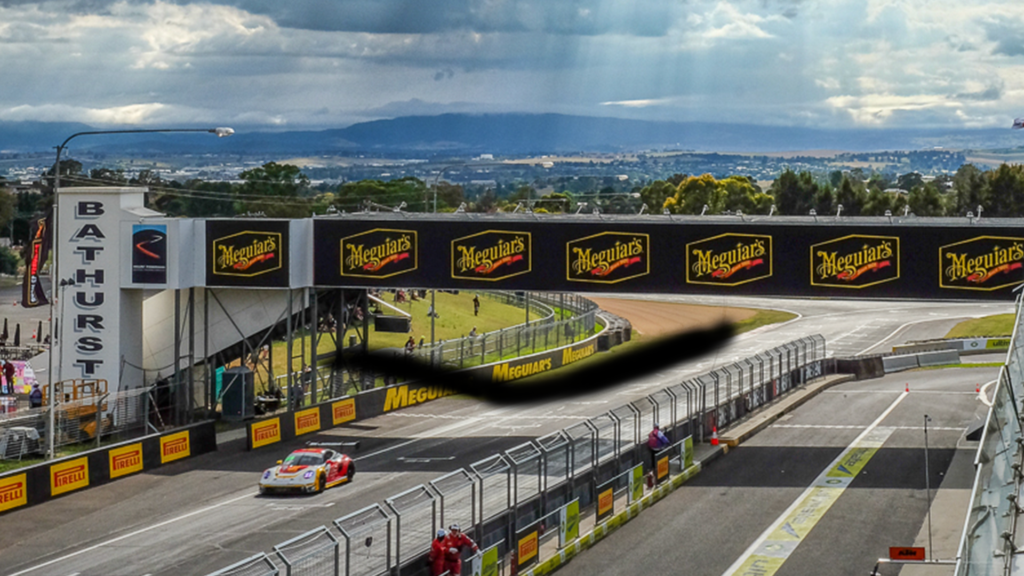
The basic setup, which dates to the 1930s, is fairly simple. The start/finish line is on a relatively short main straight with a pit lane running alongside it at the base of the mountain, bounded by 90-degree corners at either end. From turn 1, cars head up the long Mountain Straight, which begins the nearly 600-foot ascent, disappearing from view about half-way up, where they hustle through a short complex of corners that are hidden from spectators. From turn 4 (the Cutting) on, though, drivers emerge onto a series of high-speed sweepers that take them the rest of the way to the top, across the spectacular Skyline—exactly what it sounds like—and then plunging, in effect over a cliff, down the Esses, which are kind of like the Corkscrew from Laguna Seca if it just kept going.
The drop culminates with a hard, off-camber, acute left called Forrest’s Elbow, which deposits traffic onto the long downhill Conrod Straight. Near the bottom they approach the Chase, a sort of high-speed chicane installed in the ’80s in an attempt to slow cars before the final corner. The Chase starts with a right-hand kink that GT3 cars enter at more than 180 miles per hour; the fastest point on the circuit, the kink is credibly claimed to be one of the quickest corners in the world. The speed that cars carry into it, and the amount they shed before the quick left-right sequence that follows, is the kind of thing that scrambles your brain. We’ve all seen brakes glowing red in the dark at Le Mans and Daytona. You ever seen them glowing in broad daylight? I have, now.
From there it’s under the pedestrian bridge, and into the final Murray’s Corner back onto the front straight.
All of what I’ve just described you can get from watching a video. What surprised me most about actually being there, besides the stunning beauty of the overall setting and the drama of its verticality, was how much of the circuit is accessible to spectators, and how close you are to the action around much of it.
There are two contiguous viewing sections, corresponding to the bottom and top parts of the track; the only points you can’t get to are along the straights going up and coming down the mountain. The bottom half extends from the entrance to the Chase on the inside and just after that point on the outside, all the way to the outside of turn 1 and a ways past that up the hill on the inside. Strewn about throughout are a multitude of grandstands, viewing berms, and even pit box rooftops that are open to one and all.
To get up top, you grab a shuttle—buses that run continuously throughout the event and cost a nominal fee to ride. It takes maybe ten, fifteen minutes, wait inclusive, depending on where you jump off. Here the viewing areas are all on the outside of the circuit, but the spots you can get to run from just after the Cutting, half-way up the mountain, up and over the top, and all the way down to Forrest’s Elbow. There is plenty of seating, and plenty of shade. And for much of that length the cars are shockingly close.
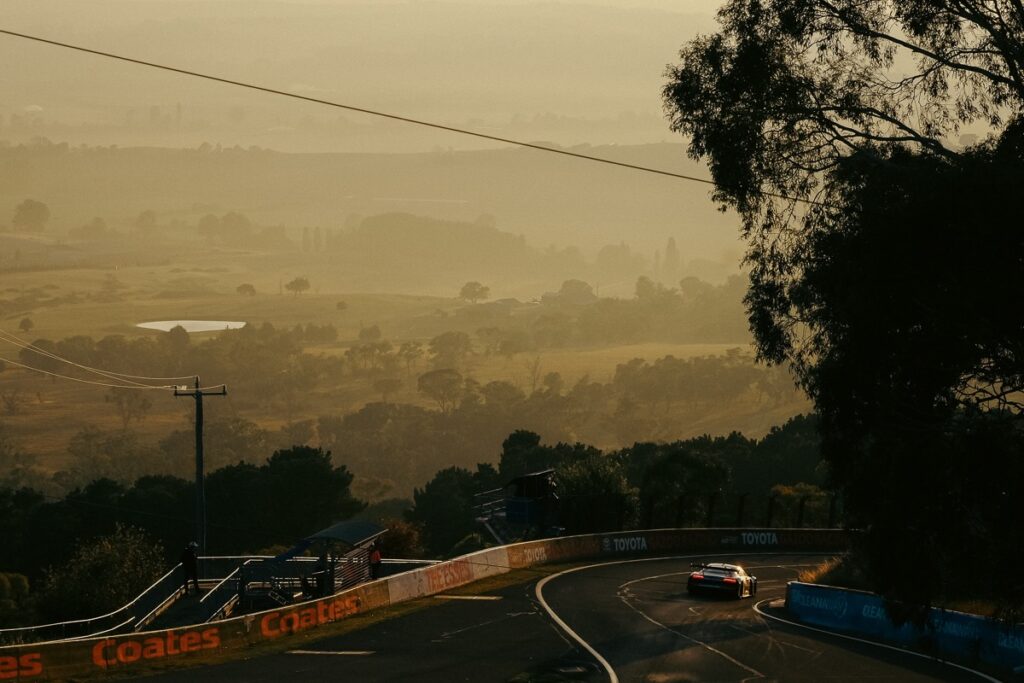
Especially through the vertiginous Esses and the Dipper that follows—a strenuous hike amidst forests of eucalyptus—there are places where you are almost directly on top of the action, looking down from maybe ten, fifteen feet overhead. It is loud. It is intense. The cars are at the absolute limit, and they are hauling ass. It is freaking awesome.
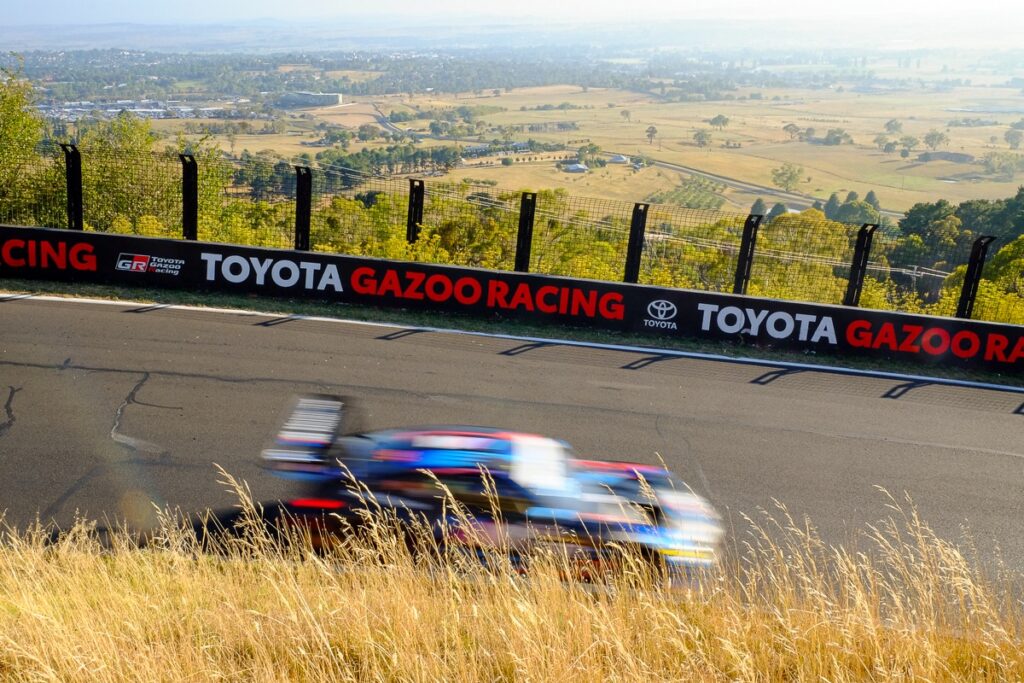
Did I mention the kangaroos? There are kangaroos.
THE 12 HOUR
We should note that the 12 Hour is not the biggest race that happens at Mount Panorama. That distinction goes instead to the Bathurst 1000, which is part of the Supercars Championship—think Australian NASCAR. Hundreds of thousands of people do turn out for the 1000, and from the ways it was variously described to me, it sounded like a much more debauched scene than the relatively tame affair I was attending, something more like a weeklong bacchanal that happens to have a car race at its center.
There is some overlap between the two events, both in terms of spectators and participants. But I think their relationship is roughly analogous to that of the Daytona 500 and the Rolex 24: one a mainstream blockbuster that forms the cornerstone of the calendar for the biggest race series in the country, the other a slightly more esoteric showcase pitting local talent against elite drivers from around the world.
And just as at the Rolex 24, the relative intimacy afforded by that niche status, and the access that flows from it, is a big part of the appeal. Much like an IMSA race, spectators are free to explore the paddock, watch crews working in their garages, and talk to whoever they might run into. I headed over on Friday morning to get the lay of the land; by 9 a.m. I’d already chatted and grabbed selfies with Valentino Rossi and Jacky Ickx. Not as a journalist, mind you! Not as any kind of VIP. Just as a dude with a ticket wandering around. Try that at Le Mans.
(They were both lovely.)
In addition to the IGTC cars, there are two support series on the undercard, one featuring a healthy field of Ferrari Challenge cars, the other a kind of catchall “Combined Sedans and Sports Cars” category boasting more than fifty entrants ranging from older GT3s and Porsche Cup cars to things as seemingly random as ’90s Skylines and RX-7s, Holden Commodores and Ford Falcons dating to the aughts, Corvettes and Mustangs, 3-series BMWs and Mitsubishi Evos of similar vintage, and homegrown IRC GTs—indigenous, track-special pony cars, Camaros ported over from a parallel universe.
There was even a Ginetta. Between the three series’ practice sessions and races, there was activity on track from dawn to dusk throughout the entire weekend. But the main event is on Sunday, and begins, famously, before the sun comes up.
I spent Friday and Saturday scouting and seeking advice from as many people as possible about a game plan for race day. Everybody told me to show up early; conventional wisdom on where to watch the start was less consistent. It took Michael Zalavari and Andrew “Skippy” Hall from DailySportsCar, who I serendipitously found myself sat next to at dinner one night, to straighten me out. “Don’t waste your time down below,” they told me. “All you’ll see are headlights, it just looks like a traffic jam. Go straight to the top.”
As it happened, I didn’t really need to show up at 4 a.m. Although I did have a nice time talking to the one lady already there at the head of the line, whose car-crazy teenager was crewing, and the older guy who arrived not long after, wearing a Make Australia Great Again hat. At some point in the conversation he referred to Uluru rather than Ayers Rock, which struck my American mind as the equivalent of someone in a MAGA hat in the U.S. earnestly asking after your pronouns. No contradiction here though, apparently. Like I say—Australia: it’s the same, only different. It’s chill.
It was still dark when the gates opened. As instructed, I headed directly for the shuttle, and secured a spot overlooking McPhillamy Park, the run across the top of the mountain to Skyline, amidst the already seated throngs from the campgrounds nearby.
The start of the Bathurst 12 Hour is one of those things so perfect that to think it was somehow arrived at haphazardly almost beggars belief. That it wasn’t conceived from the beginning with the intention of delivering its particular effect seems impossible. Every aspect—the very landscape, the orientation of the track, the time of year and the precise arc taken by the sun as a result of same, the amount of moisture in the air required to filter the light in just this way—feels so perfectly choreographed that it could only have happened by design.
From where I stood I watched headlights cutting through trees in the black of night, cars emerging from darkness in a blinding fury, flying left to right across the mountaintop before a sky betraying the first whispers of an approaching dawn; disappearing in an instant, taillights winking out of view as they plummeted over the hill, beyond which a red glow appeared on the horizon, above clouds as purple as a bruise.
That was the first lap. That was the start.
From there the drama only increased, the sky in the east taking on the fiery radiance you’ve seen in a thousand photographs, the light that you imagine has to be the result of some kind of filter or Photoshoppery. Nope. That’s just what it looks like. You find yourself swimming in a kind of luminosity that Renaissance painters fetishized—that the Impressionists invented entirely new techniques trying to capture—while clinging to the side of a mountain with race cars roaring past you. It is, to use another cliche, magical. No other word for it.
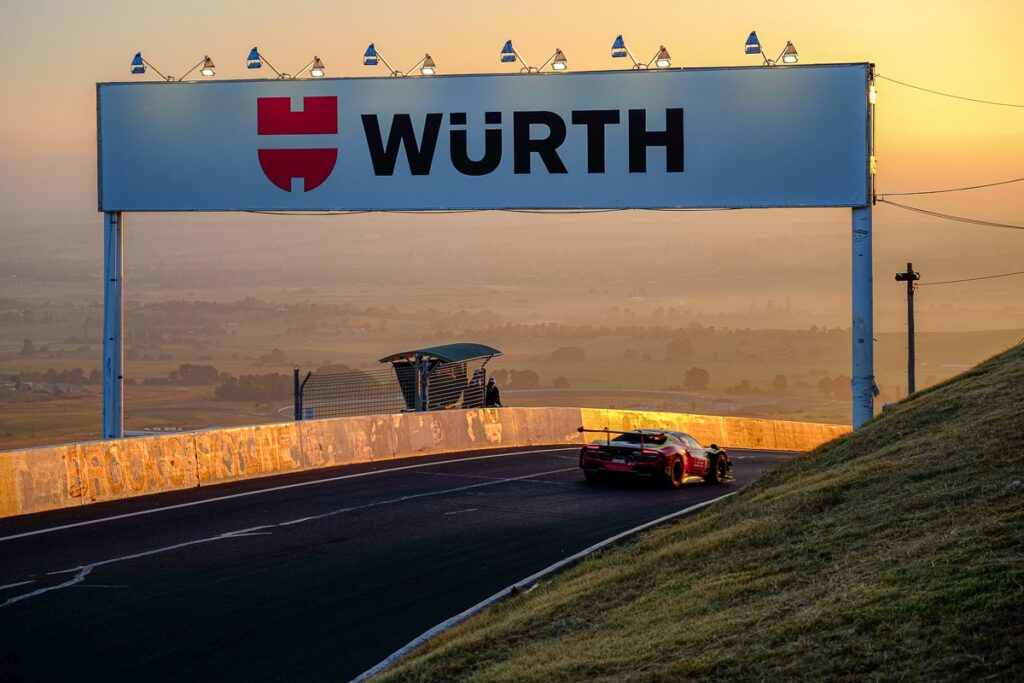
My initial thought was to watch roughly the first half of the race from up top, and then take the shuttle back down the mountain around midday for the second. As it turned out, I ended up spending eight hours wandering the entire stretch from Forrest’s Elbow to the Cutting, enjoying the unique views and sounds from dozens of different locations. The remainder I spent down below doing essentially the same thing, finally settling on a lawn at the exit of Murray’s Corner for the finish. If I went back I imagine I’d do it exactly the same.
The race itself was entertaining. The WRT BMWs ran strong from the start, and it became clear as the day progressed that they were consistently able to squeeze an extra lap or two from every stint, gradually building an advantage that, barring outside intervention, nobody else could seriously challenge. My favorite moment was watching Chaz Mostert in a Ferrari 296 GT3 shared with fellow Supercars driver Will Brown and factory Ferrari ringer Daniel Serra, running third late in the race but owing a pit stop that would take them out of contention. Mostert ripped off a series of completely gratuitous fastest laps like he was Fangio in ’57. Fastest laps of the race, I mean. Like okay, I guess we’re not going to win this—might as well at least make a point. That he did.
Mostert spent the rest of his 2025 winning the Supercars Championship, incidentally. And he just very nearly won at Daytona a couple weeks ago, alongside Kenny Habul. At Mount Panorama, it was Habul’s 75 Express AMG-Mercedes that nipped past Mostert’s Ferrari to finish on the podium behind the BMWs. So it goes.
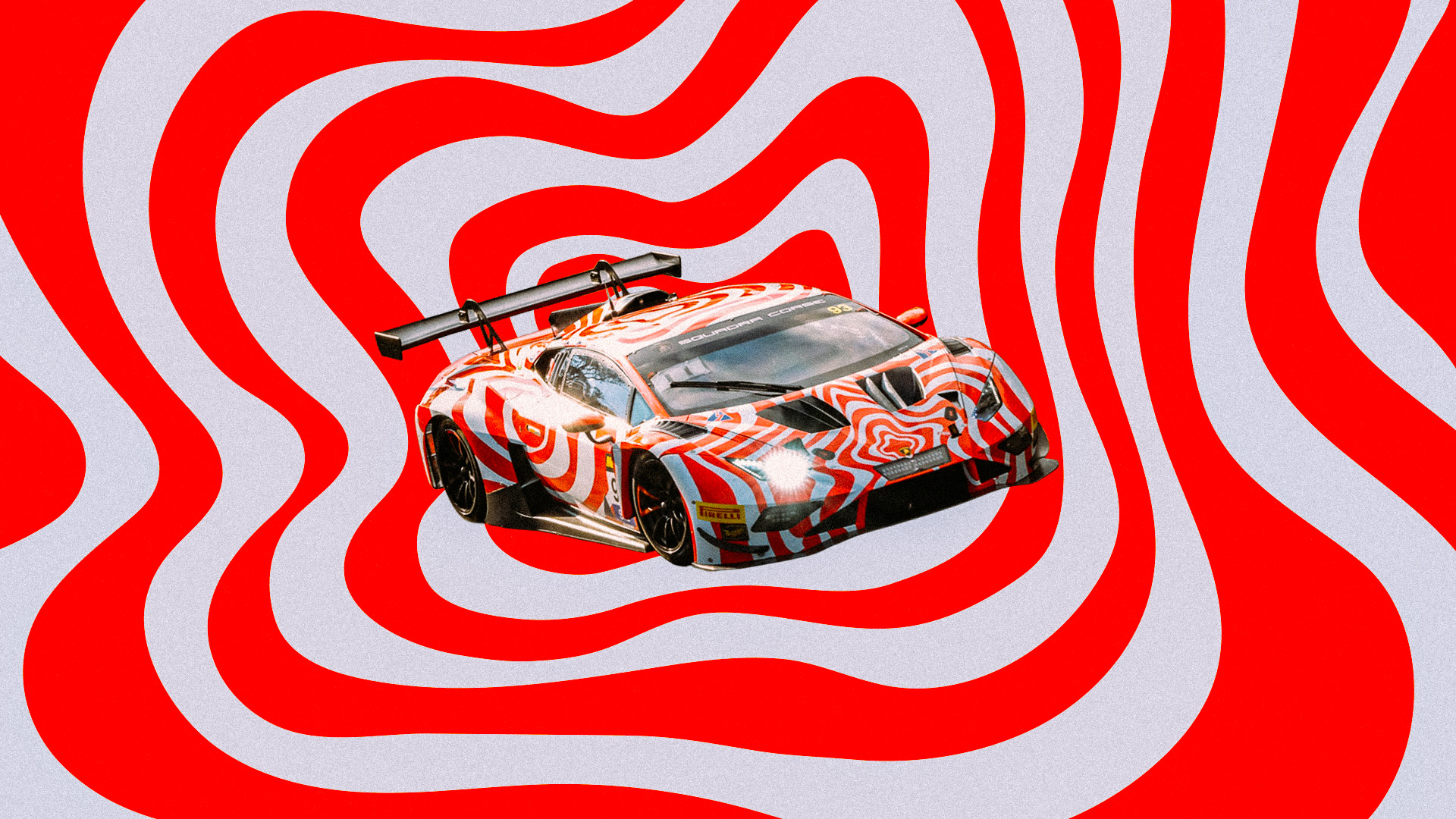
This year sees the arrival of new Mustang and Corvette GT3 entrants, the return of McLaren to the top class for the first time since 2020, the WRT BMWs defending their crown, and the Wall Racing Lamborghini continuing its run with the greatest livery in the history of motorsport. Sunday in Australia means Saturday in the U.S., with a start time of 1:45 p.m. EST, streaming live on YouTube. What better way to say “I love you” on Valentine’s Day than to invite that special someone to watch with you?
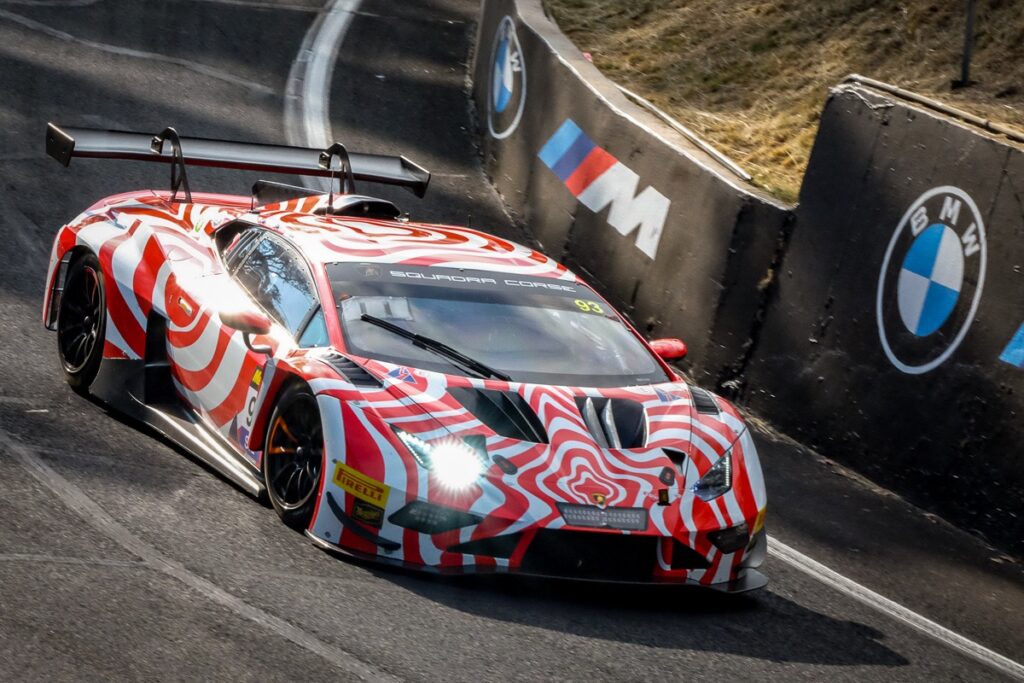
Actually, there is one better way, and that’s to start planning your trip to Bathurst in 2027. Tell ’em Hughesie sent you.
And for the love of God, if your parents tell you to put off radiation? Don’t listen to them!
Recent Posts
All Posts
February 27, 2026
February 26, 2026
February 25, 2026