Two Scoot
August 3, 2026
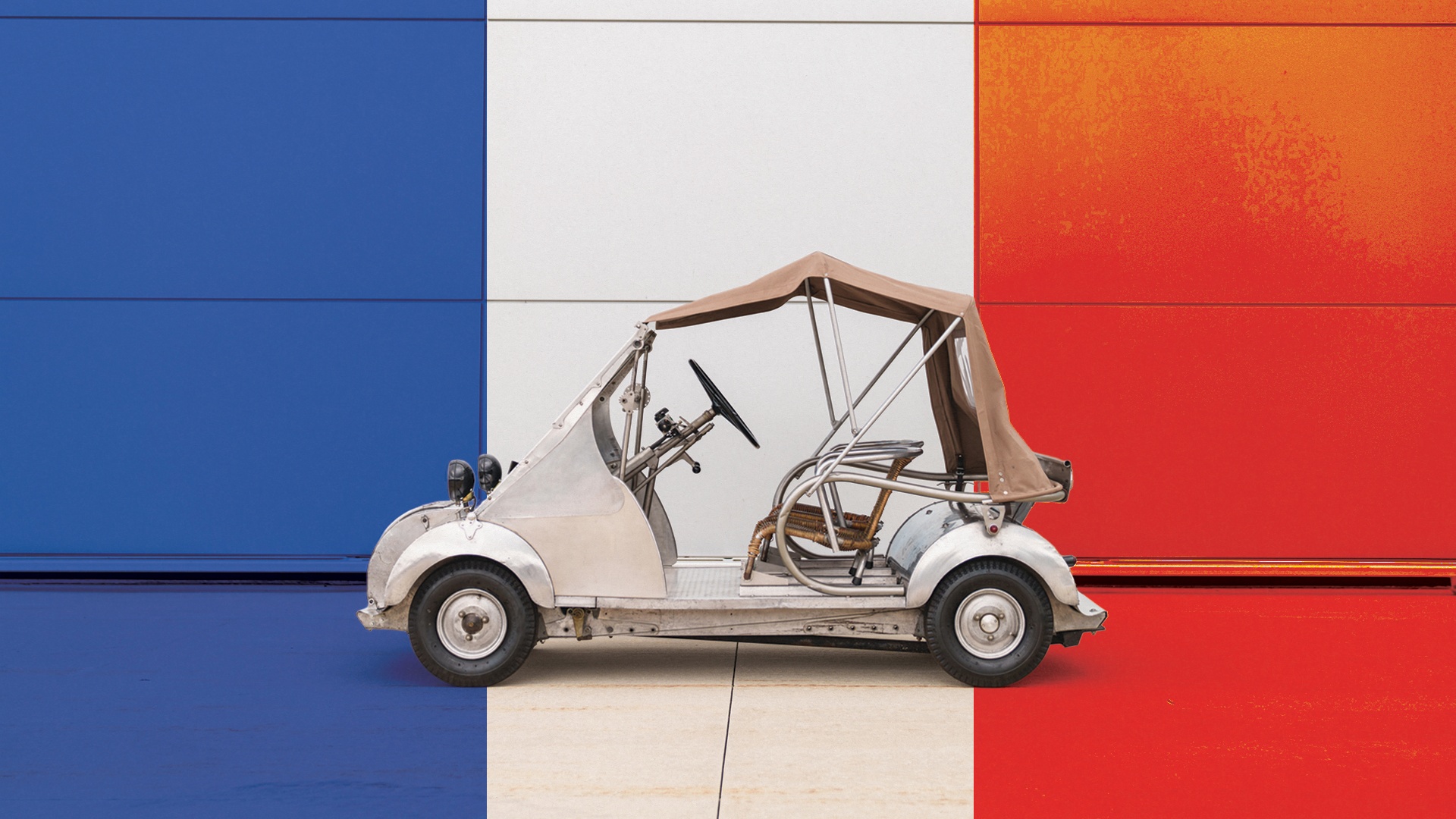
Alex KiersteinVoisin’s BiScooter attempted to improve on the postwar transportation situation with a funny little microcar built with aviation knowhow.
Cute, weird, and French … I can’t resist any of these qualities, let alone all three. But the Voisin BiScooter also comes with a healthy dose of drama, including an Anti-BiScooter project launched by hostile elements within the parent company. There’s a happy ending, of sorts, courtesy of a Spanish savior. That’s interesting, but the BiScooter is interesting without all that context, applying all of Gabriel Voisin’s characteristic engineering tendencies to a postwar basic mobility device—a voiturette.
Voisin was talented, and quick to jump into the aviation world. He started out in business with Bleriot (yes, that Bleriot), went on to produce aircraft throughout World War I, and then quit aircraft entirely. The story goes that he was disgusted by how aircraft became weapons; instead, he’d apply his aeronautical knowledge to automobiles.
(Quick side note: I didn’t realize it, but Bleriot made his money as an auto parts supplier, and used that money to fund his aviation career. He developed the first practical auto headlamp, an acetylene lamp.)
Voisin’s interwar cars were luxurious, innovative, and lightweight. Aesthetically, they weren’t as organic as the Bugattis, Talbot-Lagos, and Delahayes, instead looking more purposeful. They often featured cut-down greenhouses, and some had slab sides that predicted the integrated fenders of later cars. Often the front fenders, if not integrated, used external bracing, like the aircraft of the day. They look like the sort of luxury car you’d build if you had a thing for experimental high-performance aircraft, and that’s pretty much the gist.
After WWII, Voisin was still alive, but the economy was in shambles. Voisin was absorbed into Gnome et Rhone, formerly a supplier of engines to his automobile business, and eventually into SNECMA, a nationalized conglomerate of various aeronautical companies very much focused on aeronautical things. Voisin, taking stock of the transportation needs of a devastated Europe, came to the same conclusion as many of his contemporaries: microcars, or cyclecars. Voiturettes, if you’re French. Essentially small motorcycles or scooters with the seating position and controls of a car, roughly.
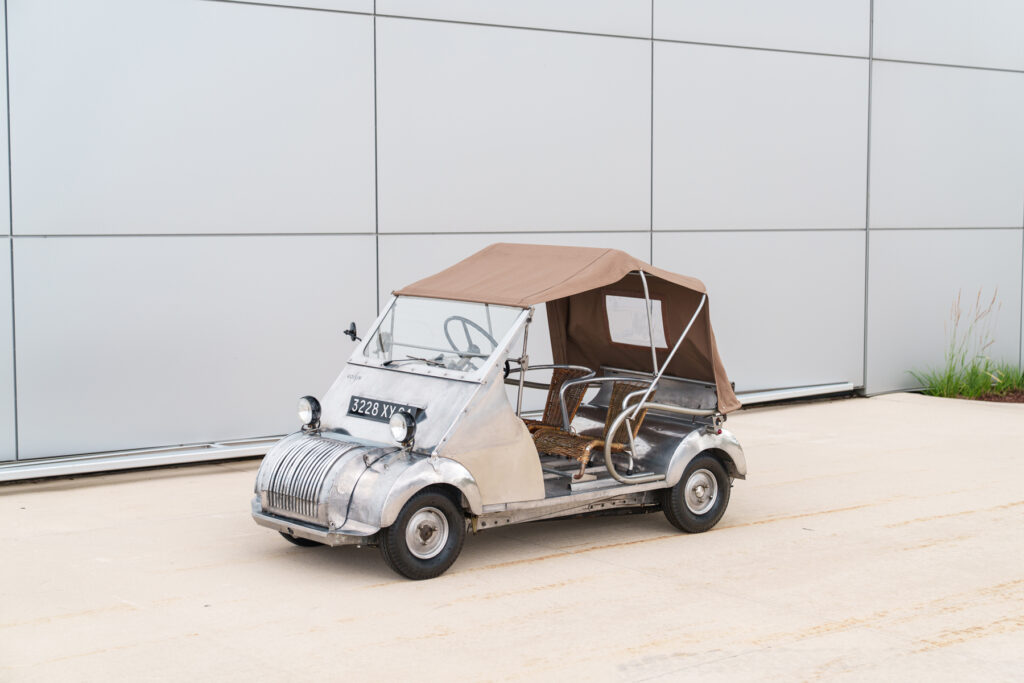
Hence, BiScooter. Four wheels, like two scooters. A single-cylinder engine drove a single front wheel for maximum simplicity. It was intended to be basic and inexpensive, and yet it’s also very Voisin. The body is riveted aluminum, basically just a floor bookended by some simple radiused curves front and rear. The hood is simply a barrel-shaped piece of aluminum standing proud of the barrel-shaped fenders. The rest of the bodywork is flat panels. And yet, it’s adorable, like a larval Nissan S-Cargo.
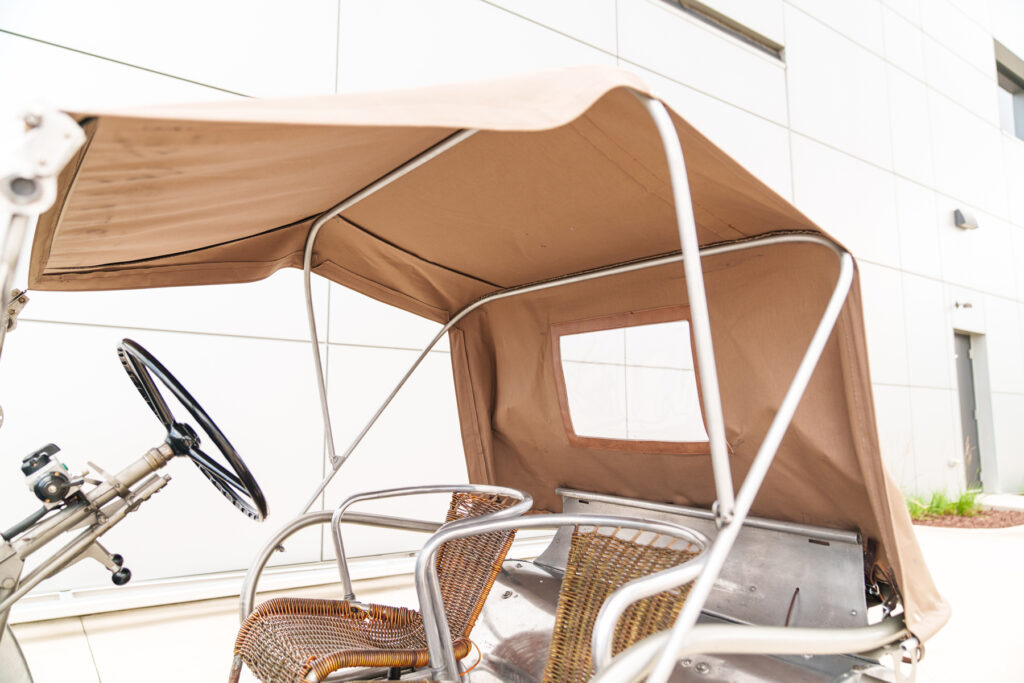
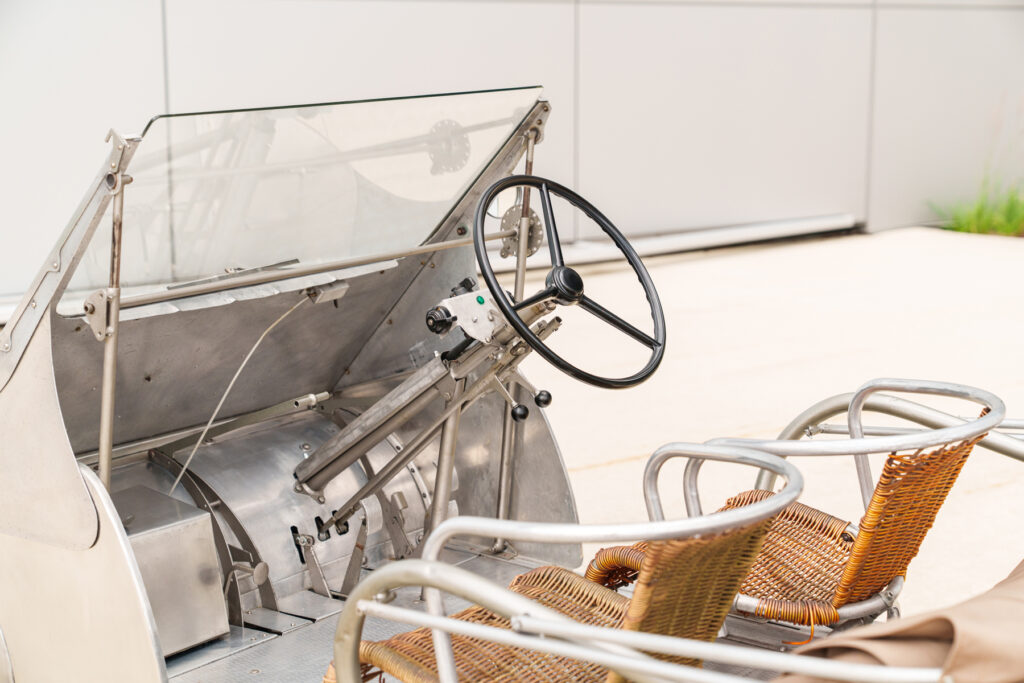
Inside, there are a pair of wicker seats, which seem odd at first, but wicker was sort of the fiberglass of its day; light and strong, it was the material of choice for many airplane seats where weight was a concern. There’s not a hint of instrumentation inside, but it’s otherwise all business, all aluminum. Minimal but not flimsy; everything looks solid albeit light.
The engine is fascinating. It’s a Gnome et Rhone single cylinder, but with a massive finned head on top. My understanding is that this is to provide extra air cooling in traffic—basically, a heatsink consisting of a lot of surface area and a lot of oil, compared to a typical air-cooled single.
There was no electric starter, just a crank, and no reverse gear. (I can’t imagine either were a problem; the 125cc single is probably easy to crank over, and if you need to turn around, just pick up the back end and rotate it.) But Voisin’s prototypes, of which there were allegedly 15, used a three-speed manual and a two-speed final drive, giving six effective forward gears. I’ve got no idea how this all worked on the move, but I’m sure it was hilarious to row through three low and then three high ratios with that Gnome single screaming away.
The internet tells me that, in 1950 when it was displayed to the public, the reception was very positive. But SNECMA’s management was not impressed or interested in production, and there seems to be some antipathy to Gabriel Voisin for reasons I can’t find in a source available to me, a non-francophone. Motor Classico, a Spanish-language magazine, tells of an Anti-BiScooter, cooked up by a SNECMA engineer named Edmond Moglia, intended to be a more conventional voiturette that would convince the management to abandon Voisin’s more ambitious idea. It worked a bit too well; SNECMA refused to proceed on either.
Thankfully, with a few changes, Gabriel Voisin was able to take his design to another manufacturer. Auto Nacional of Spain produced it as the Biscuter (same pronunciation), with a Hispano-Villiers single and a different body which looked slightly more car-like than golf-cart-like. Auto Nacional built more than 12,000 Biscuters, in various body styles, including the Pegasin, which looked like a Pegasso sports car left in a dryer too long.
I don’t know the economic or political rationale for SNECMA passing on the BiScooter, but I have to imagine that it could have produced a line of innovative, exceptionally lightweight cars with an overt aviation theme. Think Smart by way of SAAB. And how cool would a BiScooter revival as a Citroen Ami-like electric runabout be?
If you want this BiScooter prototype, it’ll be at the Gooding Pebble Beach auction in August with no reserve, with an estimate of $50,000 to $70,000.
Recent Posts
All Posts
July 30, 2026

July 27, 2026
July 17, 2026
Leave a Reply
You must be logged in to post a comment.