Wayward
June 11, 2026
Alex KiersteinWhat do you call a driverless car that stops and won’t move? A big problem.
Mostly by attrition, Waymo has assumed the lead position among the remaining robo-taxi aspirants. They’re limited to operating in certain areas and under specific circumstances, but that doesn’t mean they don’t ocasionally cause chaos, as one unit that–according to the police–blocked responders from a 5-alarm apartment fire in Austin, Texas recently.
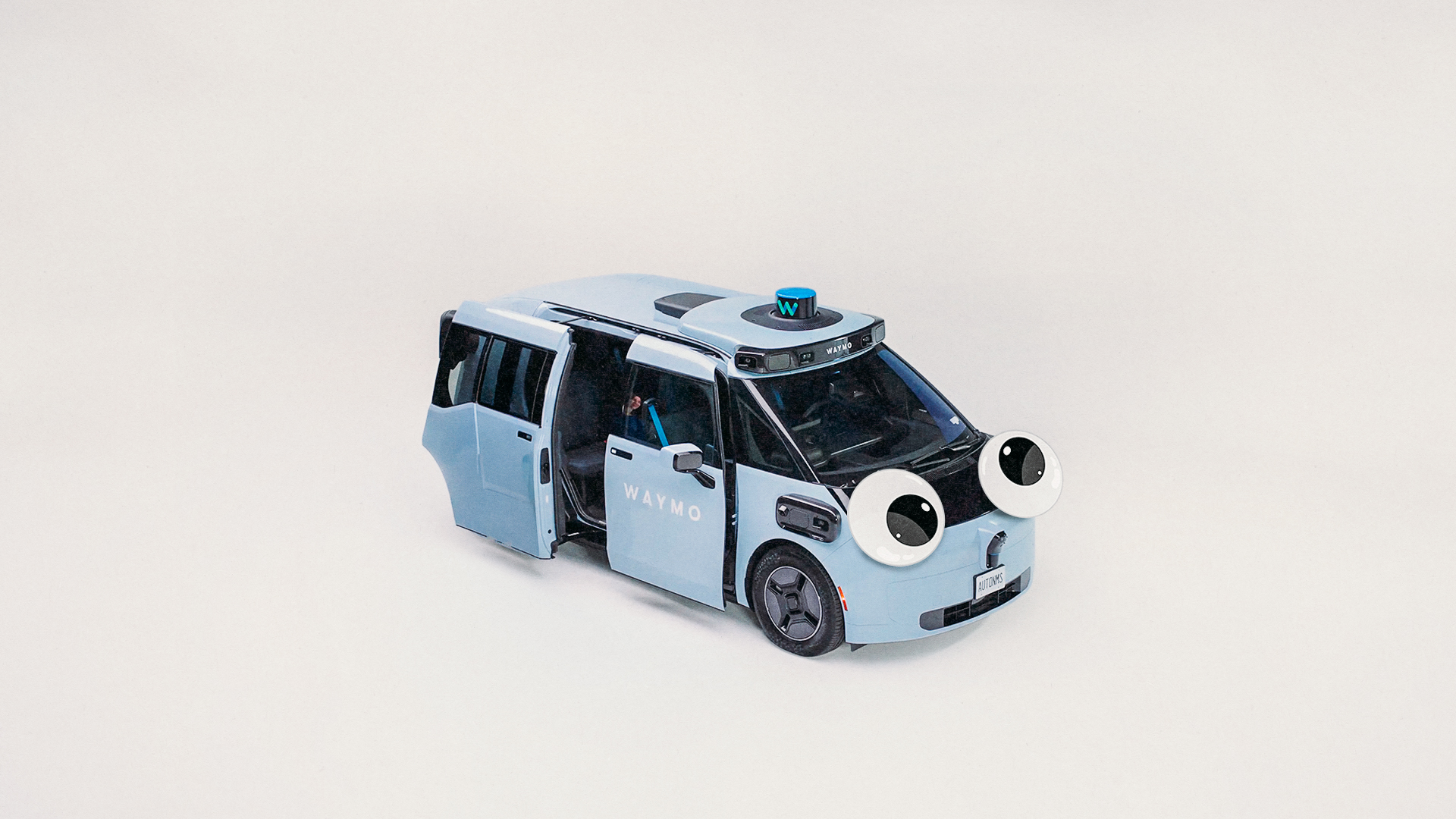
Unlike autonomous, or semi-autonomous, or autonomous-aspiring vehicles, we humans love to assign anthropomorphic characteristics to things. Especially things that move, things that do tasks autonomously. My mom put a big pair of googly eyes on her robot vacuum, and as it bashes its touch sensor into every object in the room my kids treat it like an eager but especially dim-witted pet, cheering when it finally clears the simplest of obstacles. Pair that to a century or so of science fiction in which humanity’s creations turn against us, and we’re primed to laugh nervously. Those Waymo Jaguars circling an Atlanta cul-de-sac? We laugh, nervously. It’s a little ominous, isn’t it?
Anthropomorphicizing an autonomous vehicle gives it too much credit. Animals can improvise, adapt, anticipate, in a way that programming cannot. And so under the right set of circumstances —say, an emergency vehicle nearby, presumably limiting or disabling certain paths forward—an autonomous car can become a driverless roadblock. (Or, according to Waymo, a vehicle that was attempting to leave the area before an officer approached it.) Even the most oblivious cow will eventually get the sense it should move on if a human makes enough of a racket.
Natural selection eventually weeds out animals that walk headfirst into floodwaters; for Waymo, it’s a pause in service while some code is fixed. So, you know, its vehicles don’t plunge in and get swept away.
What troubles me the most about the situation in Texas, in which that interaction between the Waymo and a law enforcement officer, is the ambiguous protocol. How exactly do you prod a Waymo to move? Do you want a Waymo to be prodded into moving? It’s like the trolley experiment, except no one knows how to operate the switch. You just yell at it for a while. Eventually, you’re connected to customer support, and go through a troubleshooting process, eventually getting access from the agent to move the switch manually. In the meantime, the trolley is, you know, crushing people.
Or, in this case, this cop has to spend at least two minutes dealing with this nonsense. An apartment complex exploded, it seems, due to a gas leak. The last thing I would want to do, on the way to help out in whatever capacity I could, would be to have to speak to a call center representative first.
I’m not an emergency systems and protocols guy, but between this and the occupant-trapping Teslas with their hidden door handles, it seems like regulation and oversight need to happen. Give people a hotline to call, a clearly observable vehicle ID number, and a quick and unambiguous process to move a wayward Waymo. Allow short, manually commanded movements in some sort of limp mode. It’s not my job to solve this for Waymo; it’s Waymo’s responsibility to ensure that its vehicles don’t become an obstacle between a raging fire and a responding firefighter.
What are we doing here, guys? How many more years of public beta testing are these vehicles going to take before they become a useful, profitable alternative to underfunded and more sensible public transportation and existing livery services? Is this a safer way to move people around, or a good way to siphon investment funds?
I think I’d feel a lot better if Waymos had big googly eyes.
Recent Posts
All Posts
June 8, 2026

June 5, 2026
June 4, 2026
Leave a Reply
You must be logged in to post a comment.