Big Oil’s Little Motor
May 22, 2026
Alex KiersteinA fuel-saving dedicated hybrid motor from a state-owned Saudi oil company? It may not come to market, but it’s real.
It’s the stuff conspiracy theories are made of. Super-efficient engines developed (or suppressed) by the government or big oil. Miracle carburetors, thermal-insulated special engines, vaporized fuel. Whenever an oil company tells us its scientists are working on something that will help us save fuel, it’s natural to be suspicious. And yet, these corporations have been toying with engine tech for decades, for various reasons depending on your level of cynicism. In the present day, the rationale for Saudi Aramco to develop a dedicated hybrid engine are easier to explain: more efficient gas engines keep gas relevant—and Aramco’s main product marketable—longer.
That’s my theory, anyhow.
Aramco’s idea is to create an engine from scratch that is perfectly suited to serve as the ICE component of a hybrid drivetrain. This makes a lot of sense, and it’s not a new idea. Gas engines work best when they can be optimized to run at a narrow RPM range, serving as a generator instead of a traction motor. You don’t need fancy valvetrain tech if you are running within a 1,000 RPM window; pushrods will do fine. This is essentially a series hybrid rationale, something that extended-range electric vehicles (EREVs) make use of.
And yet, most range extenders are built from existing traction engines. The Chevy Volt, the archetype of the EREV, used a variant of an Opel-developed I-4 that you could also find in the Aveo and Trax. It helps amortize the significant cost of developing an engine family, but it also introduces compromises that the Aramco-funded engine, and similar projects from Mahle and the like, aim to eliminate.
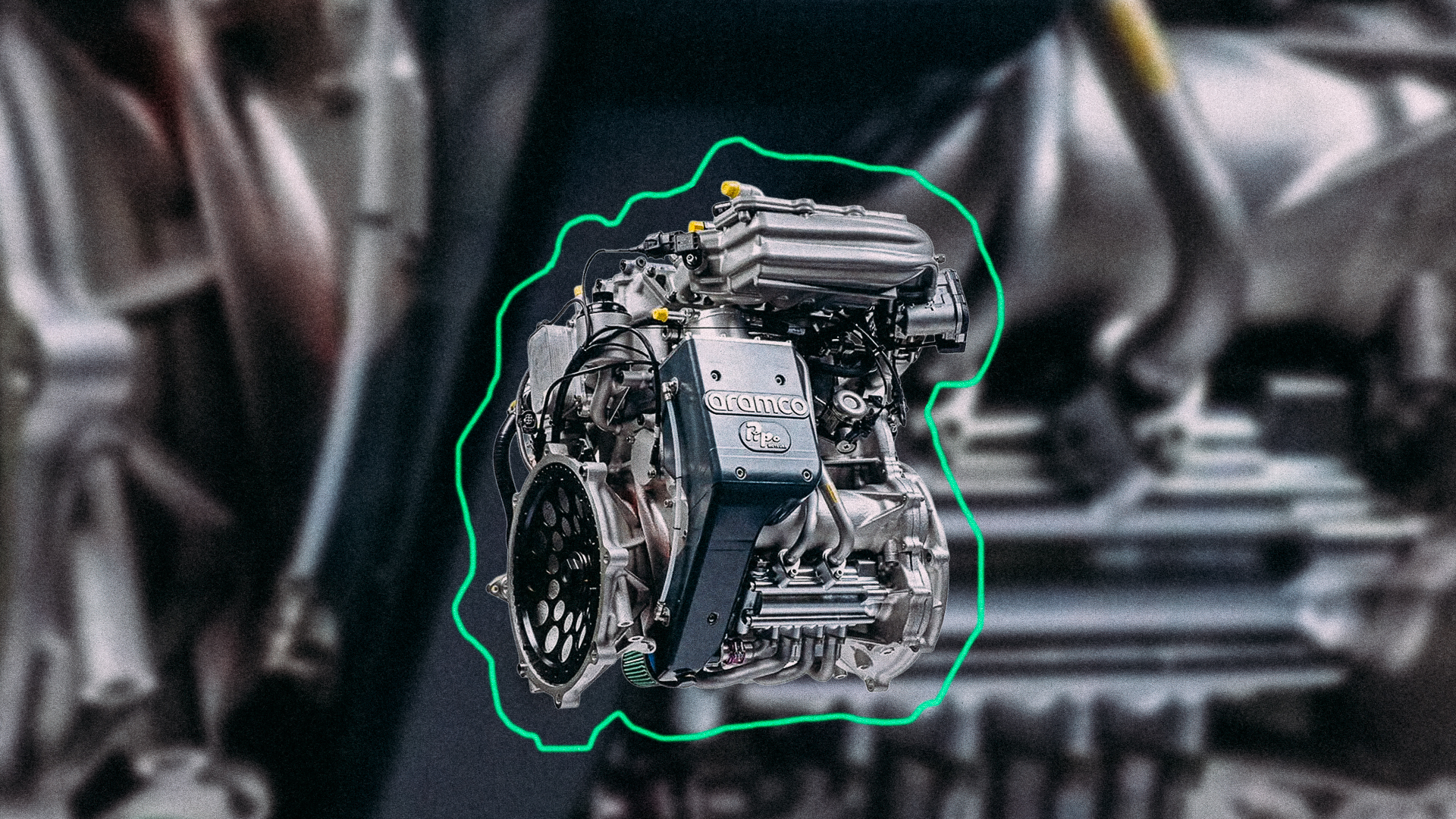
Aramco tapped Pipo Moteurs, a French outfit that seems primarily focused on motorsports, competition hydrogen-burning engines and that sort of thing, to build the prototype. The focus is less on record-breaking efficiency and more on the lowest unit cost possible. That means a simplified engine, mechanically, utilizing a simplified valvetrain and novel engine arrangement.
The head is a two-valve pushrod design, adequate for the engine’s operating range and also compact. That allowed the engineers to provide as much stroke as possible without making the engine too tall, which helps with thermal efficiency (and torque).
The e-motors are located at either end of the crankshaft, eliminating the transmission entirely. (Most hybrids today use e-motors that are internal to a transmission, which still needs to be attached to the ICE—adding width in a transverse installation, and complexity.) When you don’t need to directly drive the wheels, and only power the e-motors, many components can be eliminated.
Aramco doesn’t say in its release whether the e-motor placement means that the counterweights typically found on I4 engines, or the flywheel, are eliminated, but I presume the engineers can fine-tune the mass of the e-motors on each end of the crankshaft to do at least partial duty in both regards. Since it’s designed to operate in such a narrow range, some RPM-specific vibrations aren’t an issue, and others can be carefully tuned out with the minimum possible added mass. I’m sure the e-motors also act as starter motors.
Now, Aramco isn’t talking numbers at all at this point. I asked the company, and it responded with this statement:
“Currently, our focus is on refining the DHE concept, advancing key development areas and evaluating the potential market fit for this technology. The engine’s exact specifications, including power output, depends upon a range of factors, including the vehicles intended use, market needs, and local regulations.”
That makes it a bit hard to gauge exactly how notable an improvement this Aramco tech is. After all, despite not being designed from a clean sheet as hybrid engines, units from traditional automakers are achieving remarkable thermal efficiency figures. Nor, as I mentioned earlier, is Aramco the only player in the ground-up hybrid engine game.
Numbers would help. After all, you might not realize this, but the all-time fuel economy champ was developed by an oil company. Back in 1973, Shell Oil heavily modified an Opel Olympia Rekord wagon into a narrow-axle, truck-like, wacky special. Its engine was modified to inhale through a lawnmower carb and run at the absolute highest temperature it could without seizing. The engine bay was lousy with insulation. It achieved a Guinness-certified record: 376 miles per gallon.
Shell didn’t bury the patent on this wild thing to sell more oil; it was completely unsuitable for regular use. But that record still stands today, somehow. And that is, well, something to mull over.
Recent Posts
All Posts

May 21, 2026

Cole Pennington
May 20, 2026
Leave a Reply
You must be logged in to post a comment.