Notes: Sebring ’26
There’s the part about the bumps, of course, and how twelve hours here is more punishing than twenty-four at Daytona or Le Mans. But the other thing you frequently hear about Sebring is how the first ten hours are spent marking time until the sun goes down, when the real action begins. Having experienced an entire race week there now, clocking over a hundred thousand steps over the course of four exhausting days and nights, I can say that this is as true for spectators as it is for competitors.
I went down expecting a weeklong party, but Sebring’s not that. What it is, instead, is a slow burn, an occasionally tedious and unpleasant grind. Just when you begin to lose faith and wonder about the point of it all, though, it somehow manages to ramp up into an orgy of chaos and spectacle that redeems the entire endeavor. You just have to wait until the sun goes down on Saturday.
It’s an unlikely spot for the longest-running and most storied endurance race on the North American continent. On a road course laid out upon the tarmac of a decommissioned Army Air Force base where B-17 crews trained during World War II, the inaugural race at Hendricks Field was held on New Year’s Eve, 1950; the first 12-hour contest followed a little more than a year later, in March of 1952.
If you have any sense at all of motorsports history, the names etched into tiny plaques adorning the Alec Ullman trophy will leave you agog. Andretti, Foyt, Gurney, sure; Jim Hall, Phil Hill, or even John Fitch might not come as a surprise; but add to those Moss, Hawthorne, Surtees, McLaren, and Juan Manuel Fangio, and a picture starts to come together. This isn’t just one of the most historic racing venues in the U.S., it’s one of the holiest motorsports sites in the world. Truly sacred ground.
Which makes it all the more amusing to discover, then, that it’s kind of an armpit. We’re talking about an eighty-year-old airfield in the middle of nowhere in central Florida, after all. The town of Sebring, itself—population 11,000 and a seven-mile orange grove–lined drive away—has a cute little downtown arrayed around a shady circular park that played host to the IMSA fan fest and transporter parade that kicked off race week on Tuesday night. Stray more than a few blocks from this island of Spanish moss and tranquility, though, and it gets pretty bleak pretty fast. There is something picturesque about it, don’t get me wrong. But the pictures it evokes are ones by Harmony Korine.
Rory and I have joked for years about how funny it is to imagine the culture shock of elite European drivers, accustomed to racing in places like Spa and Imola, coming over to compete in the Rolex 24, where dining options range all the way from Red Lobster at one end of the spectrum to, well, Bonefish Grill at the other. What’s it gonna be tonight, fellas, Outback Steakhouse or Olive Garden? Or do we shoot the works and go for P.F. Chang’s?
Compared to Sebring, Daytona Beach might as well be Paris.
Amazing to think, then, of figures like Piero Taruffi or René Dreyfus making this same drive down U.S. Highway 27 some seventy years ago. Except for the Shen Yun billboards, it’s hard to imagine that it looked much different then. The track, too, retains an authentically primitive air. A hotel on the outside of turn 7 is the sole concession to modernity; teams generally stay in nearby (or not so nearby) Airbnbs, and spectators camp. It’s hot, it’s dusty, it’s pancake flat; shade is scarce, and what isn’t concrete or asphalt is sandy soil and patchy crabgrass.
If it wasn’t for this race, nothing would happen here, and honestly, it probably shouldn’t. Unless you’re a fire ant, it’s not a nice place to be.
But therein lies the magic, of course. Because it’s precisely this lack of amenities, the complete absence of anything resembling creature comforts (or even baseline habitability), that has provided the impetus for people to do here what they’ve been doing for nearly seventy-five years.
***
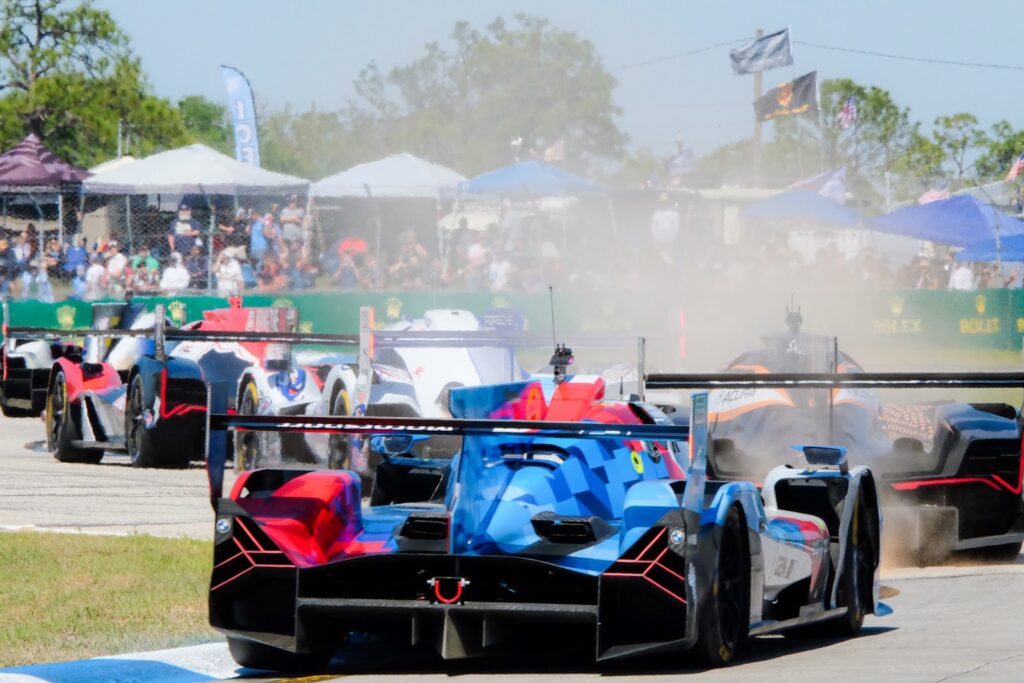
One thing Sebring does have in abundance is space. It’s a long course—3.74 miles in its current incarnation—arrayed over 348 acres, providing more than ample room for spectators to spread out, along with everything they might bring with them.
Apart from a few areas where you can reserve a spot for your Class A Prevost, there are no assigned spaces. It’s first come, first served, which means that if you want to get a prized trackside location in the notorious infield Green Park, you need to show up early. Weeks early. South of the track, along Carroll Shelby Road, an enormous field serves as a pre-staging area. That opens a month out. The most dedicated arrive before that, effectively pre-pre-staging to ensure their spot in line.
By the time I showed up, around midday on Tuesday, bleary-eyed after an overnight drive from the arctic north, there were probably ten quarter mile–long rows of RVs, campers, and cars ahead of me. Seeking confirmation that I was indeed in the right place—it’s all pretty opaque and confusing for a first-timer—I was assured by the guys outside the rented camper I’d pulled in behind, already many beers in, that this was all perfectly normal.
They’d rolled in from various parts of the country, but were part of a crew that had parked an RV weeks earlier. Boasting that they would have the best setup on site, they implored me to drop in, and regaled me with tales of the debauchery they’d witnessed and/or participated in over the years. “It’s maybe ten percent now of what it used to be,” one of them told me with a note of resignation. They’d been coming since the early ’90s, when lewd and licentious behavior still abounded. Of course, the old-timers then took pains to point out that this was nothing compared to what went on during the ’70s and ’80s, when it was apparently not uncommon for people to be engaged in impure acts atop motorhomes.
It was two hours from the time they opened the gates until we began our slow roll toward the entrance. No matter: there was still plenty of room away from the party zones, and I easily secured a spot a quick walk from the bridge over the front straight, right next to a photographer friend who had done this before.
I’m a camping minimalist. A tent, a chair, a cooler and I’m done. Not so for most of the other people here. Crews immediately set to work building temporary structures around the track, multistory viewing platforms, ad hoc lounges and saloons, even a giant circus tent—complete with bar, stage, and P.A.—that would play host to bands throughout the week. This is completely separate from the festival-type stage in the midway fan zone, mind you, with acts hired by the track. These are paying spectators booking their own live entertainment and erecting the venue to host it. Come back in a couple nights and you’ll hear the cream of the Florida cover band crop belting out “TNT” and “Fire Woman.”
Entire thrift stores’ worth of sofas were unloaded and arrayed in improvised courtyards ringed with canopies and vehicles, pickups and golf carts and precariously lifted side-by-sides. “Any of those going home with you?” I inquired of a group of young men thoughtfully arranging their furniture. “Nope!” came the cheerful reply.
As important as the infrastructure was the decor, and while the setups demonstrated some degree of thematic variety—neon palm trees here, a western taproom there—one motif was universal, as declaimed by signs, flags, and kitsch of every description. “You can’t drink all day if you don’t start in the morning.” “Stop thinking, start drinking.” “Bad day to be a beer.” “If you’re looking for a sign to drink tonight, this is it.” “Best beer is an open one.” “Alcohol: because no great story ever started with someone eating salad.” Or perhaps my favorite: “If you don’t drink, then fuck you.”
It did feel a bit aggressive, this insistence on broadcasting one’s inebriated intentions. “Performative silliness” was the phrase favored by my other camping neighbor, a skeptical veteran of many Daytonas but a fellow novitiate here, and it rang true. Especially because, at least from what I could tell over the course of the first few days, the alleged insanity of Sebring amounted to a lot more talk than action. Not only was nobody baring their breasts or getting it on in the open; what I was seeing instead felt more like the poolside patio of a boomer retirement home, and a pretty placid one at that.
Granted, there were people walking around in cow costumes. Others dressed as monks. The Elvis impersonator popped up seemingly everywhere (late period, white leather). Trump flags and MAGA hats were equally ubiquitous, although they generally appeared in concert with slowly shuffling septuagenarians as they emerged from $300,000 pusher motorhomes bearing vinyl stickers with slogans like MAN IS NOT FREE UNLESS GOVERNMENT IS LIMITED. Indeed, the amount of anti-socialist invective emanating from the back of these vehicles was enough to fool a socialist into thinking their ideology might pose an actual threat to the existing order.
(I regret that I was unable to get a photo with the guy wearing the COMMIES AREN’T COOL t-shirt.)
Conspicuously absent was seemingly any awareness—among the groundlings, in the paddock, or even the pressroom—of our limited government’s current military “excursion” or its possible implications for the future of what we were here to see. Maybe people have forgotten that the Sebring 12 Hour was cancelled in 1974 because of concerns that there wouldn’t be enough gas for spectators to get home. This was during the first OPEC oil embargo, when 9% of global supply was cut off for 150 days. Right now we’re sitting at 20% with no end in sight.
It’s worth noting, however, that crowds still showed up in 1974, race or no race, and the party went on regardless.
***
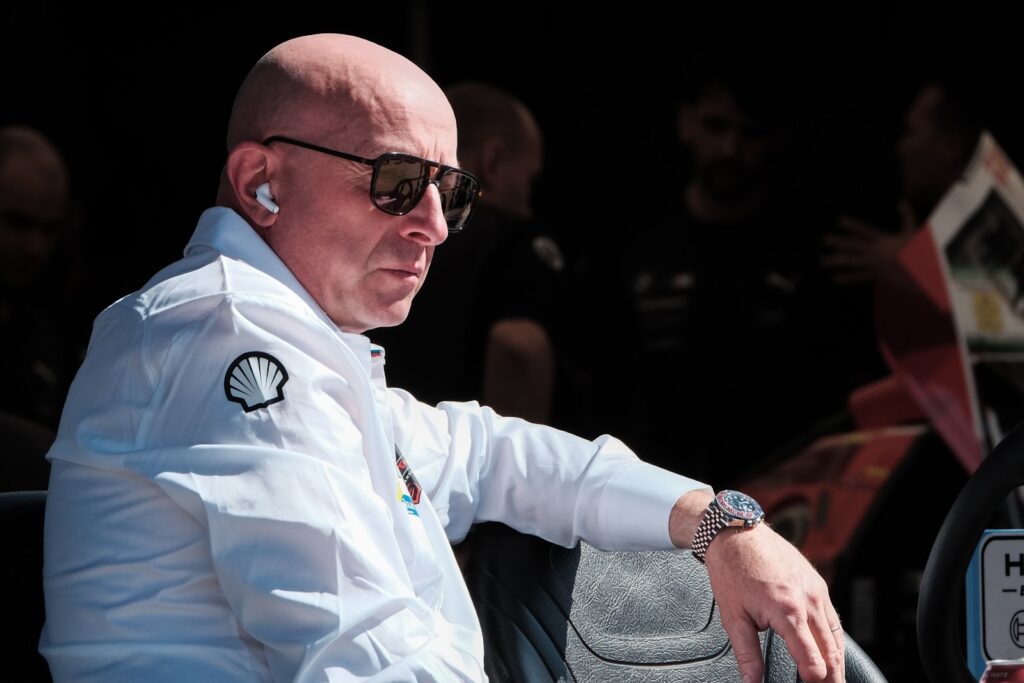
There are some notable new faces in the IMSA paddock this season, and it was fun to see them up close. WRT team principal Vincent Vosse, with his bald pate and go-to-hell shades, looks just as imperiously cool and charismatic in real life as he’s always come across in those WEC Full Access videos.
Similarly amusing was walking past the Manthey garage and hearing straight-up oompah music and Deutsche Lieder emanating from their sound system. Incredulous, I asked the guys waiting on a golf cart outside who picked their playlist. I thought they were mechanics, but realized otherwise when I recognized the one who answered as Porsche factory driver Klaus Bachler, who helpfully explained that Fridays are “traditional music day” at Manthey, a custom observed wherever in the world they might be. “But it ends at midnight in Germany!” he called out as they pulled away.
Just after sunrise on race day, the Manthey crew could be found crowded around their telemetry monitors, intently following their teammates’ progress at the Nürburgring.
Scarcely more than an hour later, the entire pit lane was overrun with fans participating in IMSA’s customary grid walk. Amidst this sea of humanity it is occasionally possible to glimpse part of a race car or bend the ear of a driver while doddering forward at an imperceptible pace beneath the beneficent eye of Wayne Taylor, bestowing blessings from his pit box balcony.
I watched the start of the race from the end of pit lane, and was treated to the rare sight of all of the billionaire bronze drivers making it through the first corner without incident. It would take a couple hours for the Penske Porsches in their Mobil 1 throwback liveries to work their way to the front, and establish the 1–2 stranglehold on the lead they would maintain for the remainder of the race. During that time I wandered like a vagrant, as I had throughout the previous days, taking in the proceedings from as many places as possible but never quite finding the spot that would entice me to settle in for more than a short spell.
It was a bit frustrating, to be honest, and I couldn’t tell if the problem was the track, with its flat corners and samey, distracting backdrops of RVs, warehouses, and endless expanses of tarmac, or simply me and my inability to focus. I did find my friends from the pre-stage lot, out back along the Fangio chicane. True to their word, they’d erected a multi-platform scaffolding that reached three stories into the sky. “Go all the way to the top,” one shouted over the roar, pointing to a couple couches set on a narrow plank accessible via a nearly vertical ladder, itself nearly twenty feet in the air. “It’s safe!”
The view from this terrifying perch did not disappoint: I could see from the exit of the hairpin at turn 7 to my left all the way down to the entrance of Cunningham at turn 10. The open case of PBR tucked between the sofas, combined with the artlessly spray-painted, track-facing sign down below reading “Sebring compound, bitch,” were powerful indications that I had indeed found my people. But even this could not curb my wanderlust for long. Shadows lengthening now, I descended (carefully) and kept walking.
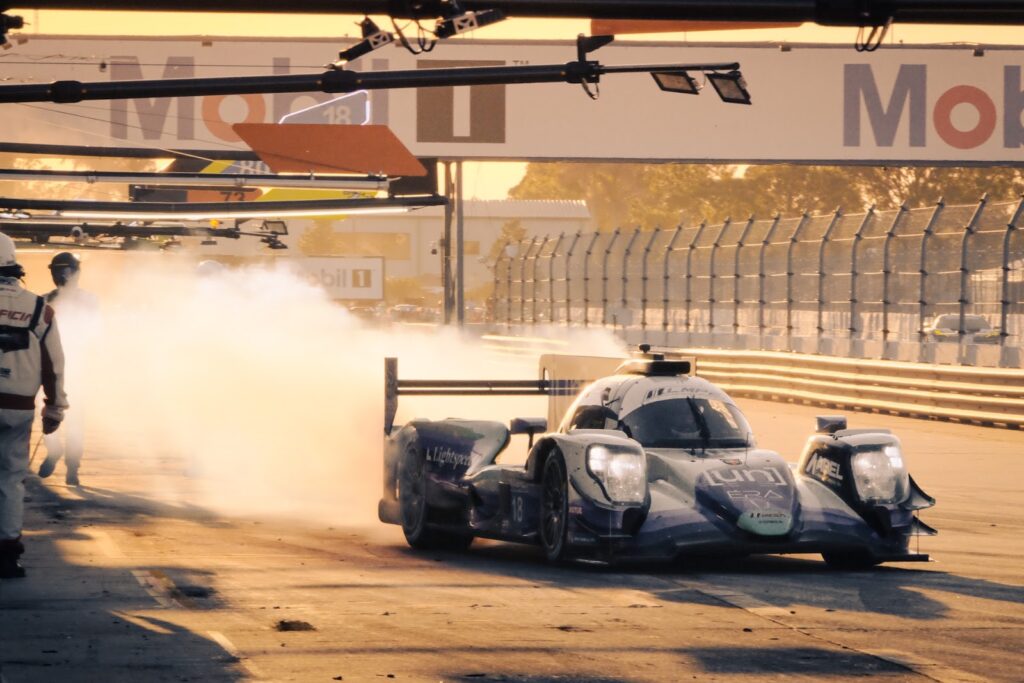
I ended up back along pit lane at sunset, which made for a great view of smoky burnouts, and outside of turn 1 as the sky turned red and then purple, doing the thing that Sebring is famous for. And sure enough, as if on cue, something palpable changed in the atmosphere. Literally, as darkness descended and the temperature dropped, and the wail of internal combustion through unrestricted exhaust deepened in the denser air. But something else was changing, too, the energy around the track, a crackling of electricity and anticipation.
On the bridge leading into Green Park and the thick of the festivities, I met up with reigning American Rally Association East Regional Overall Champion Jimmy Pelizzari. For a while we watched from overhead as taillights chased the last traces of evening light, but we soon headed across the campgrounds, plunging deeper into the beating heart of Sebring.
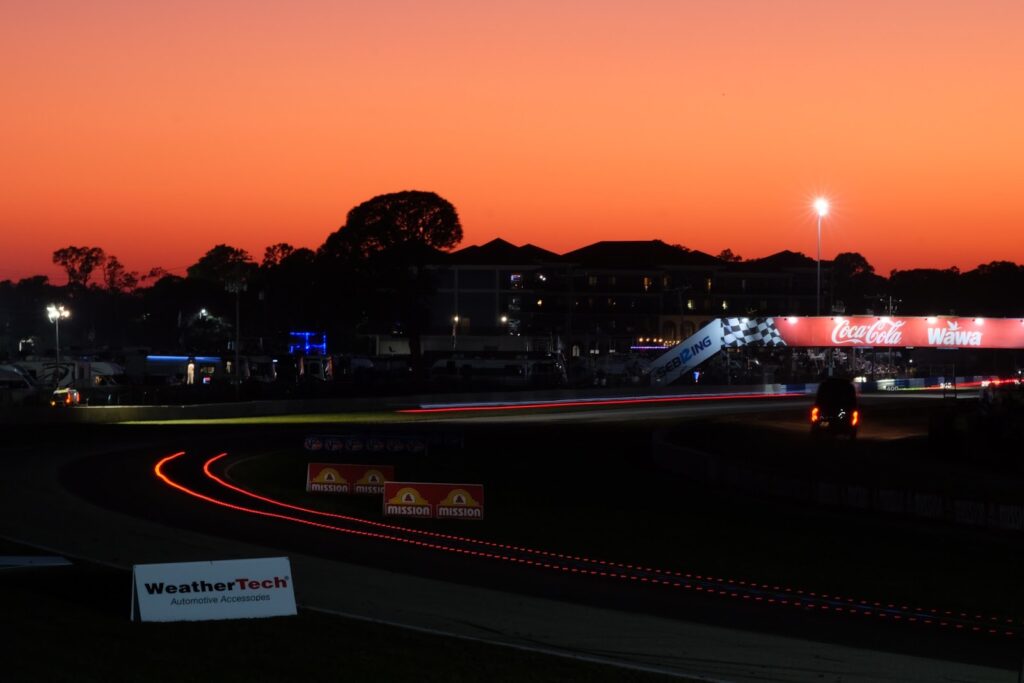
The grounds were alive now, the walkway between the trackside installations and the track itself teeming with people and humming with excitement. Blazing headlights to one side, the glow of neon and a riot of LEDs and flatscreens tuned to the race feed on the other, the night entered its carnival phase. We ducked into the party at turn 10 and were immediately invited up onto the viewing platform, where we joined a couple dozen fellow revelers.
Here at last was the good time Sebring had been threatening all week.
At my elbow a guy poured shots from a bottle of Crown Royal, as ten yards away cars belched fire with every downshift, and tortured brake rotors blazed red in the inky blackness. Further down the track it was the same story. The whole point of all of these lovingly constructed compounds, I was realizing belatedly, was not to keep strangers out, but rather to lure them in. Finally, the true nature of Sebring had revealed itself. For all the history, and the punishing test of endurance it exacts on cars, teams, and spectators alike, what this is, ultimately—the thing that has kept people coming back for three quarters of a century—is a 348-acre block party. A really solid one. With race cars.
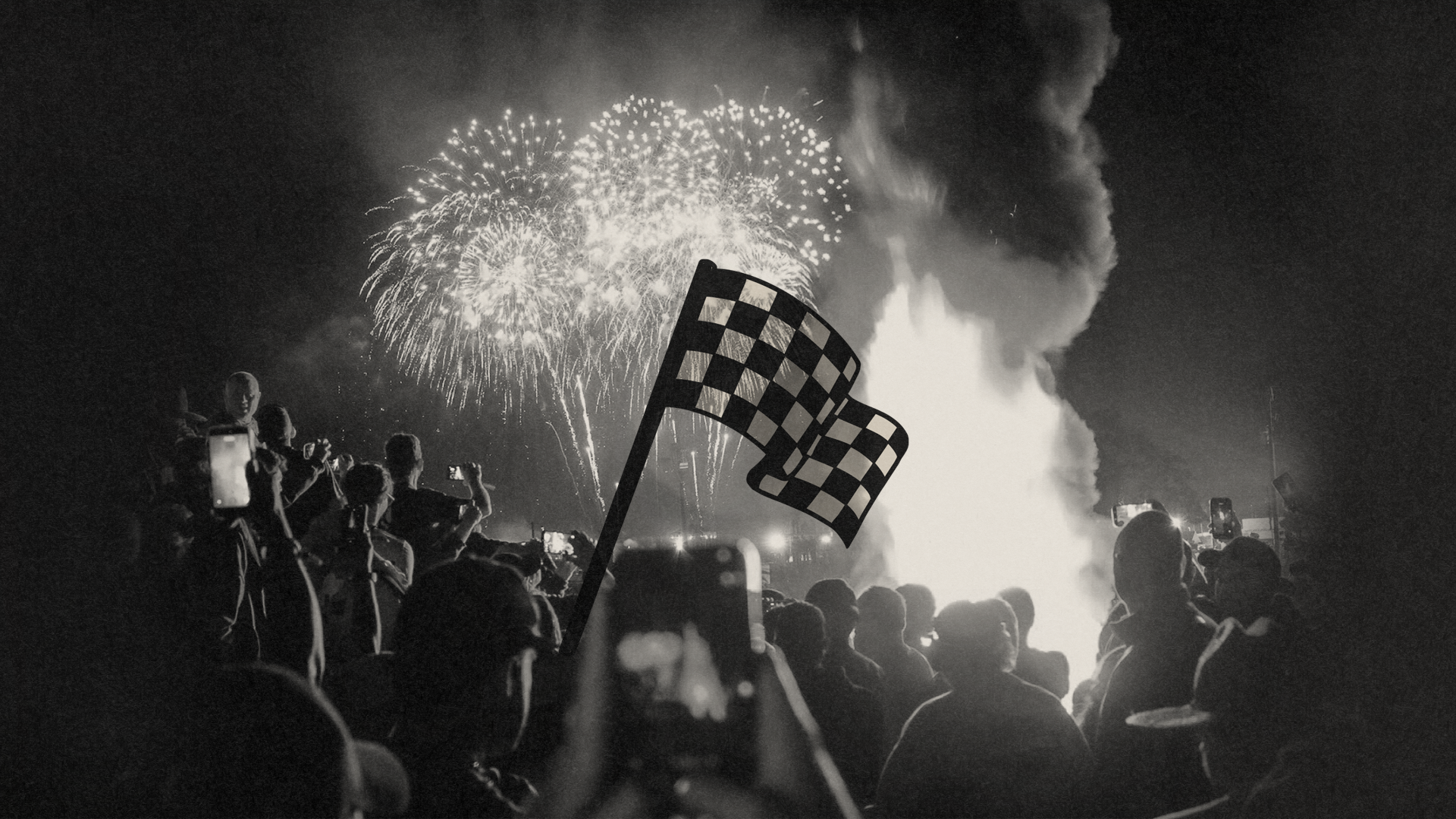
We’d made it to the fence at turn 7 when the race concluded. As fireworks along the Ulmann straight illuminated the night sky in the background, the flames before us reached even higher, the promise of the sacrificial couches now fulfilled. Numberless figures raised their phones in exaltation, silhouetted against the inferno, dizzy with drink or fatigue. All of us transfixed by the ancient rite. The burn.
Hours later, back at the campsite, my skeptical neighbor confessed to a similar conversion. As we chatted, paper lanterns floated past at odd intervals, one by one, maybe a hundred feet above our heads, carrying the flame of Sebring to parts unknown.
***
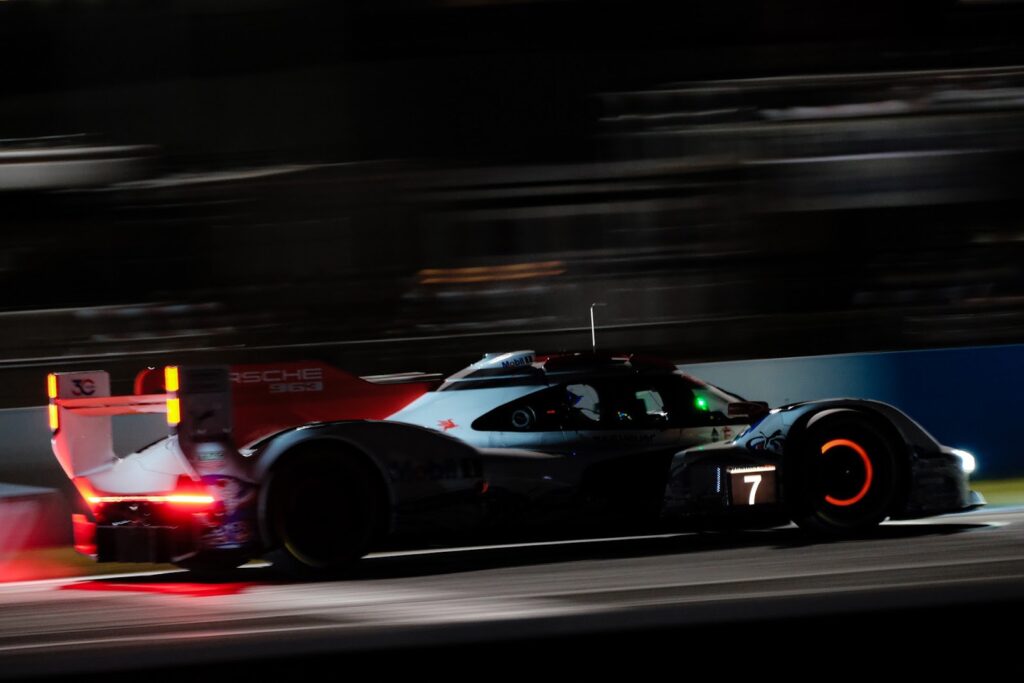
The Penske perfect finish took an uncharacteristically messy turn during the post-race press conference, when Kévin Estre, who brought the second-place number 6 car home, made a point of explaining that some people respect team orders, while his winning teammate Felipe Nasr looked on defiantly from two chairs away. Nasr’s response could most succinctly be paraphrased as, “Sorry not sorry.” Wait till your father gets home, boys. The Whelen Cadillac was elevated to the remaining step of the podium after the number 10 Wayne Taylor car that finished ahead of it failed tech inspection.
LMP2 featured another 1–2 finish as the two United Autosports cars crossed the line with a scant half-second between them. Tower Motorsports claimed third.
Porsches dominated GTD Pro as well, with the Manthey “Grello” 911 car notching the team’s first IMSA win in only its second outing, and AO Racing’s “Roxy” not far behind. The number 4 Pratt Miller Corvette took the final podium spot.
The most dramatic finish came in GTD, as Antonio Fuoco in the AF Corse Ferrari managed to squeeze past Tom Gamble in the Heart of Racing Aston Martin on the final lap. Yet another Porsche, this one belonging to Wright Motorsports, came in third.
A final word: We’ve been talking for years now about the renaissance of sports car racing, both in the U.S. and internationally. The convergence of regulations between the World Endurance Championship and IMSA in 2023 has ushered in an era of manufacturer involvement and investment that is unprecedented in the history of the sport. It no longer feels sufficient to speak of a “golden” age; this one is platinum, baby!
But as anyone who has followed it for any length of time knows, endurance racing’s fortunes are cyclical, and highly dependent on external factors, ones that even the most sagely conceived rule sets cannot control. When we herald golden eras, and shake our fellow enthusiasts by the shoulders insisting that they fully savor and appreciate them, our urgency derives from the certainty that none of this is permanent. If you’re old like me, part of you is always waiting for the other shoe to drop.
It’s impossible to know what the final results of the geopolitical and economic reordering currently underway will look like. If I had to guess, though, I’d say it’s probably not going to be great for those of us in places where motorsport is even a thing. Not to be a downer, but I don’t think it’s unreasonable to suggest that this season could represent a high water mark for sports car and endurance racing for a long time to come.
Get out there and enjoy it while you can.
Recent Posts
All Posts
April 3, 2026
April 2, 2026
April 2, 2026
Leave a Reply