The Strategy of Salvation
January 20, 2026
Alex KiersteinNissan needs some wins. The E-Power hybrid system can’t come to the Rogue soon enough.
If the chorus of analyst voices aren’t proof enough, the 2025 sales figures add some credence to the theory that some of Nissan’s current predicament involves a lack of hybrid models, particularly the Rogue, at a time in which hybrids are hot. Even if a particular buyer doesn’t end up driving home in a hybrid SUV, having the option of a parallel hybrid or PHEV seems to be important psychologically. And it means that Nissan is hurting, dealers are screaming, and buyers are shrugging … and then walking to a different lot to buy something else.
It’s not completely fair to represent this as a strategic misstep for Nissan. Nissan was an early EV pioneer, the Leaf (while lingering with too few changes) sold very well and the new generation is promising on paper, and when many of these decisions were being made it looked like the US domestic market had permanently shifted in an EV direction. What Nissan didn’t do enough of was hedge and drag its feet, like Honda and Toyota (for different reasons). In retrospect, those moves seem prescient, allowing them to remain nimble in the face of a fluid global landscape. Nissan’s strategic issue here is, it seems, an inability to quickly plug the hybrid holes in its lineup.
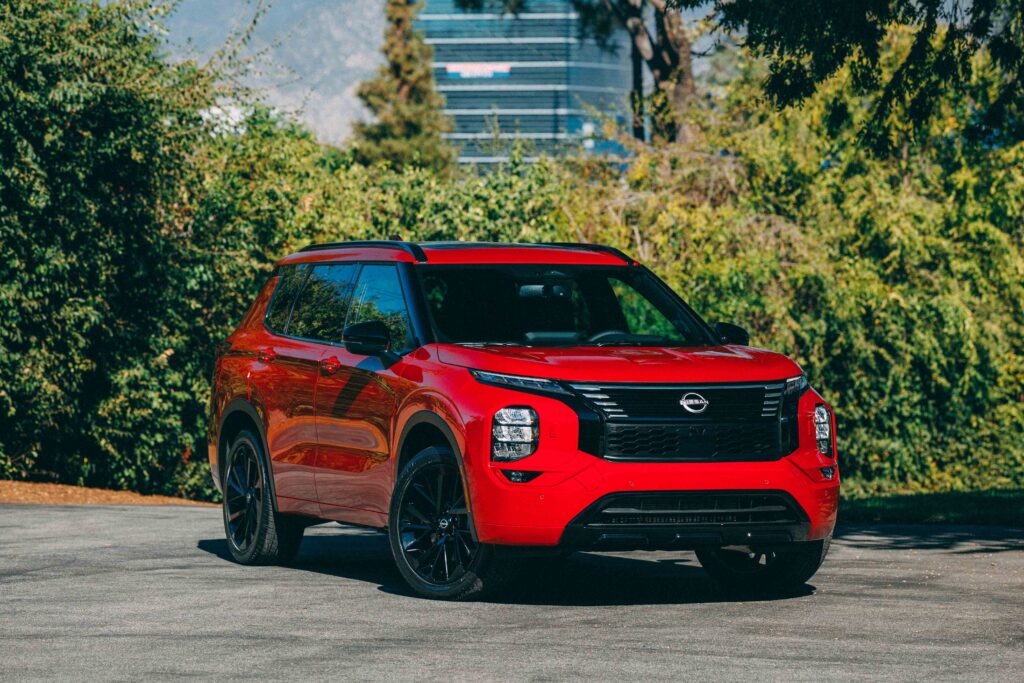
Help is coming in the form of a real hybrid Rogue, we’re told, but it’s at least half a year away. In the meantime, a rebadged and barely restyled Mitsubishi Outlander PHEV is a hastily applied bandaid that isn’t even on sale yet, and it’ll likely crest $40,000 to start like its Mitsubishi sibling. That will put the Rogue PHEV on par with a top-trim Rogue. It’ll be an option, but it may be out of reach for many buyers.
Meanwhile, as Automotive News reports, Nissan’s Mexico-built models are suffering from tariff costs. The Nissan Ariya’s abrupt departure is another unfortunate, and almost certainly very expensive, casualty of the economic climate and hostility to EVs. (It’s not all bad news; as AN points out, the Kicks is doing well despite tariffs. It’s an affordable and attractive vehicle, offering some personality in a segment relatively devoid of it. It just shows that matching the competition isn’t enough for Nissan; it must have some killer combination of features, which the Kicks does.)
So it’s worth a brief look at what is coming to help save Nissan from another round of bad luck: the E-Power hybrid system. If you put it in the context of some other quasi-moonshot tech Nissan’s attempted, like the star-crossed VCT engine, that may sound worrying. I think, however, it has a shot at success—and more importantly, could prove to be a differentiating factor.
E-Power is a series hybrid system. There is no mechanical connection between the gas engine and the wheels. If that rings a bell, it’s because GM famously did a terrible job of explaining how the original Volt worked; it was a series hybrid that also had a parallel hybrid mode. If GM had just explained that, in certain situations, the most efficient driving mode for that vehicle was to clutch the gas engine to the wheels, but that it mostly drove as an EV with a gas engine serving as a generator, maybe that association wouldn’t have stuck among fans and critics alike.
Many years later, no one seems to really care how often the engine is directly driving the wheels so long as it works well. Honda’s e:HEV system only clutches in the gas engine in a narrow set of conditions. That gives Honda hybrids an EV-like smoothness in most situations. But it’s worth noting that Honda made a very explicit decision to bring in the internal-combustion engine in high-speed cruising situations. It’s geared as if it was a manual transmission in its tallest ratio, essentially an overdrive gear. It makes sense, as internal combustion engines are the most efficient in a narrow set of operating conditions, and Honda can optimize for that specific situation (both when it is serving as a generator to top up the traction battery, or when it is clutched in during optimally efficient cruising).
Nissan’s bet is that it can do away with any sort of gearing or clutch entirely. In Europe, the Qashqai (the current version of what we got at one point as the Rogue Sport) is already on the road with that system. In all conditions, the e-motor drives the wheels. The gas engine is entirely optimized for generating power, running at a smaller range of throttle inputs and engine speeds than a conventional hybrid’s engine. It doesn’t need to idle or produce significant low-end torque, because of start-stop and the electric motor respectively.
It’s not just the fueling and valve timing that are optimized to take advantage of this. The 1.5-liter 3-cylinder’s physical characteristics are adapted to this narrower operating range. It uses a spray-applied coating to form the valve seat, rather than a press-fit, sintered seat. This apparently improves charge flow into the combustion chamber. The flow, or specifically tumble, is important to producing stable combustion during extra-lean running, or with high exhaust gas recirculation, or both. The tumble is promoted with intake manifold geometry, turbo characteristics, piston crown shape, and combustion chamber shape that is narrowly tailored to the reduced range of running conditions.
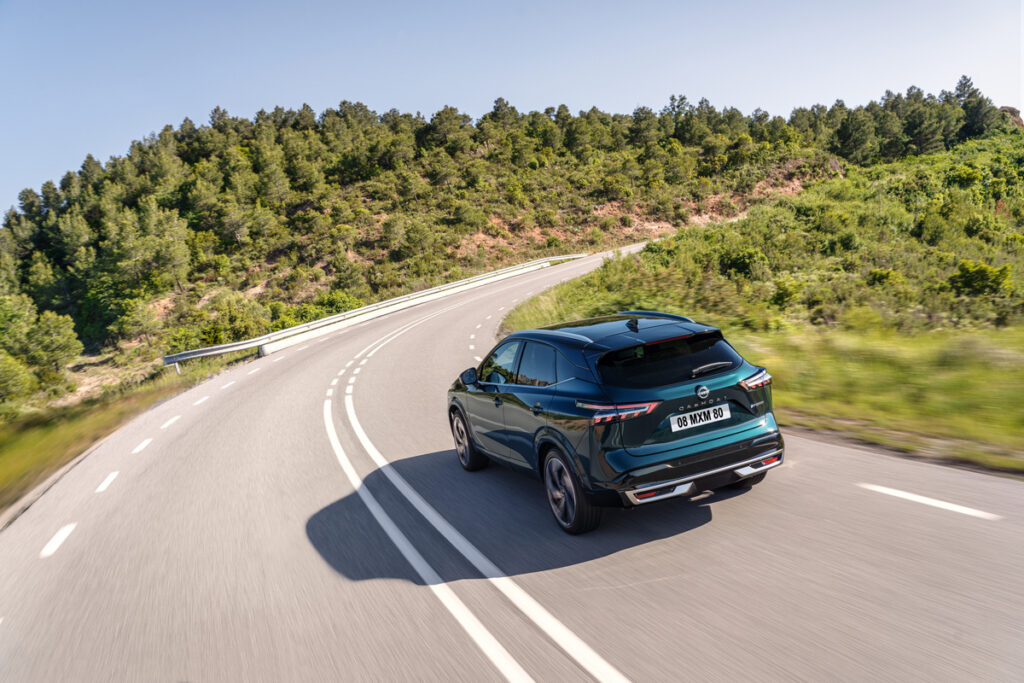
Nissan claims a net 42% thermal efficiency from the Qashqai’s E-Power setup. That’s a tiny, ego-bolstering hair above the 41% Toyota can squeeze out of its Dynamic Force engines. Most production gas engines are between 20 and 40% efficient.
An engine that must vary in daily driving between idle and high-load, producing low emissions and suitable torque, means everything is a big compromise. Thinking about it from that perspective makes Nissan’s eventual goal, which it calls fixed-point operation, even more attractive. Creating a system in which the engine only has to operate at a single RPM (or a very small range that is effective a single RPM) could up thermal efficiency to 50%, Nissan claims.
But let’s not get ahead of ourselves. E-Power exists in Europe and is functioning in vehicles on sale today. And, at least by UK numbers, does not appear to be outrageously expensive. There are three powertrains available on the UK Qashqai: a low-power 1.5T mild hybrid, a high-power 1.5T mild hybrid, and E-Power. The E-Power option (202 hp) on the UK-market Qashqai is a $2,600 step up from the mid-level 156-hp mild hybrid powertrain.
I think that leaves plenty of room in the middle for mid- to upper-trim Rogue E-Powers in the mid- to high-$30,000 tier. Look at the Honda CRV’s pricing scheme. The base CRV starts at an MSRP of roughly $31,000. The EX trim, which is probably the volume trim, is $33,150. The first hybrid is the Sport Hybrid, and it’s a $2,540 upcharge.
This is a big assumption, but assuming no other major differences in equipment, it doesn’t seem like the E-Power hardware is significantly more expensive on an unit basis than Honda’s system. That is good news for Nissan. The Rogue isn’t a bad product, but there needs to be a reason to buy it over the competition. An efficient hybrid system with an explicable point of differentiation with its competitors is good.
I’m asking Nissan for some more information about the specific advantages the E-Power system has for buyers. Does it save a significant amount of weight or money to remove the transmission (i.e., the clutch and gearset that would connect the gas engine to the wheels)? And it’d be nice to get some US-market figures or projections about efficiency, too. I hope, for Nissan’s sake, there’s an articulable efficiency or cost rationale for it.
Recent Posts
All Posts
January 19, 2026
January 19, 2026
January 16, 2026
Leave a Reply