Sail Away
December 18, 2025
Alex KiersteinThe microbrand universe brings whimsy into such staid segments as the stodgy yacht timer.
It’s a crowded watch market right now. A steady drumbeat of releases from big volume players like Seiko and Casio, especially collaborations and limited editions, make for convenient marketing beats. But it’s iterative. You’re buying a variation on an established layout and aesthetic.
That sounds like a critique, but my collection falls into these buckets. I chose a G-Shock square out of hundreds and hundreds of variations because it has a vibration alarm, but it’s otherwise a standard-fare square. My field watch is a one-year-only job with a USAF background, but it’s a regular three-hander otherwise. I know why they’re special to me, but they are not aesthetically innovative watches.
I have a friend who loves dials with a loud burst of color, bright pastels and rainbow indices. He’s helped train my eye to actually look at watches that fall outside of all of the standard buckets: The tachymeter chronographs, the three-hander sports watches, slide-rule bezels (that no one knows how to use).
I’ve dipped a toe in. I don’t have my Revue Thommen Airspeed (with a bright red dial, titanium case, and an ETA 251.262 quartz chronograph movement inside) any more, unfortunately. The cult-classic movement deserves its own article. But it is about as bright as my watches have gotten.
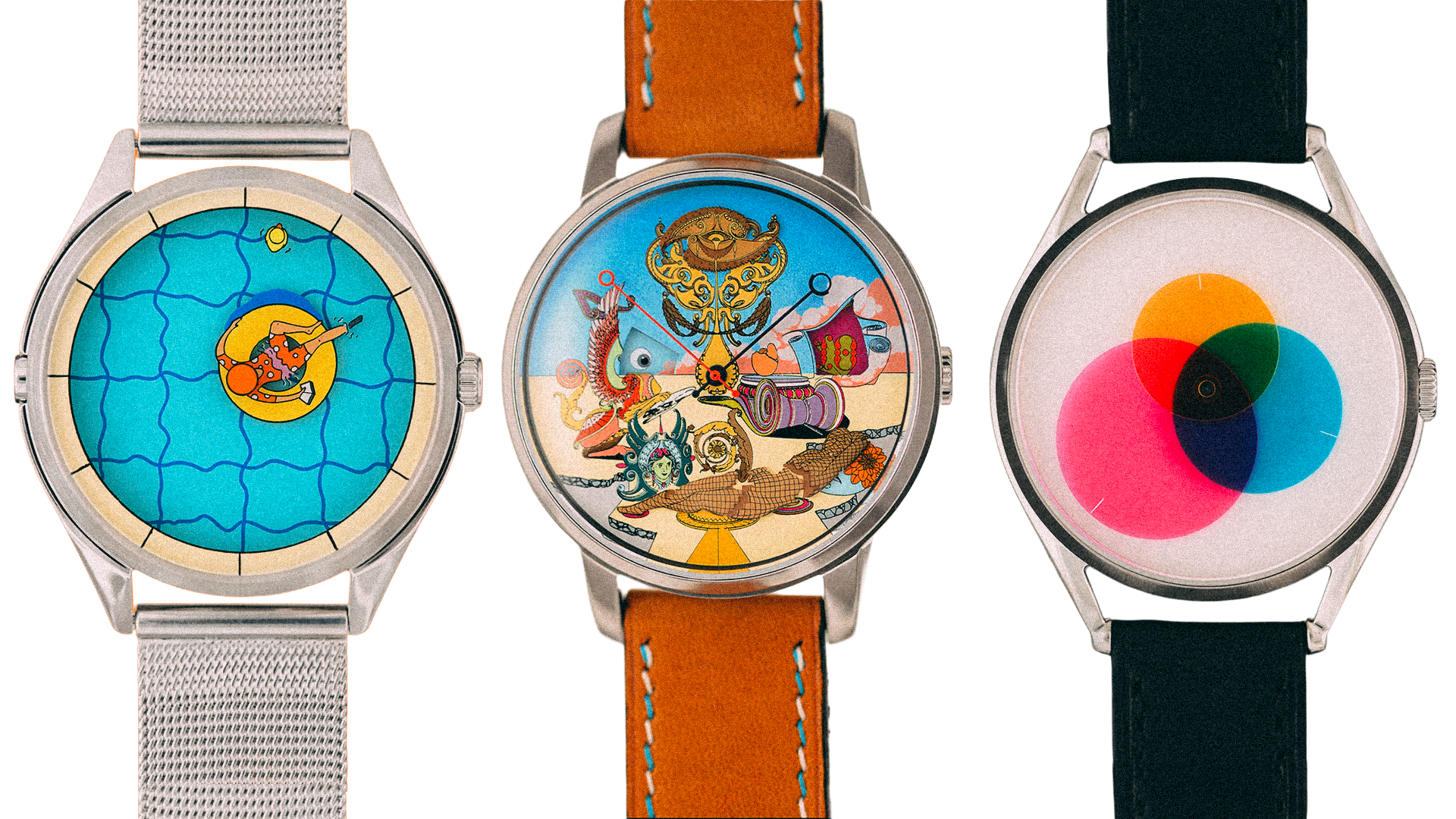
Meanwhile, out on the adventurous edge of collectordom, there is Mr. Jones Watches. They are witty office mugs, but more tasteful. They’re graphical, very bold, and conceptual. The people who buy them seem to love them, and the response in watch community forums is unrelentingly positive. It’s a London-based microbrand darling, for good reason.
There are trinket watches that loosely resemble some of Mr. Jones’ ideas, but these are serious watches with a whimsical execution. Think of these watches as a bit of an inside joke that doesn’t exclude others; the watches start conversations, owners clue-in the observers, it’s a friendly circle built on wholesale rejection of mainstream watch norms. The accessibility of Swatch without the disposable plastic essence.
Other microbrands are employing color in interesting ways to otherwise established genres. Baltic has been making watches since 2016, with assembly in France of components sourced from Hong Kong—standard practice in the lower end for this type of thing. There are numerous factories doing to-order component manufacturing, with world-class quality, so it’s been a boon for these small-scale producers aiming to hit the sub-$1,000 market. There are an equal number of high-quality (if not horologically interesting) automatic and quartz movement choices for this class, too.
Baltic has leveraged these things to build vintage-informed but relatively restrained watches, like the Aquascaphe. If it sounds like something Jacques Cousteau’s son would wear to the bottom of the ocean in an orb suspended below a giant pontoon full of gasoline, this is intentional. It riffs on some of the charm of the Blancpain Fifty Fathoms feel, but it’s not an homage.
Baltic’s first watch was the Bicompax, a two-register chronograph. The contemporary Scalegraph trades the 1940s look for a 1960s racer’s wish list of features. There’s a sporty tachymeter bezel and a three-register dial in the expected panda and reverse panda colorways. But it’s the Transat Cafe L’Or limited edition that diverges, delightfully.
The metallic-finish champagne dial is fantastic by itself. Seiko had a champagne-dial phase in the 1990s, and those watches have outsize appeal today. It adds a lot of sophistication (and contrast) to a stainless-cased watch. Beyond that, there’s the yacht timer register, with its tri-color treatment and 15-minute countdown layout. It’s used to help ensure sailboat racers cross the starting line at the appointed time, and it’s been a feature of some of the boldest watches out there—some which have held up aesthetically, and some which haven’t. The orange hands are bright, fun, and legible.
It is in no way an homage, but what immediately came to mind when I saw the Baltic Transat Cafe L’Or was the Abercrombie & Fitch Seafarer. It’s an absolute legend, a bucket list tool watch, partly because it represents an era in which A&F was a real outdoors outfitter, selling to hunters and anglers. The Seafarer combined a manual-wind chronograph movement with a tide dial. Set the time, then use the left-hand pusher to advance the tide marker to point to the local high tide. (Look at a tide chart, or more likely, your smartphone.) Then it’ll indicate the upcoming high and low tide times, which are a little over 12 hours apart.
For a vacation at the beach, that’s useful. But it is the combination of the old, venerable A&F branding (the watches themselves were made by Heuer, pre-TAG) and the bright, colorful, fun execution of the dials of the various Seafarer versions that have stuck with me. There have been many, many homages. (Yema does a fairly affordable one, for example.) But why Abercrombie hasn’t licensed its name to an outfit to reissue these watches again is one of the great mysteries of vintage tool watch enthusiasm. It’d be easy to flub it, but do it right and you’d sell every one you could make.
The blue on the dial, the orange accents, revive some of the fun of the Seafarer’s colorways. And it’s not the only brand doing this sort of thing. The Batavi Marina Chronograaf is even more colorful and interesting, with a fascinating two-layer dial. The numerals are applied to a layer of sapphire, so they cast shadows onto the lower dial surface. Like the Baltic, the Batavi has a lot of fun with the yacht timer concept.
Sigh. I should really buy a sailboat so I can justify getting one of these, shouldn’t I?
Recent Posts
All Posts


December 17, 2025
Leave a Reply