The Shadow of Hormuz

April 21, 2026
Alex KiersteinIs a new fuel crisis the herald of a small EV resurgence, or a momentary blip on the way to our old, guzzling ways?
It is difficult to pin down how carmakers are making decisions when the deluge of events that drastically change the automotive landscape is so intense. Is the Strait of Hormuz open, blockaded, or closed entirely? It seems to depend on the hour. Even though the product reveals of the last few weeks are based on decisions made years ago, before this conflict was a glimmer in the President’s eye, the optics are startling. You’re telling me that Kia will sell the EV3 in America, after a gaggle of automakers successfully argued for lower fuel economy standards while fuel prices fluctuate wildly?
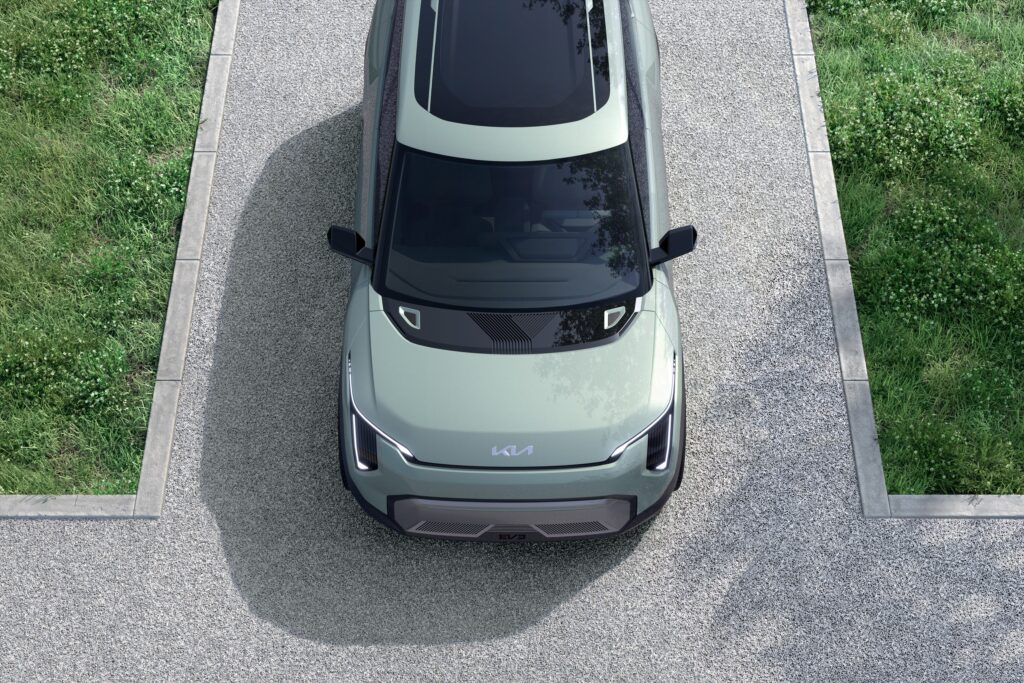
Well, yes. The Kia EV3 will be sold here, along with a whole bunch of other EVs that seemed improbable a few weeks ago. Toyota and Lexus are on an EV tear, with the Highlander going all-electric only, the Corolla and Lexus ES coming with EV versions, and even a Lexus EV supercar-like thing. Players you’d expect to be big in this emergent EV wave are absent or scaling back. Ford, a legitimate US-market EV pioneer and probable EV sales leader here, has canceled everything, basically, except the UEV. Honda has, of course, abandoned ambitious EV plans entirely.
As observers, we’re left trying to figure out which automakers were prescient, which were lucky, and to what degree any of them will be able to leverage this and any other emergent situation. Right now, it seems like there are two strategies that have helped various automakers the most. One is economy of scale, which of course is universally helpful in vehicle production. A huge variety of vehicle variants pulling out of a shared parts bin has helped Hyundai, Kia, and Genesis keep introducing new E-GMP vehicles, for example, rather than pulling back in the face of wavering interest as of a few months ago.
Another is utilizing a flexible platform. I am as guilty as anyone of thinking of these as a compromise, a branch in the automotive evolutionary tree that would be abandoned as the entire world transitioned mostly to BEVs. Many of those multi-powertrain vehicles were intended more as compliance cars than fully-realized products. The Mazda MX-30 (designed to house either a BEV or conventional gas engine, but only sold here as a BEV—and a sad one, at that) and the Honda Clarity (fuel-cell, PHEV, or BEV) come to mind. Full of damning compromises, all of them.
At one point, I also thought that a BEV or a hybrid that didn’t have a distinct visual identity would be less appealing. The weak reaction to early hybrid-versions-of-mainstream-cars and the strong sales of Prius-like quirky hatches seemed to reinforce that.
But now, powertrain flexibility seems to be desirable. Conventional parallel hybrid and BEV options in the same chassis do provide consumers with two solid choices, from a usability standpoint as well as a resource conservation standpoint. That’s because PHEV variants are on the decline here, now that automakers don’t derive as much CAFE credit from the fuel economy calculations that favored them. Real-world studies that showed poor plug-in charging behavior by consumers, making them heavy and inefficient parallel hybrids in practice, have reinforced the anti-PHEV arguments. EREVs are coming, which negate the downsides somewhat, and may soon take the place of PHEVs and cut out some of the post problematic owner habits.
At least in Europe, EVs are seeing a huge boost as consumers react to the immediate reality in front of them: soaring fuel prices. Polestar set a sales record in mainland Europe. Polestar!
Automakers’ victory laps after defeating pro-EV policies and championing lower fuel economy standards may, ultimately, be read as short-sighted. Not merely because of this particular energy crisis. This, I believe, will be one of many such events that impacts the global economy in a way that causes fuel prices to jump around. Maybe it’ll be consumer behavior; too many fuel price shocks in a generation might cause organic shifts in the market. Maybe the circumstances will change to make a separate American-market product stream untenable. Perhaps oil or other resource shortages will cause downstream effects.
The LA Times makes a very good point when considering who, globally, is best positioned to gracefully move through this and potential future geopolitical and economic fiascos: China. It uses a lot of fossil fuel, to be sure, but the massive economic and social investment it has made in “new energy vehicles” is paying off already. China is the unsurpassed leader in EV tech, has some insulation from oil price swings, and some degree of energy independence. It can use this crisis to prioritize renewable energy even further. More importantly, it is on a path to being less impacted by such crises, period.
China has a coherent strategy here, and it isn’t ideological. It’s entirely pragmatic, and it’s multi-faceted. Just like automakers are realizing that powertrain flexibility is going to help them move through a period in which demand between BEV and ICE/hybrid will sway, China is building an economic system that is more resilient to conflicts that impact energy supply and demand.
Meanwhile, stereotypical American notions of energy independence—producing more oil locally, removing “costly” fuel economy standards—are coming out of the Iran War looking bruised. Our vehicles are not noticeably cheaper, our gas prices are considerably higher. Drilling more oil in the Gulf of _______ or up in Alaska doesn’t untether us from the global energy market, and it is either stupid or cynical to promote that idea. Piecemeal sales of a new crop of compelling EVs, like the upcoming Kia EV3 or all the various new Subaru and Toyota models, also don’t address the strategic question of hardening the economy to uncertainty and strife.
But by failing to articulate a pragmatic, coherent energy strategy instead of an ideological, willfully ignorant one, America cedes geopolitical power to China. And it has already ceded the EV technological advantage.
Recent Posts
All Posts
July 27, 2026

July 17, 2026

July 16, 2026
Leave a Reply
You must be logged in to post a comment.