Audi Concept C
November 3, 2025
Jonny Lieberman
Can one car cure all of Audi’s ills? Jonny Lieberman drove the Concept C to find out.
Audi is in trouble. While the previous statement isn’t a surprise to car industry watchers, there was a time not long ago where Audi was thought of as a leader in terms of design, technology, performance, and profits.
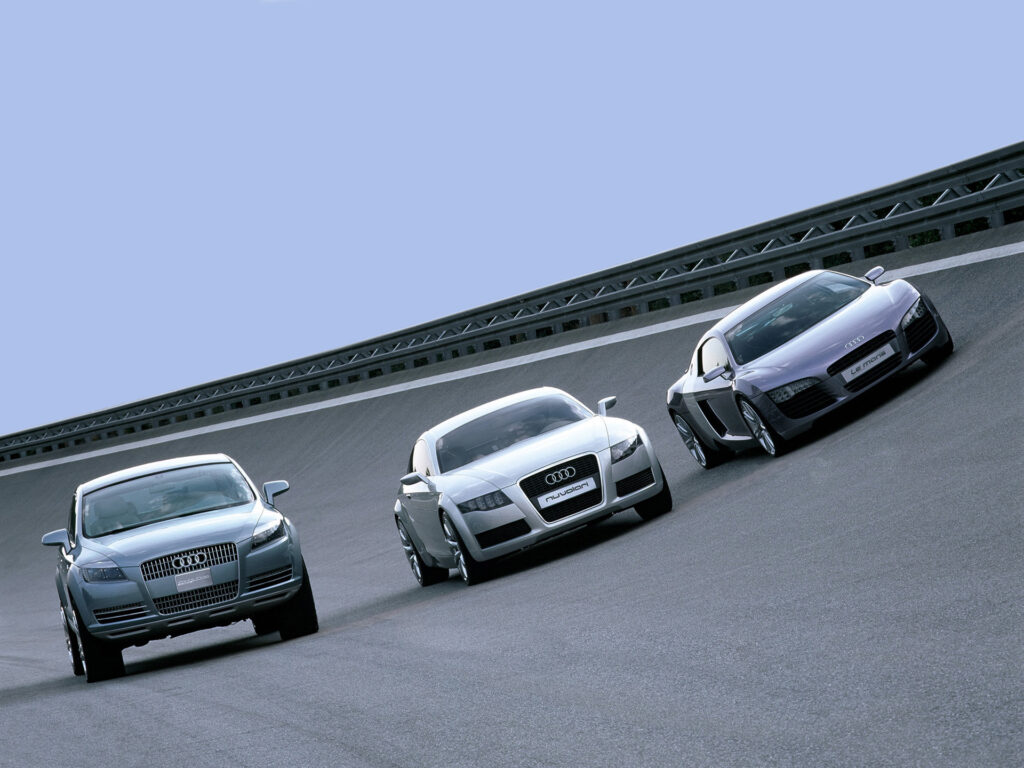
This all began in 2003 with the introduction of the Le Mans quattro concept, a car that previewed the much-loved Audi R8, a tidy supercar that featured carbon-fiber side blades, a massive-for-the-time front grille, novel LED daytime running lights, and a sinister yet seductive shape. The world swooned, the R8 was quickly followed by the gorgeous Nuvolari concept that morphed into the A5 coupe, and the athletic-for-an-SUV Pikes Peak concept that became the three-row Q7. Audi the brand was off to the races. Or at least finding its way into consumers’ hearts.
These days? Things are confused. Too many models that look too similar to each other, and the once inscrutable product names no longer make sense at a glance. I’d wager good money that most Audi employees couldn’t tell a phone-sized photo of a Q4 e-tron apart from a Q6 e-tron. Also, the A4 has been renamed the A5 because the A5 uses gasoline. Even equals EV, odd equals ICE. Never mind what Audi’s going to do with the gas-powered Q7 and Q8, where the Q7 is smaller than the Q8, expecting consumers to grok this sort of numerology is fantasy.
There’s also the (much more serious) issue of too many platforms. For years the quattro brand made bank off the fact that the overwhelming majority of its products rode on a single platform: the Volkswagen Group’s MLB Evo toolkit. Vehicles ranging from the A4 to the RS7 to the RSQ8 (and Lambo Urus, and Porsche Cayenne, and Bentley Bentayga) were all built on Modularer Längsbaukasten Evo (it translates to something like “modular latitudinal platform”). Iterating each new model off of MLB Evo meant that sixty percent of the engineering cost was already paid for. Fair, the A3 was based on the Golf platform, MQB, and the sadly departed R8 shared its bones with the even more sadly departed Lamborghini Huracan. More recently? The Q4 e-tron, the Q6 e-tron, and the recently killed off Q8 e-tron were all on separate platforms. As is the e-tron GT. Crazy, but true.
As important as the above sausage making tutorial is the fact that Audi design has gone stale. Both inside and out. It just has. Going back to the three concept cars from above, I maintain that no brand has ever so successfully re-invented itself as Audi did with that trio. The photograph of all three together parked on the curved banking of a racetrack is (probably) still sending chills down the spine of contemporary BMW and Mercedes execs. Afterall, Audi had long been the weird German carmaker. The one that bought NSU, that went rallying instead of road racing, the one with a car named after a fox. Leather-lined Subarus, really. Then suddenly, not only was Audi dominating Le Mans, but we wanted to buy its cars. That’s the power of good design. Sure, the TT came first (talk about great design) but it was a shot across the bow, not a right cross to the noggin.
Much Ado About Audi Design
The exact state of the brand hadn’t hit me until I was scooped up from the Munich airport for
the nearly four drive to Brixen, Italy by a Audi A6 e-tron. It’s generically lozenge-shaped, and
looks like an Audi face grafted onto a Chinese electric sedan. The inside was OK, but the
center screen was massive and seemed to be growing tumor-like out of the middle of the dash.
Worse was whatever was happening with the haptic buttons on the driver’s door. About a
dozen of them, and well, let’s politely call it tech overload. The car was totally fine I suppose, but with a $65,000 starting price “totally fine” is totally not good enough. Not in the premium segment.
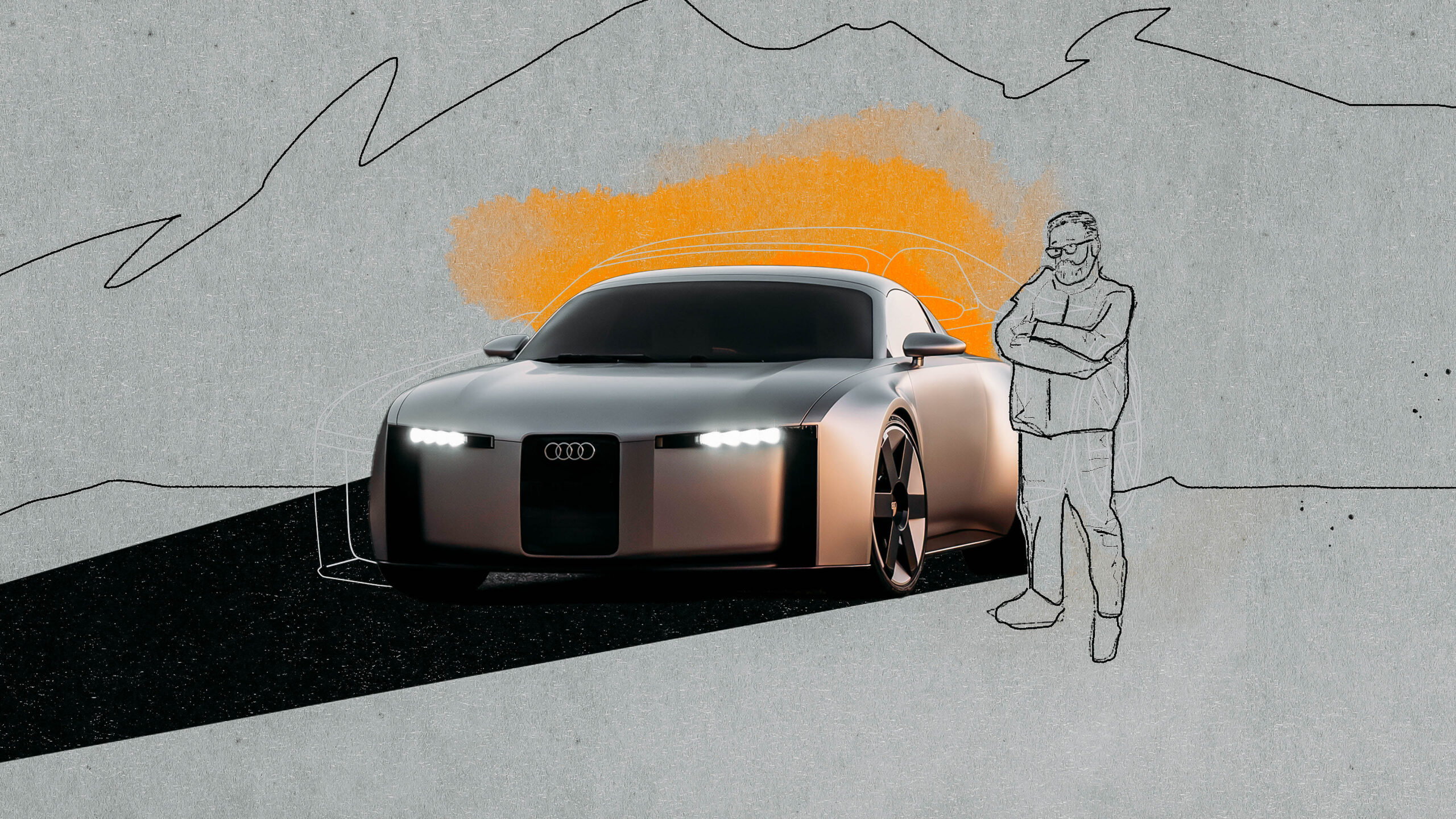
Audi is acutely aware of all of the above. Proof? The Concept C. It’s a complete design statement that’s almost too good to be true. The Concept C is both a break from the immediate past that’s dragging the brand down, as well as an embrace of what made customers fall in love with Audi nearly two decades ago.

Why the Concept C is needed
A couple of points to consider. One is that Audi is about to break open the piggy bank and go
race Formula 1. All in, that can be as much as half a billion dollars. Annually. Beyond F1, Audi
does have an incredible racing legacy. It dominated the 24 Hours of Le Mans for as long as it
chose to compete—starting in 1999 Audi competed in the great race 18 times and won 13 of
them. The brand also has an elite rally history, having won the WRC championship twice in the ‘80s as well as recently winning the 2024 Dakar in a RS Q e-tron race buggy.
Then of course there’s the incredible, though tainted by the era, Auto Union Silver Arrow history before World War II (Audi was one of the four Saxon brands that made up Auto Union, the others being DKW, Horch, and Wanderer), with the magnificent Typ C.
Point being that Audi needs something sporty and sexy and two-doory to sell to consumers. The other point is that premium brands need halo products. This point ties in nicely with the racing stuff, but in a larger sense if you’re selling A3s, you want something that the A3 buyer can aspire to. Since the sunsetting of the R8 as a thing you can buy, Audi’s hottest performer is the mighty, recently refreshed, RS e-tron GT, the 5,200-pound family sedan that incidentally can run a
9-second quarter-mile. Thing is, the RS e-tron GT has 4-doors, and even though some may find it drop dead gorgeous (hi mom!), you need a coupe/convertible atop the lineup. Why do you think Lexus bothers with the awesome but slow-selling LC500?
To reiterate, the incredible sheet metal that brought Audi up to par against its German rivals—Mercedes-Benz and BMW—has grown as stale as its interiors have become overwrought. The Concept C is a line in the sand, a jumping off point. A reboot of the brand itself. Audi design boss Massimo Frascella calls the new language, “Radical Simplicity.” In fact, he doesn’t even refer to it as a design language, but rather a design philosophy made up of four pillars: clear, technical, emotional, and intelligent. Says Frascella, “Audi is an inexplicable harmony of technicality and emotion, where rational and irrational coexist.” I’d counter that it could be, though it depends on how successfully the Concept C’s admittedly strong design aesthetic matriculates to the other Audis.

Starting outside, and no I still can’t quite explain the mini-fridge grille, the Concept C is instantly recognizable as an Audi, yet also both brand new and future facing. I don’t see radical simplicity as much as I see voluptuous brutalism, which is no bad thing. The Concept C is electric, and while the grille does nothing in the way of cooling, it does house all of the typically unsightly ADAS sensors (have a look at the snout of a Ferrari Roma). It is much rounder in person than two-dimensional photos lead you to believe. The four corners of the car show off the type of complex metal and line-work that the VW Group is so damn skilled at. The rear end is the highlight, being especially Teutonic and Cylon Raider from Battlestar Galactica at the same time.
Inside, there’s no plastic whatsoever. Which, who doesn’t love that? I asked Audi point blank will the “no plastics” thing carry over to a production car. They replied yes, but only above a certain price point. There were no details on what that price point might be, but figure the production version of the Concept C will be plastic-free, while whatever replaces the
aforementioned A3 will have plenty. The door cards and seats were fabric, the carpeting was shaggy, the dash and the steering wheel were leather lined, and all the switchgear (including the door handles) was hewn from aluminum. Audi also came to the smart decision that while you gotta have a screen, you can totally fold it away when you don’t want to see it. A cool party trick that Audi used to employ with the two generations ago A6. Perhaps most importantly, all of the switchgear now makes the exact same click when you press, or twist, or click it. Audi used to ensure this was the case in all its cars. I’m happy to report that it will be once again, starting in 2027.

And yes, I drove the car, and I’m burying the review here at the bottom of the article. Not
necessarily to force you to read more, but rather because of Audi’s platform problem. Going
forward all Audis will be built off the upcoming SSP platform. Full name is Scalable Systems
Platform, and starting in either 2027 or 2028, most VW Group products will be an SSP variant.
Stuff like the Porsche 911, Lamborghini Revuelto, and Bugatti Tourbillon will remain on their
own platforms. But everything else? Including internal combustion cars and SUVS, should be
SSP-based. Again, 2027, maybe 2028. Meaning that as of late 2025, SSP doesn’t yet exist.
So what the hell did I drive around the beautiful Italian Dolomites? My best educated guess is a
chopped-up RS e-tron GT. One engineer let slip that the surprisingly functional Concept C has a single rear motor that makes over 500 horsepower. Sounds like the rear motor of the refreshed
J1 platform that Audi co-developed and currently shares with the Porsche Taycan. You can bet that when the production car drops, Quattro will be an option. Like the heavily revised e-tron GTs and Taycans, the Concept C drives exquisitely. Balanced, direct, lively, huge power – basically everything you want in a driver’s car. Though that’s not the only reason I think they’re the same basic car. When I returned home to Los Angeles I happened to pick up an RS e-tron GT and I clocked that the tires are exactly the same size as the Concept C’s—265/30ZR21 up front, and 305/30ZR21 in the rear. Not outright proof, but close enough.
Sound
The single motor doesn’t make much noise but Audi does pump some spaceship noises through the Concept C’s speakers. Did I mention the Concept C is a folding hardtop roadster? Assuming the
silly sounds can be turned off, I think the notion of silent speed is pretty cool. The world is waking
up to how much better quiet/electric off-roading is, especially if you enjoy nature, and I think there will be a place for silent speed, too.

The conclusion
Audi has said that the production car that evolves from the Concept C will drop in 2027 as a 2028
model. We also know that the production car will be closely related to the upcoming Porsche
Boxster EV. Both vehicles—like the Concept C—will locate the batteries behind the driver,
where an engine and transmission would sit in their equivelent ICE vehicle. We know Porsche has been adamant about making the electric Boxster as light as possible. We were told that the Concept C weighs less than 4,000 pounds, which for a BEV is fantastic news, especially if the production car comes in under the two ton mark.
In the end, the Concept C is a product that Audi has to get right. To recap, whatever the
production version of the Concept C is called, it’s a vehicle that must usher in the Audi F1 era,
untangle Audi’s platform problem, serve as a halo vehicle, and reignite Audi’s design leadership
flame. That’s a big ask for one car, though based off what I saw, heard, and drove, the Concept
C is capable of accomplishing all that. And there’s still time to change the grille.

Recent Posts
All Posts
March 6, 2026
March 6, 2026

March 5, 2026
Leave a Reply