BAsic
October 4, 2025
Brett Berk
How Slate’s Tisha Johnson Designed a $27,000 Electric Pickup
“The North Star was creating something that people would love.”
It was easy for Tisha Johnson to sign on as head of design at Slate, the low-priced, electric truck company funded in part by Amazon oligarch Jeff Bezos. She’d been interested in the category for decades. “The topic of accessible or affordable EVs has been on my mind since I was a design student,” Johnson says from her studio outside of Detroit. “My graduating thesis was focused around the needs of an underserved population that needed affordable, reliable transportation, and EVs are obviously that.”
However, once she started the job, in 2022, the real struggle began. Surrounded by industry veterans, and attempting to create an American-made, battery-powered vehicle that would retail for less than half of the average cost of a current EV, she was faced with challenges. “We started by thinking we would use known methods,” Johnson says. “But our success really has to do with us just throwing out the playbook.”
Johnson’s brief was to create a product that was at once aspirational, and cost effective, an improbable Venn Diagrammatic overlap. But after a decade at Volvo, her positions in the years just prior to Slate were with a pair of venerable western Michigan hard goods manufacturers: Modern furniture giant Herman-Miller, and famed appliance maker Whirlpool. So, she sought inspiration in an unlikely piece of stolid industrial design.

“The KitchenAid Stand Mixer,” she says. “It has some cool attributes. It’s super simple in its form. It’s clearly communicating its function, yet with some thoughtful considerations. It’s been enduring, but it’s also been experiencing a certain revival. And, why? Because folks recognize its capacity for utility and personalization. You can get it in different colors. You can swap out different types of mixing bowls and attachments for whatever you use it for. And people love it. They get really excited about it.”
To create such an object at a spectacularly low price point, she and her team—which she constantly and graciously credits—had to organize themselves in opposition to the mission creep and bloat that typically defines new vehicle development, both in terms of scale and features. Simultaneously, they had to create ideas that could be executed very simply.
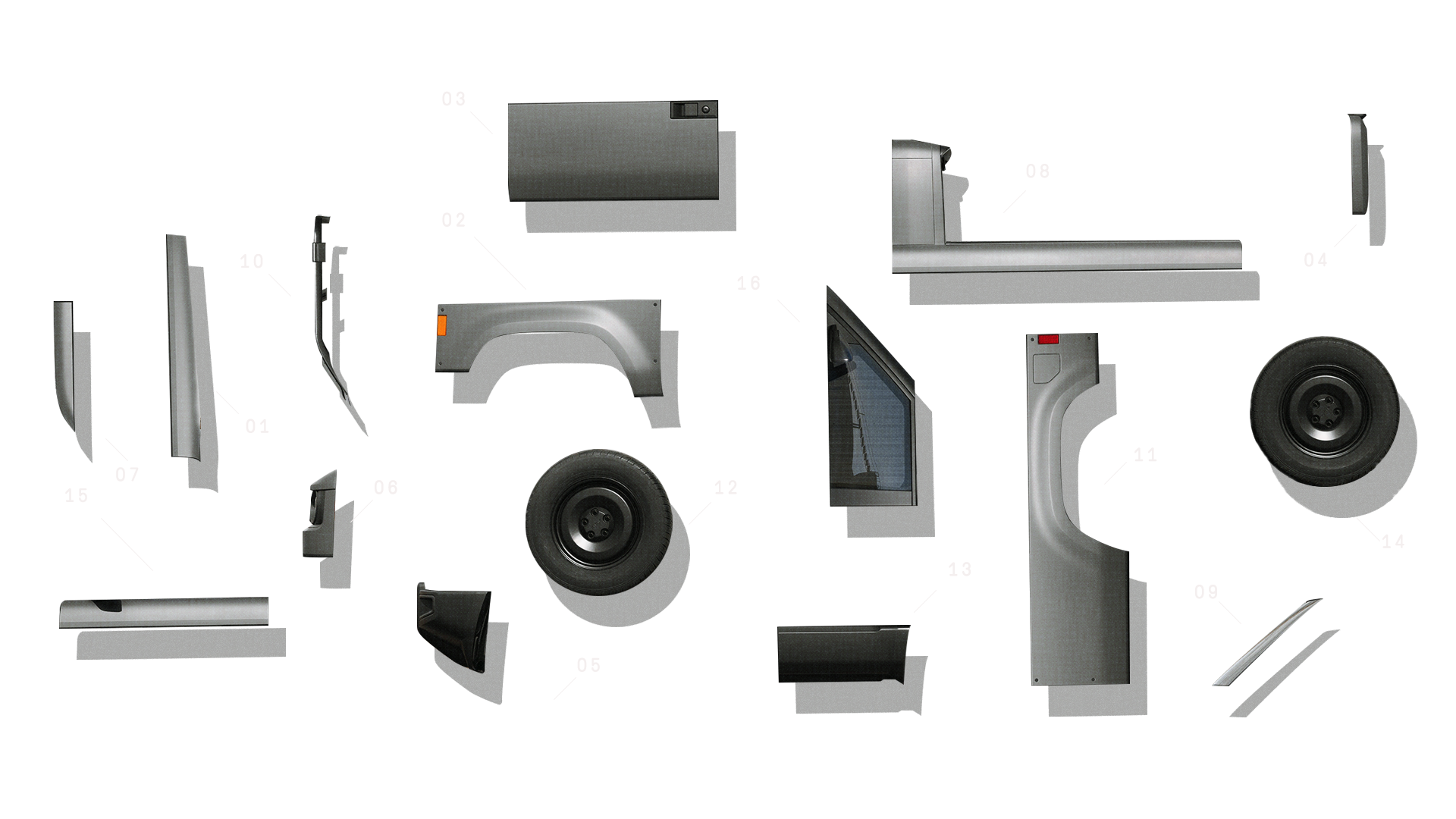
“One of our core principles was a really reductive approach in manufacturing, and in designing for manufacturing,” Johnson says. “So, if we could reduce the number of parts, or the complexity of producing those parts, anywhere around the car, then we could achieve a lower cost product. That’s dollars we’re handing back to our customers.”

This encompassed simple, but radical, designs. For example, creating symmetrical armrests that could be utilized on either side of the vehicle, as well as in a center console. Or utilizing a heathered textile fabric on the seats that looks cozily inviting, costs far less than leather, has great durability, and hides stains, so, as Johnson says, “It’s harder to see some of the daily abuse.” Ideal for a work truck.
It also included larger contraventions of convention, most notably, at the front of the vehicle. Traditionally, Johnson says, this fascia is key because it carries the vehicle’s and manufacturer’s DNA, its key signifiers of identity. “It is a touch point for the brand, and for the way that people look at vehicles, because, that area, we associate that with a face,” she says. “So, we understand as designers—across decades and decades of doing this work—that is the one place you reserve dollars. You spend money there.”

Slate’s unique selling proposition includes simplicity, do-it-yourself adaptability, and high levels of personalization, and customization. It makes this available to customers with a dizzying range of bolt-on accessories, from simple decals, to a roof-and-seat set that transform the truck into an SUV.
So instead of investing precious dollars on jewel-like materials up front, Johnson’s team decided to declutter, de-brand, and back off: to enunciate that this area is, in essence, a blank slate for owners to do what they want with. “Instead of a big imposed design statement, we provided exposed fasteners, so you can just pick up a tool and literally remove the brand mark—take the Slate logo off—if you want to, and put something else there. You could buy something in our marketplace. You can 3D print something. You can do what you want to do there.” The brand lets you choose your own signifier.
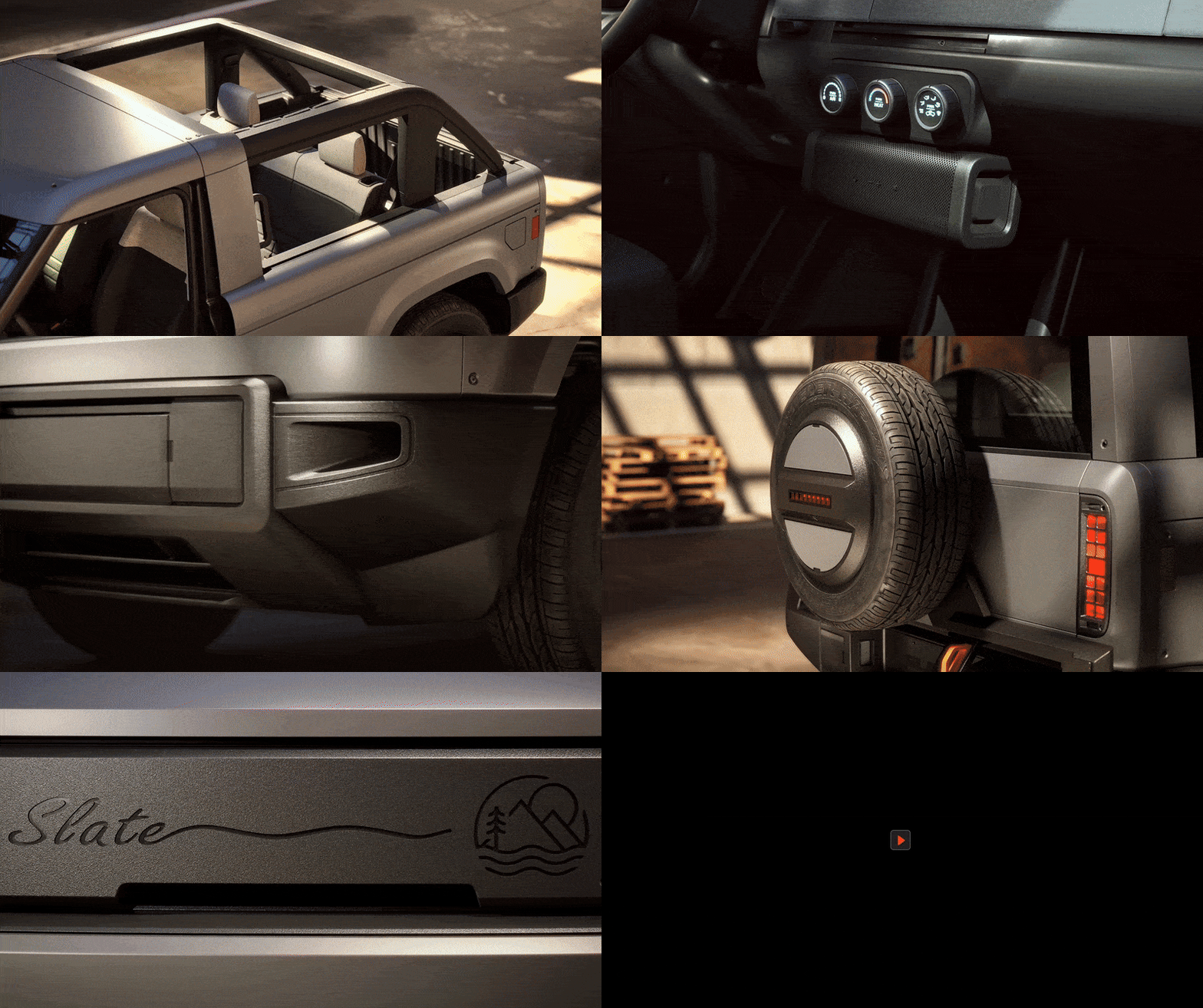
Correlative to this aesthetic, the truck comes only in one color, grey, which is baked into the molded polypropylene panels that make up the exterior. This saves the cost of building a paint shop, and streamlines production. If a buyer craves color, they can opt for a seemingly endless array of vinyl wraps in solid or patterned hues. And they don’t have to wrap the whole vehicle, they can add stripes, or blocks, designs, or other liveries.
In order to make this process at once simple and affordable—able to be completed by the consumer, without hiring a professional—Johnson and her team intentionally provided the vehicle’s exterior with built-in instructions. “When we designed the panels, we embedded coach lines on all the surfaces,” she says. “It’s a pattern. We’ve exposed a pattern to make it easy for people to get those decals on.”
The interior benefited from a similar combination of de-contenting, reimagining, and avoidance of contemporary convention. This was especially true when it came to infotainment, and its liquid crystal display proliferation, which has colonized nearly every imaginable surface on the inside of cars. The Slate team’s radical thought: bring your own.
“When you look inside, you see a very basic display behind the steering wheel. And instead of a bunch of other screens, we have a holder, a universal phone holder that has power available,” Johnson says. “That way, you’re being able to bring in your own device, something that you love, that you know, you understand.” And if you want a larger screen, the holster expands to fit a tablet. “Most people have a tablet already, it’s a sunk cost,” Johnson says. “So we’re able to provide a big screen, without charging our customers thousands of dollars.”
The same goes for their solution to a sound system. There’s just a secure place to mount your Bluetooth speaker, and owners can scale up from there with off-the-shelf equipment. “You can end up with your instrument panel becoming your sound bar,” Johnson says.
Rethinking everything has been at once challenging, and thrilling, for Johnson, so it seems logical to ask where else the Slate brand could stretch, what her dream project would be. She responds right away. “I have a real simple response for you,” she says. “We have to get this vehicle to people, super soon. And it has to be exactly right. So, right now, all our mental energy is concentrated that. I love that question, but that is our focus.”
Recent Posts
All Posts
August 3, 2026

July 30, 2026

July 27, 2026
Leave a Reply
You must be logged in to post a comment.