Pumped Up: Part III


March 11, 2026
Alex KiersteinThe weird (seriously) history of gasoline octane ratings. Variable compression test rigs, crazy blending pumps, and more.
What got me interested in doing this little series is actually the bit I’m going to cover in this chapter: how gas is marketed. “Premium” or “Super” sounds like it may be better in some way than “Regular” gas, but of course you can’t market “More Detonation Resistant” and “Slightly Less Detonation Resistant” grades in any meaningful way.
Thus, octane ratings. Eventually, I want to talk about the marketing (and consumer confusion) around higher-grade gasolines. But first, I need to talk about how (and why) octane ratings were established in the first place.
A Leaden Past
At one point, these gas grades were helpful rather than confusing. Early gas internal combustion engines had low compression, with lower specific output but the ability to run on lower-octane fuels.
Those pioneer-era gasolines were basically just byproducts of kerosene production, not formulated for any real consistency or target specification. They worked fine in low-compression engines. Octane? Who knows! It wasn’t an issue…until engine design, block and head metallurgy, and so forth developed, bringing higher-compression engines and they started to knock. That’s what sent Kettering and company on a quest that ended up with tetraethyl lead (TEL) in our gas, air, and bodies.

The Octane Odyssey
It also made it clear, especially to those involved in early military aviation—which was way ahead of automotive engine tech in the search for extreme output from the smallest and lightest engine—that a method of grading gas was necessary. Hence, octane rating. Knock-induced engine failure was a much bigger deal aloft in a fabric-covered wooden airplane than on the ground. With octane-rated gas, military aviation got a consistent product and could increase engine compression to match.
Before World War II, some auto engines were becoming powerful enough, with high enough compression ratios, that knock could occur when burning some of that era’s gas. The anti-knock capabilities couldn’t be easily determined by a driver before pouring it in the tank. (That said, the “high” compression ratios look ridiculous by modern standards. The original Ford flathead V-8 was in the range of 5.5:1.)
Without agreed upon standards, fuel consistency was a problem—drive from one region to another, and different quality gas might cause your engine to knock. Enter the Cooperative Fuels Research (CFR) Committee, which involved the who’s who of burning gas, pumping gas, and standards: the American Petroleum Institute, Society of Automotive Engineers, Automobile Manufacturers Association, and the National Bureau of Standards. This acronym soup commissioned Waukesha Motor Company to build a single-cylinder engine as a test rig, in 1928.
Get this: it had variable compression. Eat your heart out, Nissan! Waukesha knocked it together (groan) in just 45 days. It moved the entire cylinder up and down, changing the compression ratio without having to, say, remove the head and re-shim it. The design was a major success, and established a test-engine standard that was utilized for decades, although the CFR engine was updated over time. The bottom line is that it provided a repeatable, consistent way to determine the knock resistance of gas, allowing for standardized octane grades.
Remember in Part 1, when I mentioned that the octane rating compares compares the volatility of a quantity of gas to the behavior of two known hydrocarbons? (Being heptane, which knocks like crazy; and octane, which is the “100 octane” rating reference). This is the test engine that is actually used to compare fuel with the reference hydrocarbons.
Optimizing for Octane
If you have a standardized measure of octane, you can take advantage of a higher compression ratio, advance the timing, increase combustion temperatures, and generate more power. And automakers did just that. The high-performance V-8s emerging in the 1950s, like the Oldsmobile Rocket V-8, added compression—and thus power—year-over-year. By 1957, the Rocket had a 10:1 compression ratio good for more than 300 hp, depending on the specific displacement and carburetion. The ‘68 Pontiac GTO’s 400 squeezed gas to the tune of 10.75:1, getting close to the hairy edge for a street motor.
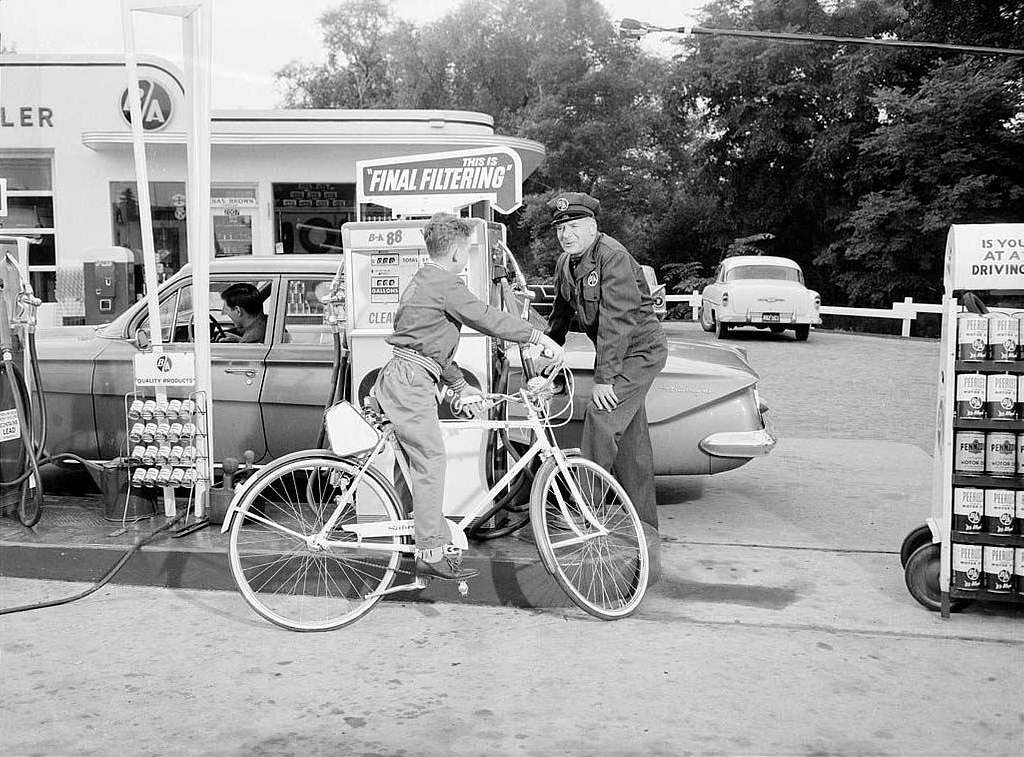
The weird thing is, gas stations didn’t advertise the octane rating until the FTC stepped in and issued a regulation about it in 1970. So there were a couple of decades after WWII in which engines increased in power, but the advertising environment around gas grades was more subjective. It seems like automakers generally recommended “premium” gas in performance engines and “regular” in most normal cars, but there weren’t hard numbers to reference. I suppose if you experienced knock, you filled up next time with something more premium. That’s what my dad recalls, being a period reference of sorts.
It should be said that with TEL involved, octane ratings were in general higher than they are now. (And remember, octane ratings vary regionally, too. I’m on the West Coast, and we have lower octane gas than other regions.) The NYT, writing in 1970 and linked to above, notes that “regular” gas (leaded) had an octane rating of 91 to 95, and premium was “up to 101” octane.
Regular is now, generally, 87 octane. Mid-grade is 89–90, and premium is 91–94. Some of this can be explained by abandoning TEL for ethanol. But also, I think it’s just how things settled out to some degree.
But Wait! There’s More
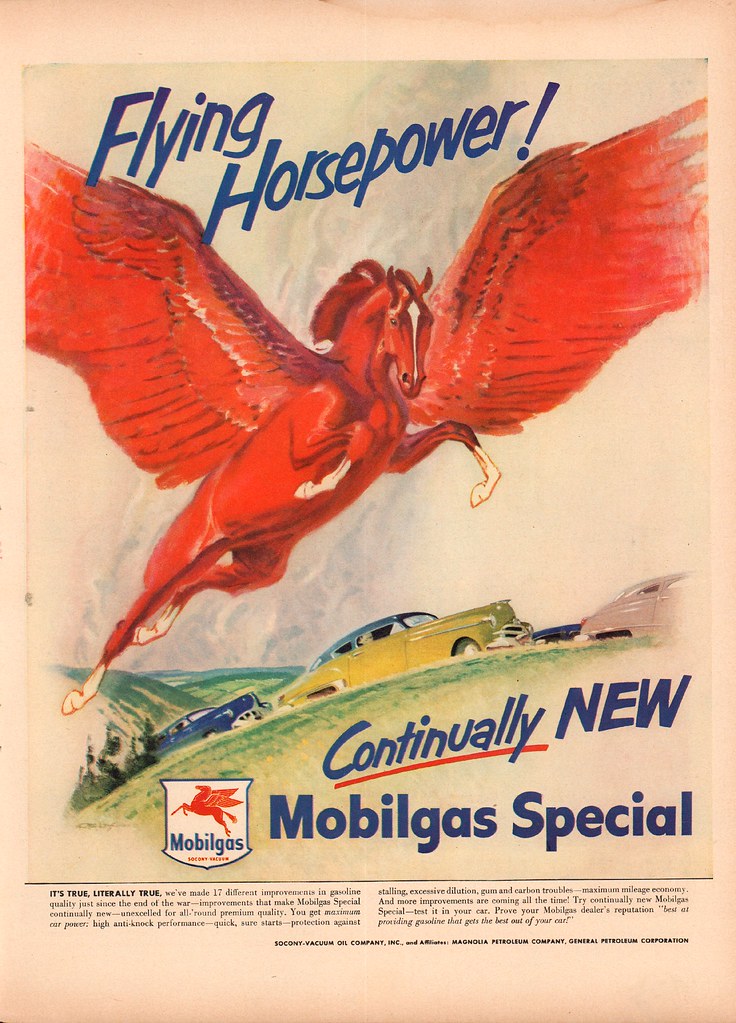
In addition to the baseline octane ratings being higher overall, there was a lot more choice at the pump. Sunoco, for example, offered a contraption called a “Custom-Blended” pump, which would mix you up any one of several Sunoco gas “brands.” For example, Sunoco 190 was a “sub-regular” low-octane blend, not that the octane rating was displayed anywhere, remember. Sunoco 260 was a high-octane premium blend. The pump fed out of two tanks, varying the proportions to meet the customer’s selected product.
The pump described above had five available gas types. The sort of strange thing to the modern observer (me) is that the gas grades were marketed as individual products. Texaco had the Fire Chief and Sky Chief lines, and later marketed the Petrox additive in its Sky Chief line (basically a detergent that reduced TEL deposits). And so on.
You’d think having those drier, theoretically more objective octane numbers on the pumps would be a lot less confusing than punching a mixture into some Dial-A-Blend pump. And yet, are Americans still wasting money on premium gas? You bet. More on that in the next installment.
Recent Posts
All Posts
August 3, 2026

July 30, 2026

July 27, 2026
Leave a Reply
You must be logged in to post a comment.