Curbside
Over the past decade and a half EV station builders and operators have linked up the two coasts via a series of charging corridors and they’re building charging plazas along major coastal routes, offering ever-faster DC fast-charging options. Now some charging providers are offering charging that takes advantage of newer 800-volt architectures, hoping to cater to deep-pocketed EV owners who want a charging experience that’s as quick and easy as filling up their cars with gas.
But there’s another category of EV charger, one that has been largely overlooked on this side of the Atlantic while being a common sight in western Europe. And it is perhaps the one that holds the key to a number of US states achieving their goals of phasing out the sale of gas and diesel-engined cars and trucks by 2035–curbside chargers. Smaller, slower and more conveniently located, they’ve appeared in European cities in a dazzling variety of designs, ranging from ones built into street light poles to outlets that fold out of the pavement.
What most have in common is that they use existing electrical infrastructure nearby, including phone and broadband access points located near apartment buildings, and other types of municipal electrical infrastructure including street lights.
The trade-offs are modest Level 2 charging speeds below 15kW. They’re useful for a quick top-up, but their real value is giving apartment dwellers opportunities to recharge their cars at night. Curbside chargers also cater to those who might not have a dedicated parking spot on their street each night.
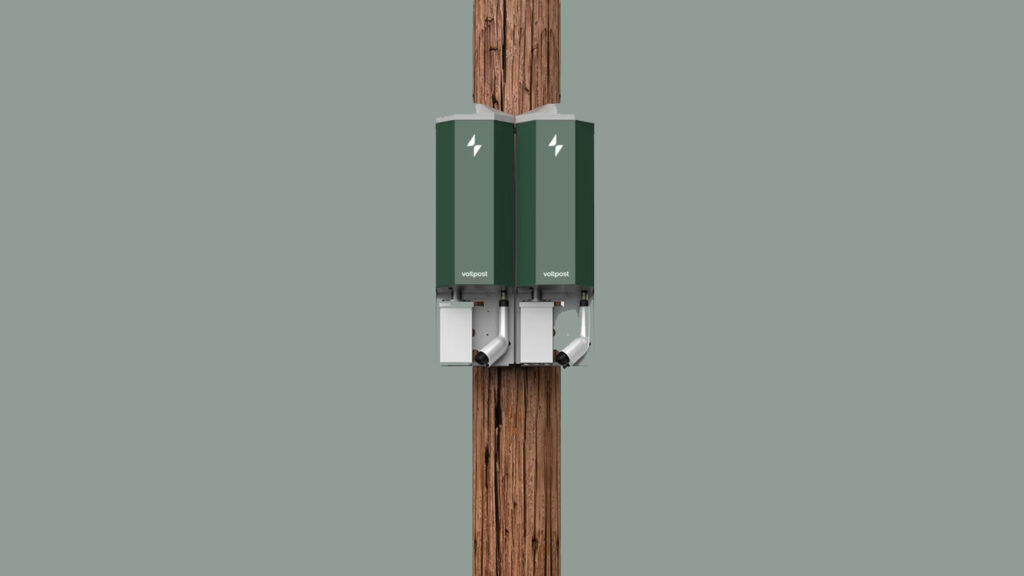
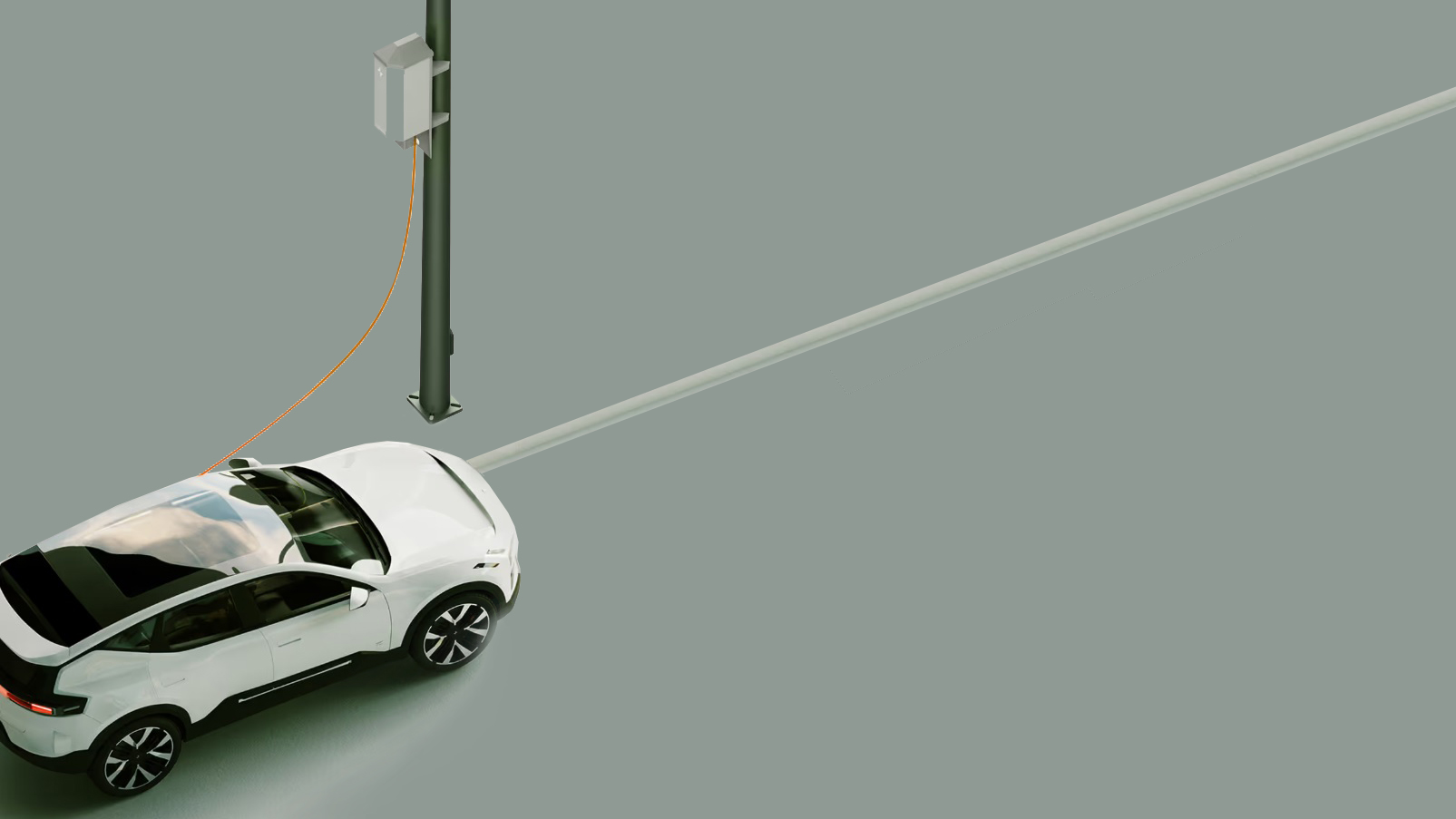
One promising design offered by New York-based startup Voltpost uses a cylindrical housing attached to a lamp post about 10 feet above ground level. It deploys a charging cord to an EV below once a driver activates it via a smartphone app.
The Level 2 charger, dubbed Voltpost Air, uses an existing electrical connection to offer 9.6 kW to a single EV, and takes just a couple of hours to install on a given streetlight pole. The high position makes the charger more vandal-resistant, while not taking up space around the base of the pole itself.
More importantly, the charger does not require permitting or excavation work, which has tended to add significant costs and headaches to deploying regular chargers.
Earlier this year the company received $2.6 million to install 75 Level 2 chargers across New Jersey, New York, and Connecticut, in a partnership with ZipCar.
“With millions of streetlights in the United States, the opportunity to convert even a fraction into chargers will make a significant positive impact,” said Jeffrey Prosserman, CEO and Co-Founder of Voltpost.
Another far more compact curbside charger design revealed by Rheinmetall a couple of years ago features a charger that deploys out of the pavement, requiring the owner to supply their own cord.
It’s an elegant approach, but one that’s perhaps a bit more difficult for cities to install in existing infrastructure, pointing to solutions that could be integrated into the sidewalks of the future.
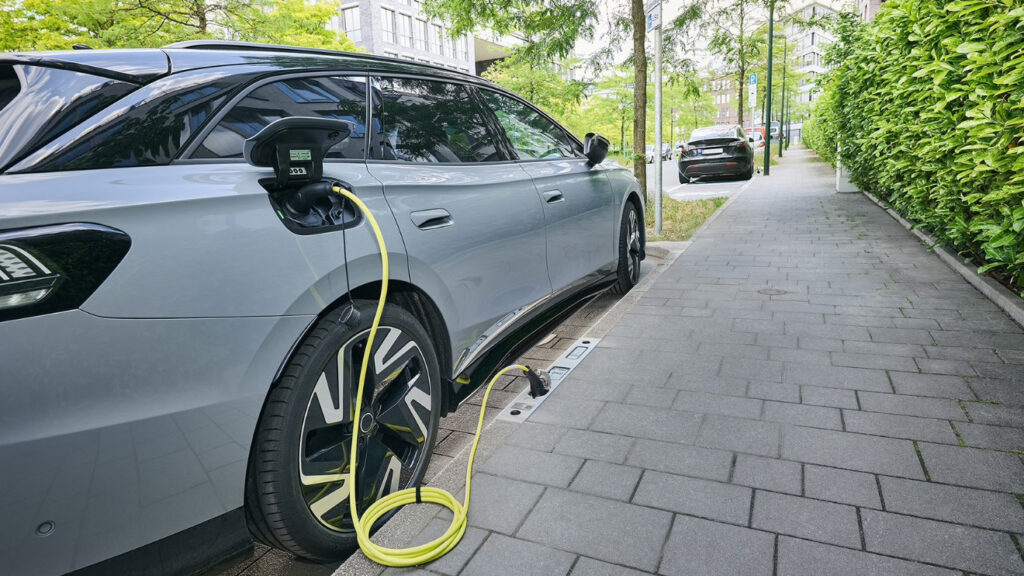
But efforts by cities to deploy rudimentary curbside chargers even on a modest scale have been few and far between in the US.
Earlier this summer the city of Portland undertook a project to install about 40 EV chargers on utility poles throughout the city, with the help of a grant from the US Department of Energy.
“These poles were selected based on PBOT’s [Portland Bureau of Transportation] new EV Charging in the Public Right-of-Way policy location and siting criteria, their proximity to apartments and commercial districts, and distance from existing charging stations,” the city said in August of this year.
Of course, a total of 40 EV chargers on utility poles in a city the size of Portland is a drop in the bucket given the fact that the state of Oregon is still committed to 90% ZEV-only sales by the year 2035.
What’s still missing are efforts by large US cities to install thousands of such chargers in a given area.
San Francisco — a city we usually think of as being at the forefront of EV adoption — embarked on its first curbside charging project only earlier this year. The city opted for charging posts built by startup itselectric, but since launching this spring the project saw just a handful of chargers installed, with local residents still needing to sign up to actually use them.
And the city is still in the early stages of developing a permitting process for other curbside charging designs.
“While California is currently requiring that vehicles switch from petroleum to electric power, the current national policy environment for California’s ability to require this is unclear,” notes a feasibility study by the San Francisco Municipal Transportation Agency (SMFTA).
So far, most cities with high rates of EV adoption have chosen to back larger charging plazas with fewer total chargers built by a familiar cast of station developers, often in shopping plazas or other high traffic areas. There are a few exceptions, of course, in some downtown areas where slower Level 2 chargers have been installed in municipal parking lots and other popular spots, but they’re still far from quiet residential areas.

For now, the issue of residential charging is still driven by the outdated belief that almost all EV owners will also own their own garage complete with a charger or at least a wall outlet, in addition to another car or two. But if EV ownership is to get out of its early-adopter phase at some point, the issue of charging might not be as easy to continue shifting to the owners themselves, even in EV-dense cities like San Francisco.
“As approximately 65% of households in San Francisco rent their homes, often in older, garage-less multifamily apartment buildings, there is a large population of residents who will rely on public curbside EV chargers,” the SFMTA adds, noting that there are just over 1100 publicly accessible chargers in the city.
If states are planning on sticking to EV adoption goals, and some of them appear to be, this is a problem that needs a solution.
Recent Posts
All Posts
August 3, 2026

July 30, 2026

July 27, 2026
Leave a Reply
You must be logged in to post a comment.