FILM FRIDAY: POLIZIOTTO SPRINT
December 5, 2025
Peter Hughes
Peter Hughes says this is the best car movie ever made...
Cars and movies were both invented within a decade of each other, towards the end of the century before last. Five minutes later people started arguing about the best car movie and the debate has continued more or less unabated ever since. There’s a good chance you’ve participated in it at some point. There are a handful of titles that come up frequently enough to suggest something approaching broad consensus: Bullitt. Vanishing Point. The Italian Job. Grand Prix. Gone In 60 Seconds. Ronin. Cars. Le Mans. And, um, Cannonball.
All fine films, and great car movies. But not one of them is The Greatest Car Movie of All Time. That distinction—stay with me—goes to a movie you’ve probably never heard of. I had certainly never heard of it until four years ago. A friend who is a connoisseur of obscure action movies, having just received a big shipment of Blu-rays from his favorite distributor, suggested we watch it. I’ve not been the same since.
Poliziotto Sprint—we’re going to disregard the hopelessly generic English title, Highway Racer—is a 1977 poliziottesco. Literally “police-esque,” this was a genre of crime thriller that can largely be read as a response to the anni di piombo, the Years of Lead, a period of Italian history marked by stochastic violence, assassinations, and random acts of domestic terrorism. Much of it was inexplicable and blamed by authorities on whatever political faction or contingent was most convenient; little of it served any legible purpose beyond keeping the general populace in a state of perpetual confusion and anxiety. (Can’t imagine what it would be like to live through a time like that, right?) Poliziotteschi looked to tough but right-minded cops as protagonists who could restore a sense of order and justice to a world that seemed out of control.
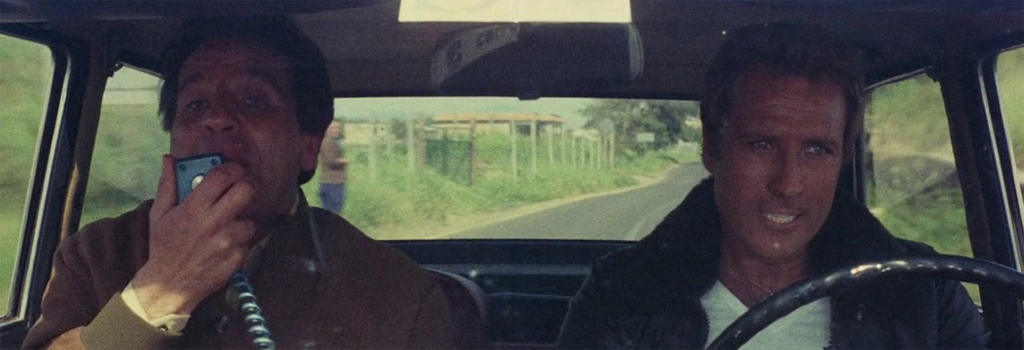
Enter self-centered hothead Marco Palma, portrayed by hunky Maurizio Merli. A grown man who sleeps beneath a poster of Niki Lauda’s championship-winning Ferrari 312T, Palma’s ambition as a driver has somehow lead him to law enforcement, where we find him plying his trade behind the wheel of an unmarked Alfa Giulia, squalo sei—Shark 6—as a member of the squadra mobile, an elite unit less concerned with handing out traffic tickets than the pursuit of high-stakes criminals. Think CHiPs meets the FBI.
Rome is in the midst of a crime spree, and we are immediately treated to a high-speed chase through the crowded streets of the Eternal City, with the Alfa hot on the tail of a fleeing Porsche 912 in a sequence that sets the tone for everything to follow. By which I mean, it is jaw-droppingly spectacular. Every car here is fantastic; the settings unbelievable, the driving and stunts heart-stopping, and everything is real. No special effects, no camera trickery, no fake BS. It’s astonishing.
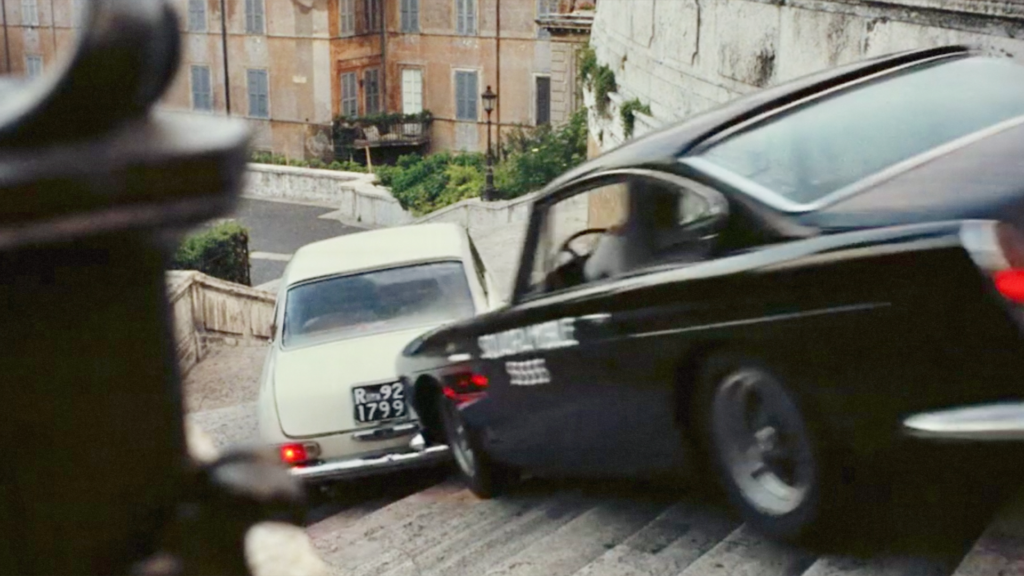
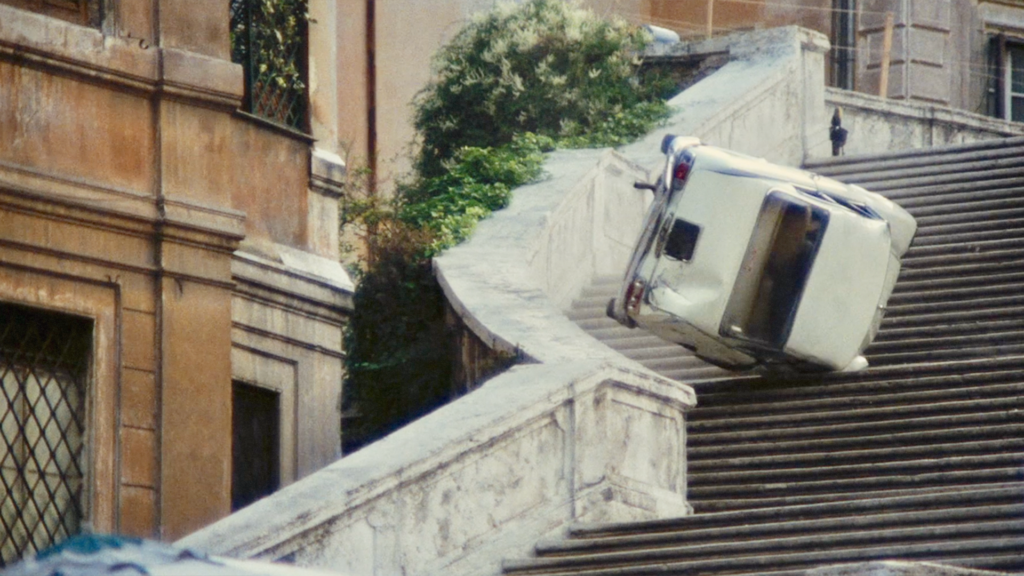
That chase ends badly for our hero, who blames his luck on the 1600’s lack of power. His demand for an upgrade puts him at odds with his circumspect boss, Tagliafferi (Giancarlo Sbragia), a former pursuit driver who rues his young charge’s impetuousness but clearly recognizes in him something of his earlier self. Tagliaferri is loosely based on a legendary real-life squadra mobile officer named Armando Spatafora, who leveraged his success nabbing bad guys in the early ’60s into somehow convincing the force to procure him a Ferrari interceptor. No official record exists, but the story goes that he once supposedly followed a desperate suspect down the Spanish Steps—a scene recreated in a flashback in Poliziotto Sprint.
Again: no special effects. It may or may not have happened in real life, but in shooting this movie, they absolutely sent a 1963 Ferrari 250 GT 2+2 and a 1966 Lancia Flavia Coupe careening down the actual 250-year-old multitiered staircase leading to the Piazza di Spagna, one of Europe’s most celebrated tourist attractions and beloved public spaces. A fucking UNESCO site! The Lancia rolls!
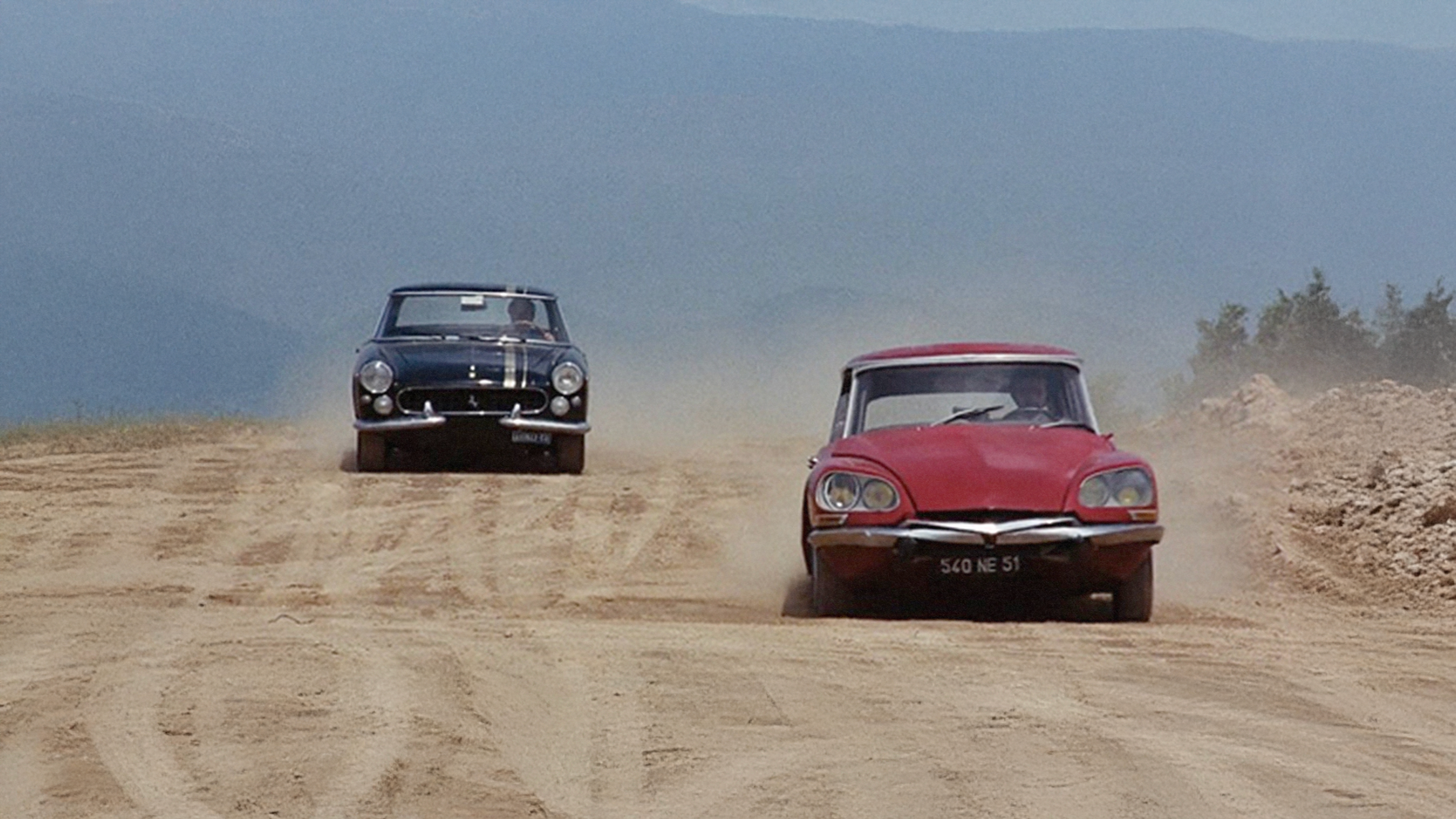
Before that, though, we meet our villains, led by the suave but mysterious Frenchman, Dossena (Angelo Infanti), but known universally as Il Nizzardo—the Niçois, but also possibly a pun: “the nice guy.” (Can any Italian speakers confirm?) Employing a pair of identical brown Citroën DS getaway cars to flummox would-be pursuers, these guys use automatic rifles to rob banks while wearing jumpsuits and full-faced Boeri helmets, three to a car. And Il Nizzardo has skills, taking full advantage of the Citroën’s hydropneumatic suspension in a series of increasingly inventive evasive maneuvers. Somewhat predictably, Dossena also turns out to be the veteran Tagliafferi’s old rival and nemesis. More chase scenes ensue, which, if you are anything at all like me, will leave you in disbelief.
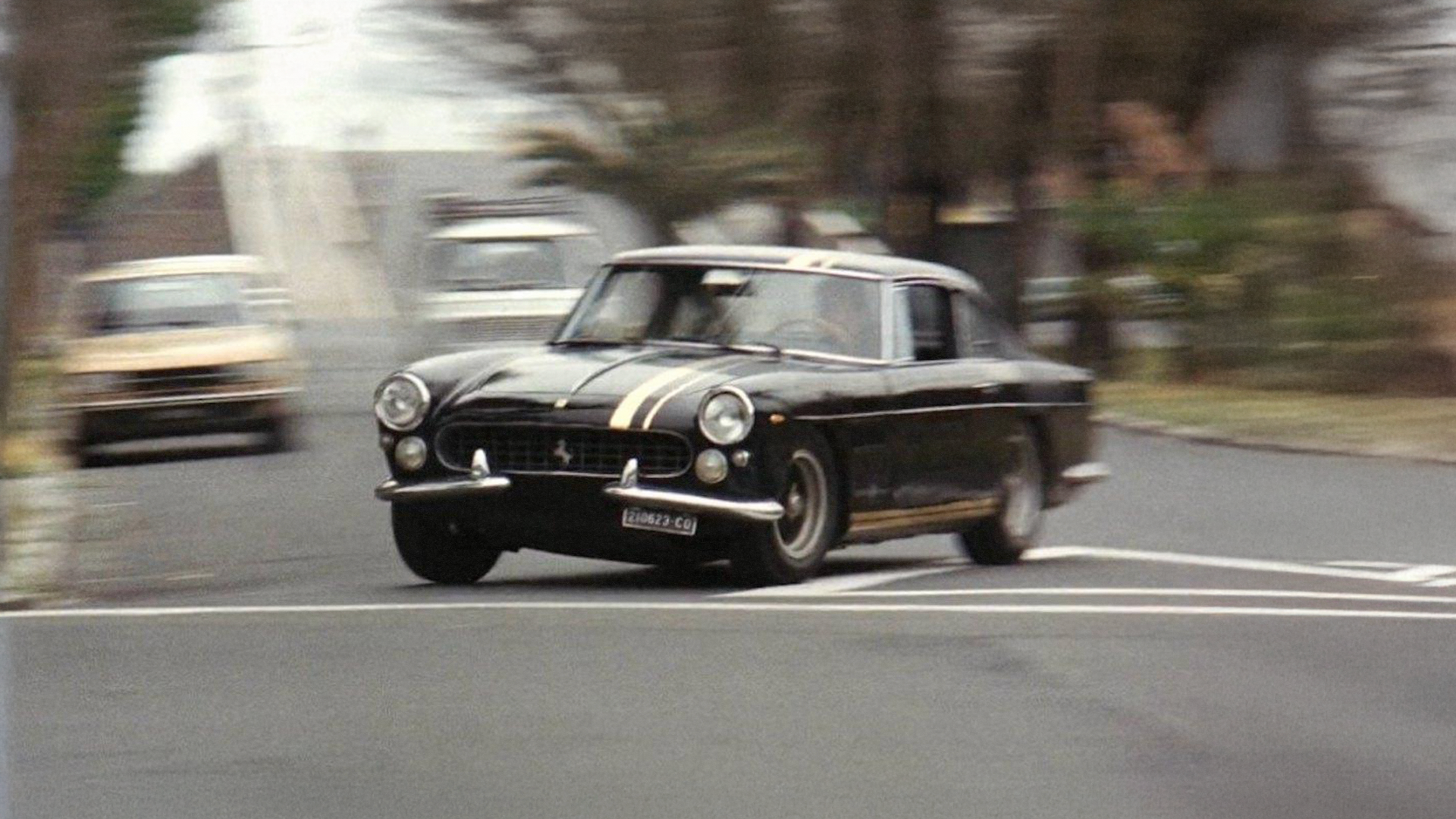
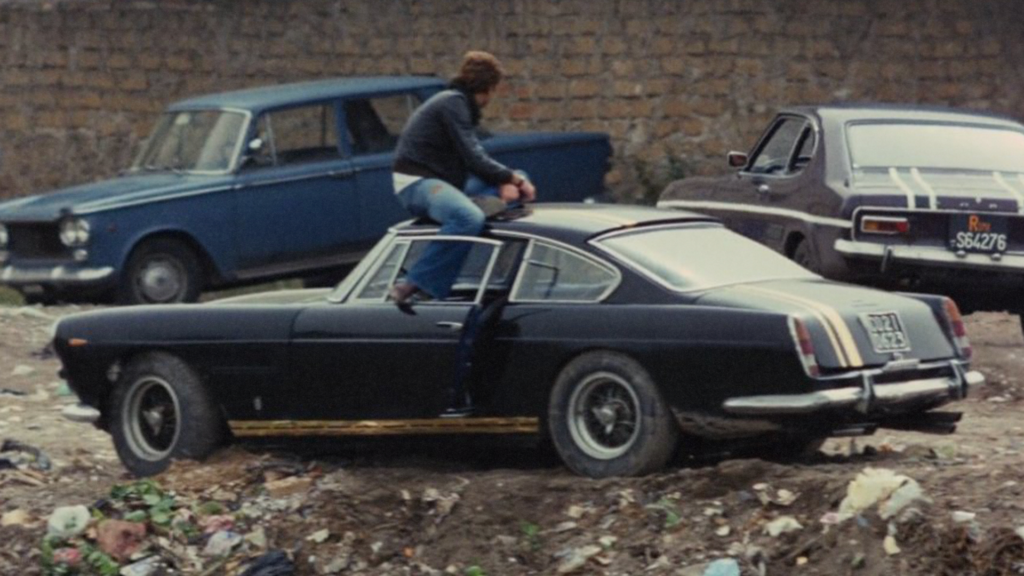
When one of them ends in tragedy, Palma briefly turns in his badge. It takes a stirring pep talk from his boss to lure him back—that, and the promise of bringing the latter’s old Ferrari out of mothballs so that Palma can use it to infiltrate the baddies’ gang. In lieu of the traditional action movie training montage, we get a sequence of mentor and protégé bonding over the “wild beast” while restoring it to its former glory (including what appears to be at least a partial engine teardown). Some puzzling aesthetic choices leave it looking uncannily like an old Hertz Shelby GT350, but that’s no matter.
It’s worth noting that the 250 GT 2+2 (also known as the GTE) was the first series production Ferrari four-seater, with somewhat staid styling that lacked the sex appeal of its more illustrious stablemates. But it sat on the same long-wheelbase chassis that earlier undergirded the 250 Tour de France and shared its three-liter V12 with legends like the 250 GT SWB and 250 GTO. Also Enzo used one as his personal car. There is no evidence to suggest that he ever drove it down any historical monuments, however.
All of this leads to further escapades and a final showdown in a quarry outside of town that provides the backdrop for one of the most memorable automotive stunts ever committed to celluloid. There is no denouement, and what seems superficially like a pat conclusion is complicated by our knowledge that both hero and villain here live by a complex code of honor, governed as much by chivalry as antagonism.
Somebody recently uploaded a dubbed version to YouTube that you can see for free, but honestly it’s well worth the few bucks to your streamer of choice to watch it in the original Italian—so much more fun (and from what I could tell the dub elides a lot of the technical details that are like catnip to any real car enthusiast). It’s a bold claim, I know, declaring this The Greatest Car Movie of All Time. But check out Poliziotto Sprint and prove me wrong see if you don’t agree!
Alloy official rating: 5 sacrificial Peugeot 304s
Recent Posts
All Posts
March 17, 2026
March 16, 2026
March 12, 2026