Film Friday: Drive My Car
December 12, 2025
Peter Hughes
This week, Peter Hughes swaps crashes and jumps for an emotional crashout.
First things first: Drive My Car is not a car movie in the way that the movies we’ve been talking about are car movies. There are no chases, stunts, or explosions, and only one minor accident.
It is, instead, a beautifully shot, glacially paced, three-hour-long meditation on love, death, memory, and loss. Dramatic events do occur, but they almost always happen off-screen, and they’re talked about reluctantly and solemnly, because when dramatic events occur in real life they are quite often painful and difficult to talk about. If you’ve ever tapped out of a Bergman movie after twenty minutes, Drive My Car is probably not for you. If you’re the kind of glutton for punishment who likes that kind of thing, though, keep reading.
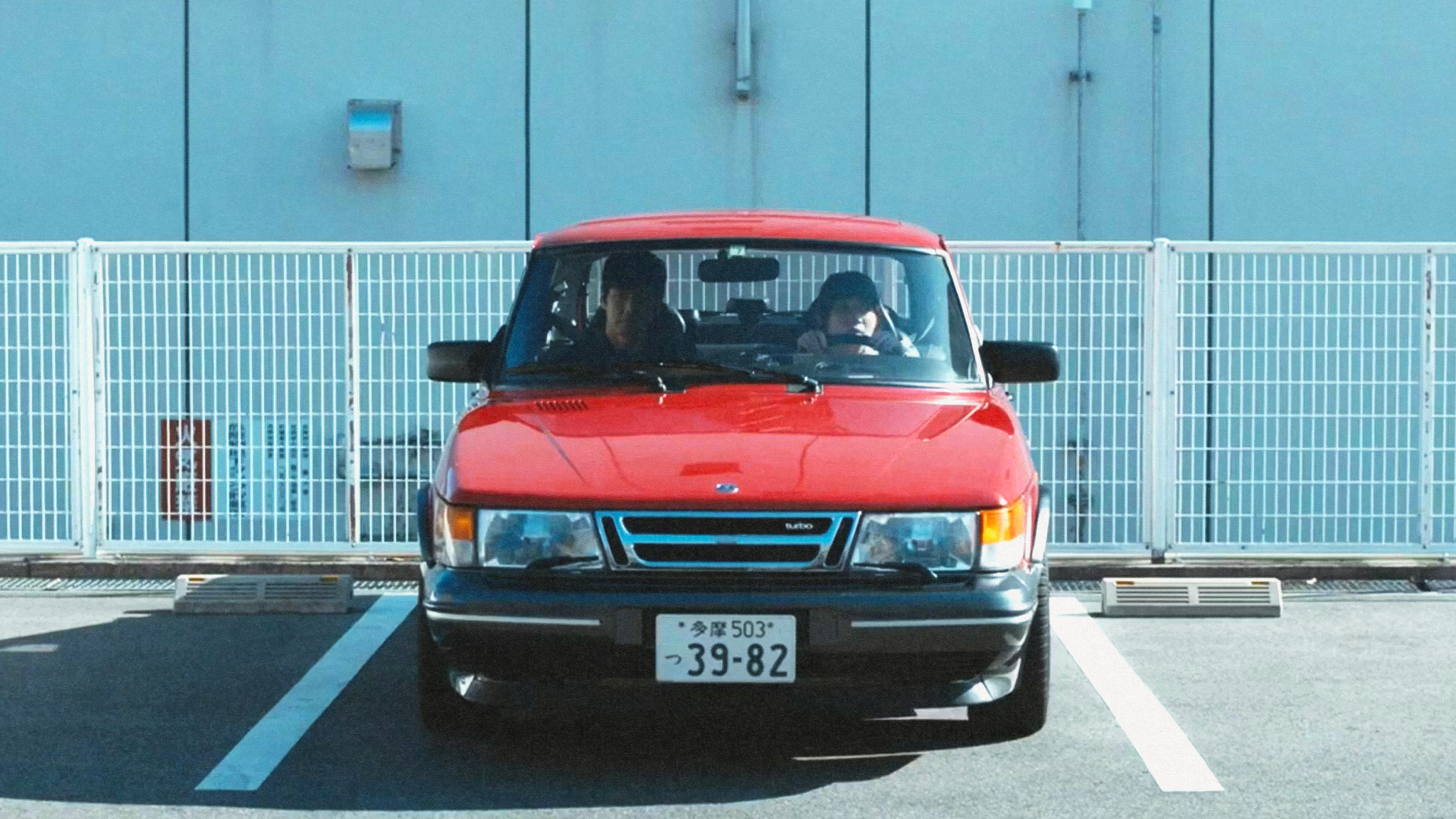
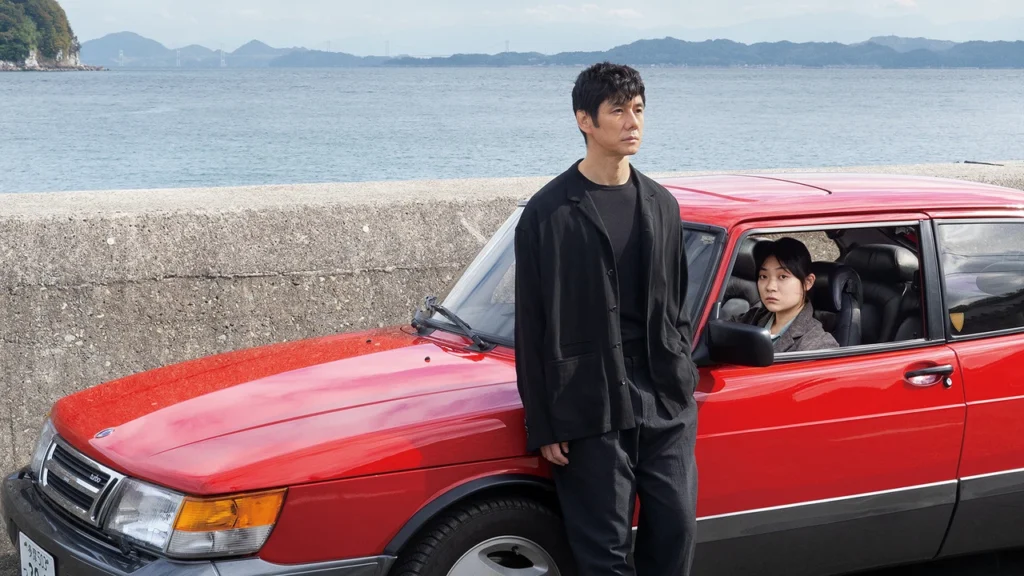
The twin focal points of Drive My Car are Yūsuke Kafuku (Hidetoshi Nishijima), a middle-aged theater director and widower, and his car, a 1987 Saab 900 Turbo. It’s a movie from which I’ve kept my distance since its release in 2021, because I was wary of the feelings it might arouse in me. I thought it would bum me out, to be honest. Don’t worry, my wife is fine. My Saab, on the other hand, has seen better days.
An ’88 in near identical spec to the movie car, it still runs, technically. (Did the last time I checked, anyway.) But it suffers from such an advanced stage of structural rot that the interventions required to make it roadworthy again could never be justified by even the most optimistic projections of potential value. The car is toast. It still sits in my driveway for the same reason that people are sometimes kept on life support long after their natural lives have ended, or bedrooms are left untouched as a sort of shrine to their former occupants. Moving on is hard.
Drive My Car opens with Kafuku and his still-living wife, Oto (Reika Kirishima), in bed, but not more than four minutes elapse before we are riding along with them in the Saab. And man, it is all here. A car more richly distinctive and peculiar in its sensory details than any I’ve ever owned or possibly driven, and every one of them is in evidence, lovingly captured.
The deeply and unexpectedly sonorous exhaust note; the particular squeak of the door as it opens, the tidy and mechanical thunk as it latches; the vinyl of the glovebox door lifting at the corners (they all do that!); the rate of the driver’s power window as it labors ever so slightly on its way back up. There’s an intimacy to the way the Saab is portrayed in this movie that borders on tenderness. While cars are often used in film as a way to reflect or magnify the character of their drivers, here it’s different. The immaculately preserved condition of Kafuku’s C900 does point to a certain fastidiousness, but in the way it serves as a place of refuge for him, it’s almost as if the car is a character in its own right.
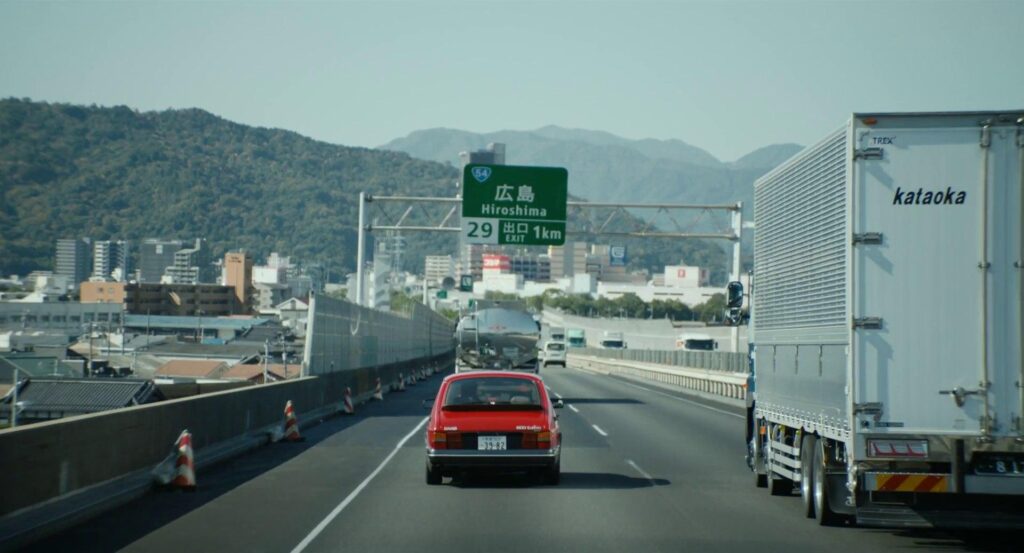
Two years after Oto’s death, Kafuku has accepted a residency in Hiroshima, where he’ll be directing a production of Chekhov’s Uncle Vanya. He heads down from Tokyo in the Saab, and upon arrival is told that accommodations have been made for him an hour’s drive away, per his request (he likes to use the commute to rehearse lines). For liability reasons, though, they can’t let him drive himself. But it’s fine—they’ve hired a driver! To shuttle him around in his thirty-year-old Saab. The look on his face could not be more perfectly hilarious, or correct.
Kafuku’s consternation is a feeling I know well. On rare occasions over the ten years that my Saab served as a daily driver, I had to make trips into New York City, which invariably meant handing the keys over to parking garage attendants at some point. The list of hurriedly scrawled instructions I left taped to the steering wheel got longer every time:
• IGNITION IS ON FLOOR BETWEEN SEATS
• MAKE SURE TRANSMISSION IS IN REVERSE BEFORE REMOVING KEY
• PULL UP ON RING UNDER SHIFT KNOB TO ENGAGE REVERSE
• DON’T PUT IT IN REVERSE WITHOUT SHIFTING INTO SECOND FIRST THOUGH
• I DON’T KNOW WHY YOU WOULD BUT FOR THE LOVE OF GOD PLEASE DO NOT TOUCH THE TRIP ODOMETER
• I’M SORRY ABOUT THE PUDDLES OF OIL
• Et cetera
The theater company reps assure Kafuku that his driver, a deferential young woman named Misake (Tōko Miura), is experienced and capable; when she asks if he’s uncomfortable with her being a woman, he replies not unreasonably that “the car is old and has quirks,” an understatement if ever there was one. This ain’t a Corolla, baby! Saabs are weird! Not to mention that it’s a left-hand-drive car in right-hand-drive Japan. Nevertheless, he eventually assents, and discovers to his surprise that Misake is not only every bit as competent as his handlers promised, but that she treats the Saab with a meticulousness that mirrors his own.
“I like that car,” she tells him at one point. “I can tell it’s been treated with care, so I also want to drive it with care.” Exactly what you want to hear from the person to whom you’ve entrusted your prized ride. (To give you an idea of how cool Misake is, at one point Kafuku expresses regret that he’s seen so little of Hiroshima during his visit and asks her to take him someplace she likes. She brings him to a garbage incineration plant.)
Over the course of the film, as rehearsals progress and the production comes together, Kafuku and Misake come to discover that they have more in common than their appreciation for the best of Trollhättan. Secrets are revealed, grief is shared, and an unlikely bond develops. It’s intense and powerful stuff. At the movie’s emotional climax, on a hillside overlooking the ruins of her family home in Hokkaido, Kafuku tells Misake through tears, “Those who survive keep thinking about the dead…. We must keep living.”
Watching this while holding back tears of my own, because I am me, I thought about the Saab in my driveway. You’re probably rolling your eyes at this, and you’d be right to. Except for the fact that at that very moment, Drive My Car cuts from an overhead view of Kafuku and Misake embracing, her childhood village extending out beneath their feet, to—hand to God—a perfectly composed front-three-quarter view shot of the Saab parked below, centered in frame, surrounded by snow. Hold…hold…and, scene!
Maybe Drive My Car is a car movie after all. In fact, in its impeccably reserved and subtle way, it might be more profoundly a car movie than any smash-’em-up thrill-ride flick could ever hope to be. Our lives are not about our cars, after all, just as this is not a film “about” a Saab. But more than any other movie I can think of, Drive My Car portrays and truly captures the role that a good car can play in our lives: as sanctuary, as mute witness, as storehouse for memory, and as a vector for new beginnings.
No wonder I can’t get rid of the damned thing.
Alloy Official Rating: 4 30 amp fuses in the glovebox for when the sunroof won’t close
Recent Posts
All Posts
March 17, 2026
March 16, 2026
March 12, 2026